


AI Generated Summary
- The Partition of the Indian subcontinent triggered the migration of Sikh and Hindu families from Baltistan to India, bringing to a close more than four hundred years of Sikh presence in the region.
- That brief conversation opened the door to a remarkable story connecting Skardu to the travels of Guru Nanak and revealing a Sikh presence that endured in Baltistan for more than four centuries.
- Following the conquest of the region by Dogra General Zorawar Singh in 1840, Baltistan became part of the Sikh Empire before later coming under the Dogra rulers of the princely state of Jammu and Kashmir.
Skardu is often celebrated for its dramatic mountains, turquoise rivers and as the gateway to some of the world’s highest peaks. Yet hidden amid its breathtaking landscape lies a lesser-known chapter of South Asian history—one that speaks of centuries of shared faith, trade and coexistence.
During a recent trek through Pakistan’s Baltistan region, after hiking in the scenic Nangma Valley near Khaplu, our journey brought us to Skardu. While driving through the town, our local guide casually mentioned that Sikh families had once lived in several neighbourhoods before the Partition of 1947. The remark was intriguing, but what followed proved even more unexpected.
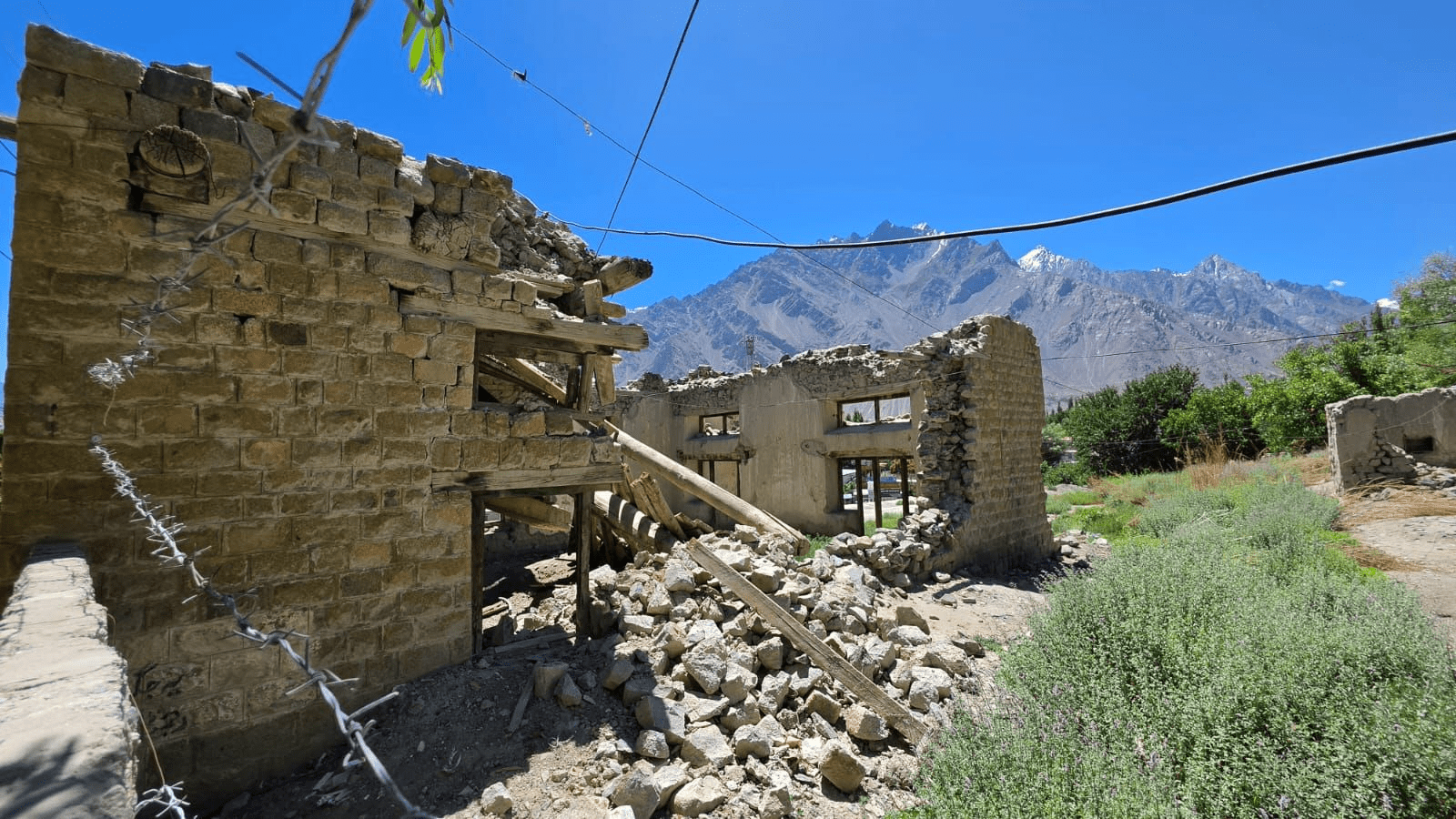
A resident directed us to a place locals still call “Asthan Nanak Pir”—a small hill overlooking the town where the remains of a historic Sikh shrine still survive. That brief conversation opened the door to a remarkable story connecting Skardu to the travels of Guru Nanak and revealing a Sikh presence that endured in Baltistan for more than four centuries.
Situated at the confluence of the Shigar and Indus rivers, Skardu occupies a strategic and cultural crossroads between Kashmir, Ladakh and Central Asia. The wider Baltistan region has long been shaped by multiple civilizations and faiths. Before the arrival of Islam, indigenous Bon traditions and Tibetan Buddhism flourished here, leaving behind rock carvings, inscriptions and monuments that continue to define the area’s archaeological landscape.
Evidence of this layered heritage is still visible today. Ancient Buddhist carvings, including the famous meditating Buddha at Manthal, stand alongside Islamic monuments, reflecting centuries of religious and cultural transformation rather than abrupt replacement. Even today, the Balti language retains strong Tibetan influences, and traditional Tibetan script remains part of the region’s cultural identity.
Against this rich historical backdrop emerged another significant chapter.
According to Sikh tradition, Guru Nanak, accompanied by Bhai Mardana, travelled through Baltistan while returning from Tibet in the early sixteenth century. His visit is believed to have inspired the establishment of a shrine that later became known as Gurdwara Chhota Nankana Sahib. Although the original structure no longer survives in its entirety, local residents continue to identify the site by its enduring name—Asthan Nanak Pir.
The Sikh connection to Baltistan expanded considerably during the nineteenth century. Following the conquest of the region by Dogra General Zorawar Singh in 1840, Baltistan became part of the Sikh Empire before later coming under the Dogra rulers of the princely state of Jammu and Kashmir. As trade routes developed, Sikh and Hindu merchant families settled in Skardu and neighbouring valleys, contributing to commerce and local administration.
Their presence extended beyond business.
Several elderly residents still recall stories passed down through generations about Sikh and Hindu neighbours who lived peacefully alongside the Muslim majority. Particularly remembered are two Sikh families—known locally as Gangu and Lassu—who reportedly donated land for the construction of Shia Imam Bargahs in the early twentieth century. The neighbourhoods associated with those families continue to preserve their names, and local memory still honours their contribution to the community’s religious life.
Historical records also reflect this demographic reality. By the early twentieth century, while Muslims constituted an overwhelming majority of Baltistan’s population, prosperous Sikh and Hindu trading communities had established themselves in Skardu and surrounding valleys such as Khaplu and Shigar.
That centuries-old continuity came to an abrupt end in 1947.
The Partition of the Indian subcontinent triggered the migration of Sikh and Hindu families from Baltistan to India, bringing to a close more than four hundred years of Sikh presence in the region. Their departure left behind places of worship, homes and memories that have gradually faded from public consciousness.
Today, the most visible reminder of that history stands on a modest hill overlooking Skardu’s polo ground. The historic gurdwara associated with Guru Nanak’s visit has largely disappeared. Its prayer hall and community kitchen no longer exist, and only portions of the former travellers’ rest house remain standing. The structure survives in a fragile state and is currently inaccessible to the public.
The site evokes mixed emotions. Architecturally modest but historically significant, it represents far more than a neglected building. It bears witness to centuries during which diverse religious communities shared the same landscape, participated in each other’s civic life and left enduring marks on the region’s social fabric.
Ironically, even many Sikhs visiting northern Pakistan today are unaware that Skardu once possessed such deep Sikh roots. Likewise, younger generations of local residents often know the place only by its folk name, with little awareness of its wider historical significance.
As Baltistan increasingly attracts international tourists for its spectacular scenery, its multicultural past deserves equal attention. The valleys of northern Pakistan are not only repositories of natural beauty but also living archives of the many civilizations, languages and faiths that have intersected there over the centuries.
Remembering Skardu’s forgotten Sikh heritage is not merely about preserving one community’s history. It is about recognising the shared cultural inheritance of the Himalayan region—an inheritance that continues to survive, quietly, beneath the shadow of its mountains.