


AI Generated Summary
- For generations, the story of the Sikh Empire has been told through the achievements of Maharaja Ranjit Singh, the visionary ruler who united Punjab and established one of the most powerful kingdoms in the Indian subcontinent.
- The Sword, revisits the life of Sada Kaur, the formidable leader of the Kanhaiya Misl, who emerged as one of the most influential political and military figures of her era.
- She also played a key role in the successful capture of Lahore in 1799, a milestone that laid the foundation for the Sikh Empire.
For generations, the story of the Sikh Empire has been told through the achievements of Maharaja Ranjit Singh, the visionary ruler who united Punjab and established one of the most powerful kingdoms in the Indian subcontinent. Yet historians and authors are increasingly turning their attention to the women whose influence helped shape that empire, challenging long-held narratives that relegated them to the margins of history.
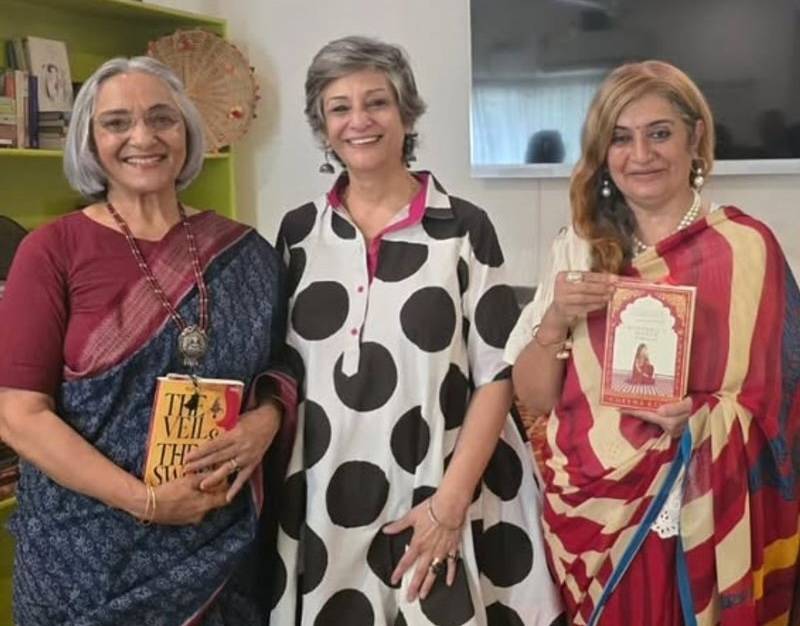
At a recent literary discussion hosted by Majha House founder Preeti Gill, authors Ranjit Powar and Chetna Keer shed light on two remarkable women—Sada Kaur and Moran Sarkar—whose contributions, they argue, have been overlooked or misrepresented in mainstream historical accounts.
Powar’s latest work, The Veil & The Sword, revisits the life of Sada Kaur, the formidable leader of the Kanhaiya Misl, who emerged as one of the most influential political and military figures of her era. Despite her central role in the rise of the Sikh Empire, Sada Kaur is often remembered merely as the mother-in-law of Maharaja Ranjit Singh.
According to Powar, such a description fails to capture the scale of her achievements. Widowed at a young age, Sada Kaur assumed leadership of her misl and demonstrated extraordinary political acumen in a period when women rarely exercised independent authority. She forged strategic alliances, provided military support, and played a decisive role in positioning the young Ranjit Singh as a dominant force in Punjab.
Her influence extended beyond diplomacy. Historians credit her with helping secure the alliances and resources that paved the way for Ranjit Singh’s ascent, including the marriage of her daughter, Mehtab Kaur, to the future Maharaja. She also played a key role in the successful capture of Lahore in 1799, a milestone that laid the foundation for the Sikh Empire.
“Sada Kaur was not simply a royal relative standing in the background,” Powar noted during the discussion. “She was a strategist, commander and political visionary whose contributions were crucial to the emergence of the empire.”
The conversation also turned to Moran Sarkar, the subject of Keer’s new historical novel, Maharaja’s Moran. While Moran has frequently been depicted in historical records as a dancer or consort, Keer contends that such portrayals oversimplify a far more complex figure.
Historical accounts of Moran remain fragmented and often contradictory. Keer argues that these inconsistencies have obscured the influence she wielded within the social and cultural life of the kingdom. Rather than viewing her solely through the lens of romance, the author presents Moran as an intelligent and independent woman who maintained a strong connection with ordinary people.
“She served as a bridge between the Maharaja and the public,” Keer said. “Her contribution was social rather than political, but it was no less significant.”
The author also highlights Moran’s determination to maintain her independence. Rather than residing within Lahore Fort alongside the Maharaja’s other wives and consorts, she chose to live separately, a decision that reflected both her individuality and social standing.
The relationship between Moran and Maharaja Ranjit Singh has long been the subject of folklore and debate. Keer points to the ruler’s willingness to face criticism and opposition, including from influential religious figures, as evidence of the depth of their bond.
The discussion underscored a broader issue within both colonial and later historical writings: the tendency to judge women associated with power through morality, rumour and gender stereotypes rather than evaluating their political, social or administrative contributions.
Gill observed that recent works focusing on women of the Sikh Empire are part of a growing movement to revisit history from perspectives that have often been neglected. By examining court culture, diplomacy, succession struggles and social life through women’s experiences, authors are opening new avenues for understanding Punjab’s past.
As scholars continue to reassess historical narratives, figures like Sada Kaur and Moran Sarkar are gradually emerging from the footnotes. Their stories suggest that the rise of the Sikh Empire was not shaped by great men alone, but also by women whose leadership, intelligence and influence helped define an era.