


AI Generated Summary
- Here, beneath the golden dome that gleams like a beacon of hope, the true soul of the place reveals itself not in rituals or architecture alone, but in the hum of the world’s largest community kitchen — the Langar.
- In the heart of Amritsar, amid the marble pathways and shimmering waters of the Sarovar, the Golden Temple stands not just as Sikhism’s holiest shrine but as a living testament to humanity’s highest ideals.
- In an age of Instagram reels and fleeting trends, the Langar remains timeless — a daily reminder that equality isn’t an abstract ideal but something you can taste, feel, and live.
In the heart of Amritsar, amid the marble pathways and shimmering waters of the Sarovar, the Golden Temple stands not just as Sikhism’s holiest shrine but as a living testament to humanity’s highest ideals. Here, beneath the golden dome that gleams like a beacon of hope, the true soul of the place reveals itself not in rituals or architecture alone, but in the hum of the world’s largest community kitchen — the Langar. Every day, without fail, equality is served on steel plates to tens of thousands, erasing distinctions of caste, creed, class, or nationality.
The tradition traces back to Guru Nanak, the founder of Sikhism in the 15th century. He established the Langar to challenge the rigid hierarchies of Indian society. Rich and poor, Hindu and Muslim, Brahmin and Dalit — all sat together on the floor as equals, sharing simple vegetarian meals prepared with love and service (seva). Guru Angad Dev formalized it further, and today it thrives at Harmandir Sahib as Guru ka Langar, embodying the Sikh principles of sarbat da bhala (welfare of all) and ek Onkar (one God, one humanity).
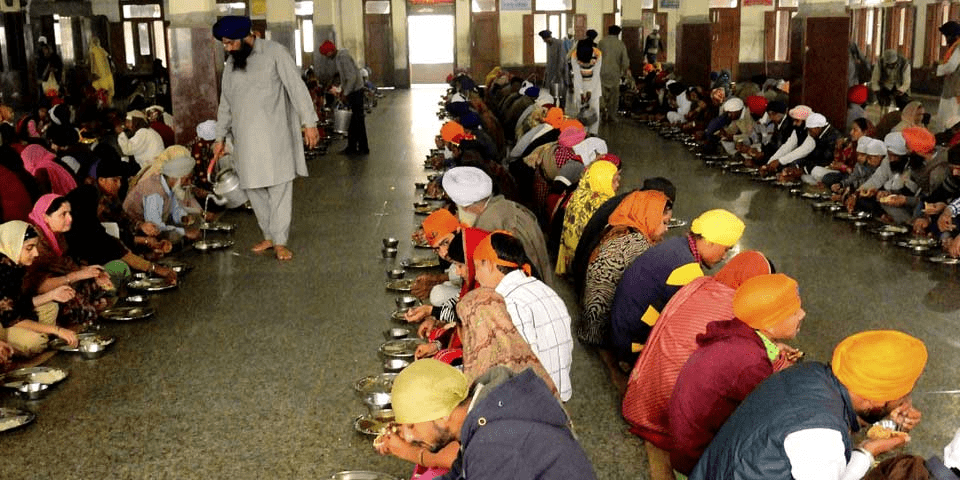
Step into the Langar Hall and the scene unfolds like a quiet revolution. Volunteers — men, women, and children from all walks of life — work in seamless coordination. Gigantic cauldrons bubble with dal, mountains of rotis are rolled and baked in industrial ovens, and rice steams in vast quantities. The kitchen operates 24/7, powered entirely by donations and the tireless hands of kar sevaks (selfless volunteers). No one is turned away. Pilgrims, tourists, locals, the homeless, the affluent — all sit cross-legged in long rows (pangat) on the floor, receiving the same meal with the same warmth. There are no reservations, no VIP sections. A CEO might sit beside a daily wage laborer; a foreign visitor next to a local farmer. In that shared space, social barriers dissolve.
The scale is staggering. The Golden Temple serves between 50,000 and 100,000 meals daily, sometimes surging higher during festivals like Baisakhi or Guru Nanak’s Gurpurab. Yet the operation runs with remarkable efficiency and zero waste. Excess food is often distributed or repurposed. The meals — typically dal, roti, rice, sabzi, and a sweet — are nourishing and prepared with utmost hygiene, but their real sustenance lies in the message they carry: dignity for all.
In a world fractured by inequality, polarization, and division, the Langar offers a radical counter-narrative. It is not mere charity but a profound act of humility and solidarity. By insisting everyone sits on the ground, it humbles the mighty and uplifts the marginalized. It teaches that true spirituality manifests in service, not sermons. Sikhs believe that sharing food this way fosters community, reduces ego, and builds empathy — lessons the world desperately needs.
Visitors often leave transformed. The experience lingers: the rhythmic clatter of utensils, the aroma of fresh chapatis, the quiet dignity of strangers breaking bread together. In an age of Instagram reels and fleeting trends, the Langar remains timeless — a daily reminder that equality isn’t an abstract ideal but something you can taste, feel, and live.
As the sun sets over the Golden Temple, casting its reflection in the holy pool, the Langar continues its quiet work into the night. Here, every plate served reaffirms a simple yet revolutionary truth: we are all one. In feeding bodies, it nourishes souls — proving that the most powerful revolutions often begin not with grand declarations, but with a shared meal.