


AI Generated Summary
- As he prepares to expand his rajma cultivation and refine his diversified approach, Sher Singh’s story offers hope that innovation on individual farms could collectively ease the pressures on Punjab’s overstretched resources.
- In the heart of Punjab’s agrarian belt, where water scarcity and traditional rice-wheat cycles have long strained natural resources, one farmer is quietly rewriting the script for the future of farming.
- Beyond rajma, Sher Singh has introduced groundnut and soybean into his fields as part of a deliberate strategy to cut down on irrigation demands.
In the heart of Punjab’s agrarian belt, where water scarcity and traditional rice-wheat cycles have long strained natural resources, one farmer is quietly rewriting the script for the future of farming. Sher Singh, a progressive cultivator from Nasirewal village in Kapurthala district, is spearheading experiments with less water-intensive crops, proving that profitability and environmental stewardship can go hand in hand.
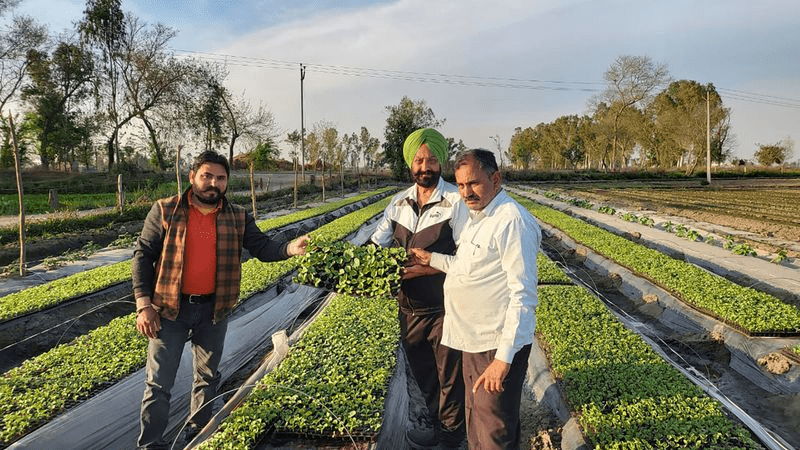
Sher Singh, who manages over 250 acres of farmland — 30 of which he owns — has this season turned heads with a successful rajma (red kidney bean) harvest. Encouraged by strong market returns, he now intends to scale up significantly. “This year I cultivated rajma on 19 acres and earned good profits. Next season, I plan to increase the area under rajma to nearly 50 acres,” he said.
The shift did not happen overnight. Two years ago, Sher Singh began with a modest trial on just one kanal of land. Satisfied with the initial results, he expanded the experiment. The crop’s relatively short duration of about 90 days, coupled with manageable input costs — primarily seeds — has made it an attractive option. “The cultivation cost is not very high. Since the profits are good, I want to increase the area under the crop,” he added.
Beyond rajma, Sher Singh has introduced groundnut and soybean into his fields as part of a deliberate strategy to cut down on irrigation demands. “I am trying to find alternatives where water consumption is lower. Crop diversification is the need of the hour,” he emphasised.
His commitment to sustainability extends well beyond new crop choices. Since 2007, Sher Singh has steadfastly refused to burn paddy residue, a practice that continues to plague large parts of northern India every winter. Instead, he incorporates the straw back into the soil, enhancing fertility and reducing air pollution. In addition to field crops, he grows vegetables such as bottle gourd and pumpkin, further broadening his farm’s output and resilience.
A farmer since 2000, Sher Singh credits a spirit of continuous learning and institutional support for his success. “I have been farming since 2000 and I always try to adopt new methods, technologies and crops to diversify my farming,” he said. “The Agriculture Department and Krishi Vigyan Kendra (KVK), Kapurthala, have been very supportive in guiding me through these experiments.”
Agricultural experts view such grassroots initiatives as vital at a time when Punjab grapples with depleting groundwater levels and the environmental costs of monoculture. Sher Singh’s work stands as a practical model for fellow farmers seeking viable alternatives that balance economic gains with ecological responsibility.
As he prepares to expand his rajma cultivation and refine his diversified approach, Sher Singh’s story offers hope that innovation on individual farms could collectively ease the pressures on Punjab’s overstretched resources.