


AI Generated Summary
- In a small Punjab village, an unusual statue of Ravana stands as a reminder of an older generation’s wisdom, even as the changing landscape slowly erases the world it once knew.
- The village pond, the old bawli or stepwell, the sandy pathways and the open spaces where children gathered to play gulli-danda had vanished from the familiar landscape.
- Rich in historical and mythological associations, the village also found a place in Indian literature through celebrated writer Mulk Raj Anand’s autobiographical novel, Confessions of a Lover.
In a small Punjab village, an unusual statue of Ravana stands as a reminder of an older generation’s wisdom, even as the changing landscape slowly erases the world it once knew.
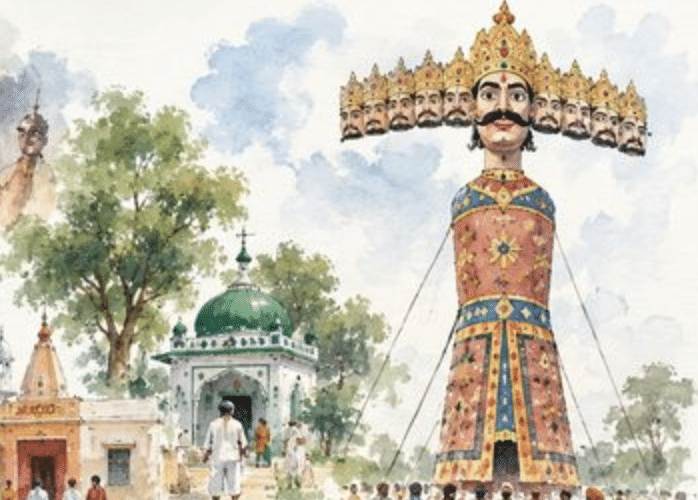
In the historic village of Kahnuwan, near Gurdaspur in Punjab, stands an unusual figure from the Ramayana. Ravana, the mighty king of Lanka, wears his crown but has no arms. Unlike the towering effigies that are set ablaze during Dussehra celebrations across India, this cement statue has remained a permanent part of the village’s identity, carrying a message that has passed from one generation to another.
It was a photograph of this peculiar statue that inspired a native of Kahnuwan to return to his birthplace after many years. What began as a journey of curiosity soon became an emotional encounter with childhood memories, fading traditions and the changing character of rural Punjab.
The road to Kahnuwan was as much a journey through time as it was through the countryside. Memories of the village’s once-celebrated Ramlila performances came alive, recalling an era when local theatre was not merely entertainment but an important part of community life.
Among the unforgettable characters was Pandit Charanjee Lal Lalari, whose imposing, pot-bellied presence made his portrayal of Lord Parashurama particularly memorable. Equally remarkable was Pandit Ram Parkash Tiwari, who played the harmonium with just one hand, having lost the other during India’s struggle against British rule.
The village stage had once brought together an entire cast of familiar faces portraying Lord Rama, Lakshmana, Hanuman, Manthara, Kevat, Kumbhakarna and Jambavan. These performances reflected a time when religious storytelling, artistic expression and collective participation were woven into the everyday rhythms of village life.
Kahnuwan itself occupies a distinctive place in Punjab’s cultural landscape. Rich in historical and mythological associations, the village also found a place in Indian literature through celebrated writer Mulk Raj Anand’s autobiographical novel, Confessions of a Lover.
Upon returning, the visitor was welcomed by childhood friends who accompanied him through the familiar lanes. Some landmarks had survived the passage of time. Gugga Pir’s dargah, the Mandi temple associated with the Nath yogis, and the ancient gurdwara adjoining the Kali Mata temple continued to stand, preserving the village’s diverse spiritual heritage.
Their continued presence offered a reassuring glimpse of a community in which different religious traditions had long existed alongside one another.
Yet beyond these surviving landmarks, much of the Kahnuwan of childhood had disappeared.
The old bazaar, once a lively centre of commerce and conversation, had fallen into disrepair. The sweet shops that sold balushahi, mesu and gulgule were gone. So were the kulfi stalls, traditional biscuit-making establishments, bicycle repair shops and kite makers whose workshops and string-dyeing corners once attracted excited children.
The transformation extended beyond the marketplace. The village pond, the old bawli or stepwell, the sandy pathways and the open spaces where children gathered to play gulli-danda had vanished from the familiar landscape.
These were more than physical features of a village. They were the informal meeting grounds where friendships developed, stories circulated and generations shared a sense of belonging.
Among the remembered personalities was Khairu Mirasi, the village chowkidar, whose appearance was traditionally regarded as a favourable omen by those pursuing legal disputes or hoping to arrange successful marriages. Such beliefs, whether rooted in superstition or local folklore, formed part of the distinctive social character of rural life.
His old home, too, had disappeared, leaving behind little more than memories.
The changing landscape of Kahnuwan reflects a broader transformation occurring across villages in Punjab and elsewhere in India. As commercial activity, housing and social life shift towards expanding suburban centres, traditional village marketplaces and communal spaces often lose their former significance.
For older residents, however, the emotional attachment remains undiminished. The familiar sentiment, “Jeena yahan, marna yahan” — to live here and die here — continues to express a bond with the land that changing circumstances have not entirely weakened.
The most striking moment of the visit came when the returning villager shared glimpses of Kahnuwan with his daughter living in the United States and his son in India through a video call.
Both were intrigued by the same sight: Ravana standing crowned but without arms.
Why, they wondered, would a village preserve such an unusual depiction of the legendary king?
The question brought back an explanation the visitor had received from his mother many decades earlier.
According to the village tradition she had passed down, the elders had deliberately conceived Ravana without arms as a moral lesson. His crown represented power and authority, while the absence of arms symbolised the restraint that should be imposed upon those who harbour dishonourable intentions towards women.
The statue, she explained, was intended as a lasting warning against anyone who cast an evil eye upon the daughters, sisters and mothers of the community.
Whether the precise origins and age of the structure can be historically established remains a separate question. Its significance, however, lies in the meaning generations of villagers have attached to it.
In the Ramayana, Ravana is remembered as a powerful and learned ruler whose arrogance and actions ultimately brought about his downfall. Kahnuwan’s armless representation offers a local interpretation of that larger moral narrative: power without ethical restraint is ultimately hollow.
There is also a deeper contrast in the village’s changing surroundings. While shops, pathways, gathering places and old homes have disappeared, the armless Ravana continues to stand, preserving a lesson that the community’s elders considered important enough to embody in stone and cement.
For those returning to their ancestral homes, such symbols become bridges between generations. They connect children who have grown up in different cities and countries with the stories, beliefs and values of a place they may know only through their parents.
Kahnuwan’s unusual Ravana is therefore more than a curiosity of rural Punjab. It is a reminder that a village’s heritage does not reside only in grand monuments or documented historical events. It also survives in modest landmarks, oral traditions, shared memories and the wisdom that families carry across generations.
The old Kahnuwan may be steadily disappearing from its streets and marketplaces, but its armless Ravana still stands crowned — a silent witness to a changing village and an enduring message about the limits of power and the importance of respecting women.