


AI Generated Summary
- The award, given to the cadet judged the best all-round performer of the course, closed a path that ran from Daly College, Indore, through the National Cadet Corps and the NCC Special Entry, to a Short Service Commission in the Indian Army.
- It is a front door that, for those who treat the ‘C’ Certificate as the start of training rather than the end of it, can lead to the highest honour the academy gives.
- Admiral Swaminathan, reviewing the parade, spoke of warfare that had grown faster and more sensor-heavy since he was a young officer, and of trust as the currency of command—“unlike social media, followership in uniform is hard-earned.
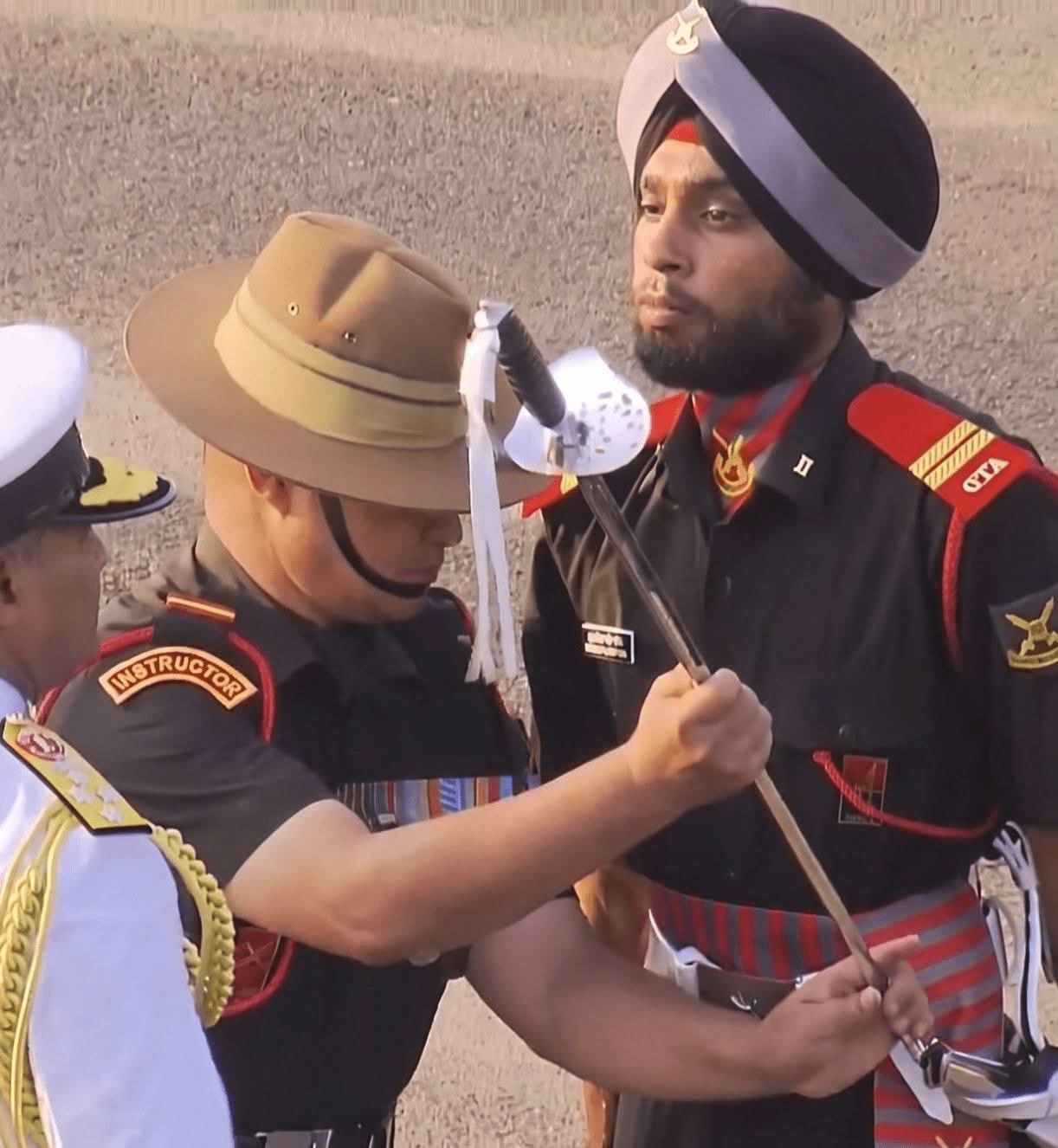
On 5 September 2026, at the Parameshwaran Drill Square of the Officers Training Academy (OTA), Chennai, Battalion Under Officer Gurkeerat Singh Hora received the Sword of Honour from Chief of the Naval Staff Admiral Krishna Swaminathan. The award, given to the cadet judged the best all-round performer of the course, closed a path that ran from Daly College, Indore, through the National Cadet Corps and the NCC Special Entry, to a Short Service Commission in the Indian Army.
Three hundred and forty-two Indian officer cadets—313 men and 29 women of the SSC-122 and SSC (Women)-36 courses—were commissioned that morning, along with 17 cadets from Seychelles, Tanzania, Uganda, Zimbabwe, Eswatini, Bhutan and Lesotho. Hora also took the Bronze Medal. Academy Under Officer Abhinab Chauhan won the OTA Gold Medal; Academy Cadet Adjutant Niket Singh Tomar took Silver. After the parade, the new lieutenants crossed the symbolic Antim Pag and became officers.
Hora’s route was the NCC Special Entry, open to holders of the NCC ‘C’ Certificate. He secured All India Rank 45, cleared the Services Selection Board, and joined OTA Chennai. The academy assesses leadership, military training, physical fitness, discipline, academics and officer-like qualities. The Sword is not a prize for one paper or one event; it is the academy’s judgement that a single cadet has led across the whole of that test.
Daly College, founded in the late nineteenth century as a residential school for the children of Central Indian princely houses, still trains a small number of students who later choose uniformed service. Hora’s NCC years there gave him the certificate, the habit of drill and the first taste of command that the Special Entry is designed to convert into a commission. In a system that also produces officers through NDA, CDS and technical streams, his result is a public argument for that pipeline: a school cadet can, if he stays the course, finish first among his peers at OTA.
Admiral Swaminathan, reviewing the parade, spoke of warfare that had grown faster and more sensor-heavy since he was a young officer, and of trust as the currency of command—“unlike social media, followership in uniform is hard-earned.” Those remarks sit behind the Sword. The academy is not only teaching parade-ground precision; it is selecting the junior leaders who will have to earn that followership in a more technical battlefield. Hora’s award is the academy’s statement that he is the cadet of this course most ready to begin that work.
For NCC cadets still in school and college, the story is practical rather than ceremonial. AIR 45 and then the Sword show that the Special Entry is not a back door. It is a front door that, for those who treat the ‘C’ Certificate as the start of training rather than the end of it, can lead to the highest honour the academy gives. Lieutenant Gurkeerat Singh Hora now wears that honour into service.