


AI Generated Summary
- He referred to recent protests at Jantar Mantar, organised by the CJP, as an illustration of the continuing willingness of young people to question authority and demand accountability from those in power.
- Discussing his historical novel Crimson Spring with fellow diplomat and author Navdeep Suri, Sarna explored the political and cultural landscape of early twentieth-century Punjab, the circumstances surrounding the Jallianwala Bagh massacre and the enduring influence of India’s young revolutionaries.
- Set against the turbulent years preceding the massacre of April 1919, Crimson Spring revisits one of the defining tragedies of colonial India while examining the larger forces that shaped the subcontinent’s political consciousness.
Former diplomat and author discusses the revolutionary movements that shaped Punjab, the enduring relevance of political dissent and the historical complexities behind contemporary conflicts.
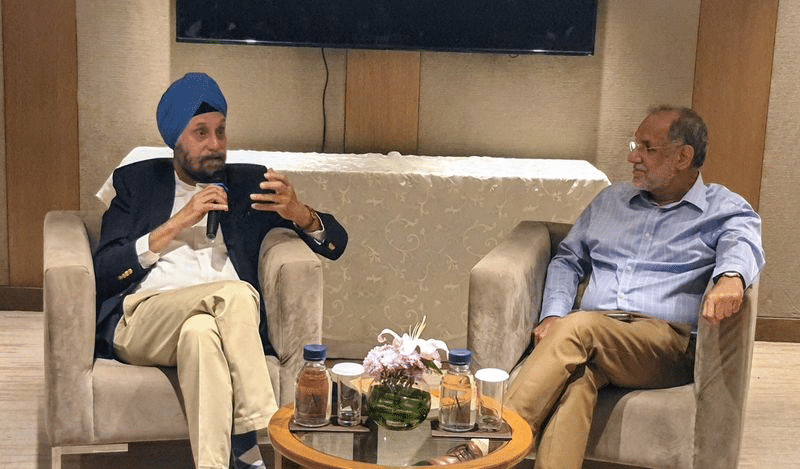
History is rarely a collection of disconnected events. Beneath moments of political upheaval, social unrest and revolutionary change lie decades of evolving ideas, collective aspirations and unresolved tensions. This interconnectedness of the past and present formed the central theme of a literary conversation with author and former Indian Ambassador Navtej Sarna, organised by the Prabha Khaitan Foundation.
Discussing his historical novel Crimson Spring with fellow diplomat and author Navdeep Suri, Sarna explored the political and cultural landscape of early twentieth-century Punjab, the circumstances surrounding the Jallianwala Bagh massacre and the enduring influence of India’s young revolutionaries.
Set against the turbulent years preceding the massacre of April 1919, Crimson Spring revisits one of the defining tragedies of colonial India while examining the larger forces that shaped the subcontinent’s political consciousness. For Sarna, the significance of Jallianwala Bagh extends beyond the brutality of the event itself. It represents a turning point in the emergence of revolutionary thought, the demand for accountability and the assertion of human dignity.
Drawing parallels between the political awakening of that period and contemporary youth-led movements, Sarna observed that the ideals of resistance and justice continue to find expression among younger generations. He referred to recent protests at Jantar Mantar, organised by the CJP, as an illustration of the continuing willingness of young people to question authority and demand accountability from those in power.
The discussion brought into focus the extraordinary youth of several figures who shaped India’s freedom struggle. Kartar Singh Sarabha was executed at just 19, while Bhagat Singh was 23 when he was hanged. Their willingness to challenge colonial authority, Sarna suggested, reflected an idealism that transcended personal interests and continues to inspire successive generations.
While acknowledging that revolutionary movements sometimes took violent directions, he emphasised the powerful convictions from which they originated. Their legacy, he noted, remains relevant wherever citizens seek to challenge injustice and make their voices heard.
Beyond the familiar narratives of resistance against British rule, the conversation examined the overlapping political, religious and social movements that transformed Punjab in the decades before Independence.
The Ghadar Movement, the Singh Sabha Movement and the Gurdwara Reform Movement, Sarna explained, must be understood within a shared historical landscape rather than as separate developments. Their emergence coincided with changing political identities, growing demands for reform and the return of Indian soldiers who had served during the First World War.
These developments contributed to a society undergoing profound transformation, with consequences that would extend far beyond the immediate struggle against colonial rule.
Sarna’s interest in this period was also driven by a desire to reconstruct the world of undivided Punjab. Through Crimson Spring, he sought to explore its everyday life, cultural relationships and competing political currents, while tracing the circumstances that eventually contributed to Partition.
Although the novel uses fictional characters to bring this world to life, Sarna stressed the importance of preserving the integrity of historical events. Fiction, in his approach, becomes a means of entering the emotional and social realities of the past without altering its documented foundations.
The discussion also challenged the tendency to view the Partition of 1947 as a sudden rupture. The violence that accompanied the division of the subcontinent, Sarna suggested, emerged from a society already shaped by decades of political mobilisation, colonial interventions, changing communal identities and growing distrust.
Understanding those earlier developments, therefore, becomes essential to understanding how a culturally interconnected region eventually experienced one of the most traumatic divisions in modern history.
The conversation subsequently moved beyond the Indian subcontinent to examine contemporary geopolitical conflicts, particularly the escalating tensions in West Asia.
Drawing upon their diplomatic experience in the region, Sarna and Suri reflected on the influence of historical grievances, competing claims and collective memories in shaping present-day international relations.
Speaking about the conflict involving Israel and Iran, Sarna described the war as one of choice and pointed to Iran’s complex historical consciousness and deeply embedded narratives of sacrifice and martyrdom. While acknowledging the difficulty of identifying an immediate resolution, he maintained that hope remained necessary even in seemingly intractable conflicts.
Across these diverse subjects, the discussion returned repeatedly to a common idea: the past does not disappear with the passage of time. Its movements, conflicts and convictions continue to shape political identities and public aspirations long after the events themselves have ended.
Through Crimson Spring, Sarna offers not merely a literary reconstruction of Jallianwala Bagh, but an invitation to examine the historical forces that produce both tragedy and transformation. More than a century after the massacre, the questions surrounding political power, public dissent, collective identity and the courage of young idealists remain strikingly relevant.