


AI Generated Summary
- Professor Bahadur Singh Sunet, president of the Bhai Ghanaiya Ji Mission and coordinator of the Bhai Ghanaiya Ji Charity and Peace International Foundation, said a nationwide observance could help carry the ideals associated with Bhai Ghanaiya Ji beyond their historical and religious context and introduce them to a much wider audience.
- The Guru endorsed the spirit behind his service and, according to tradition, provided him with medicines and bandages so that he could not only offer water but also tend to the wounds of those injured in battle.
- The campaign to have September 20 observed across India as ‘Bhai Ghanaiya Ji Manav Sewa Sankalp Diwas’ has gathered fresh momentum, with organisations associated with his legacy urging the Centre to give national recognition to his message of humanitarian service without discrimination.
Demand to mark September 20 nationwide seeks to bring centuries-old message of compassion, equality and service to younger generations
The campaign to have September 20 observed across India as ‘Bhai Ghanaiya Ji Manav Sewa Sankalp Diwas’ has gathered fresh momentum, with organisations associated with his legacy urging the Centre to give national recognition to his message of humanitarian service without discrimination.
Professor Bahadur Singh Sunet, president of the Bhai Ghanaiya Ji Mission and coordinator of the Bhai Ghanaiya Ji Charity and Peace International Foundation, said a nationwide observance could help carry the ideals associated with Bhai Ghanaiya Ji beyond their historical and religious context and introduce them to a much wider audience.
He said Bhai Ghanaiya Ji’s life embodied compassion, equality, peace and service to humanity — principles that remain relevant in contemporary society and should particularly be shared with younger generations.
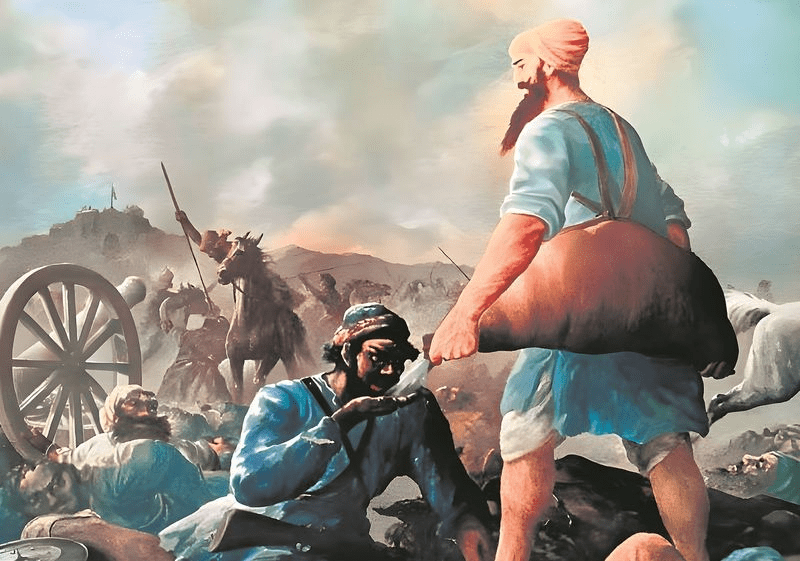
Bhai Ghanaiya Ji occupies a distinctive place in Sikh history for tending to the wounded during the battles fought around Anandpur Sahib in the time of Guru Gobind Singh. According to historical tradition, he would carry water across the battlefield and offer it to injured soldiers irrespective of which side they belonged to.
His actions reportedly prompted complaints from some Sikhs who saw him giving water to wounded enemy soldiers as well. When the matter reached Guru Gobind Singh, Bhai Ghanaiya Ji explained that amid the wounded he did not see friend or foe, but the same divine presence in every human being.
The Guru endorsed the spirit behind his service and, according to tradition, provided him with medicines and bandages so that he could not only offer water but also tend to the wounds of those injured in battle.
Sunet said it was this refusal to discriminate even in the midst of conflict that made Bhai Ghanaiya Ji’s example particularly significant as a humanitarian ideal. His message, he said, belonged not to one community alone but represented a larger philosophy of serving human beings on the basis of need rather than identity.
Organisations working to preserve and promote his legacy have pursued wider recognition of this philosophy for decades and have approached institutions in India and abroad. Sunet said the humanitarian significance of the Bhai Ghanaiya tradition had also been acknowledged by the International Red Cross and Red Crescent Movement and the Indian Red Cross Society. He said the Indian Red Cross had published material relating to Bhai Ghanaiya Ji on its website.
The demand for an institutional observance is not new. The Punjab Government began marking September 20 as Bhai Ghanaiya Ji Manav Sewa Diwas at the state level in 2014, with social organisations participating in programmes associated with the occasion. According to Sunet, the official observances were subsequently discontinued.
He has now called for their revival, while arguing that the initiative should be expanded beyond Punjab and adopted at the national level.
The proposal has also received support from public representatives. Punjab Assembly Speaker Kultar Singh Sandhwan has written to the Prime Minister seeking a national-level observance of September 20, while Sant Balbir Singh Seechewal has raised in Parliament the need to spread awareness about Bhai Ghanaiya Ji’s humanitarian legacy, Sunet said.
The organisations behind the campaign are seeking support from political, religious and social groups across the country to broaden the initiative.
Sunet said dedicating September 20 to Bhai Ghanaiya Ji at the national level could turn the occasion into an annual platform for humanitarian service, communal harmony and peace. It could also bring greater public attention to the Sikh principle of ‘sarbat da bhala’ — the welfare of all.
At the heart of the demand, he said, is a simple message drawn from an episode more than three centuries old: that compassion does not require a person to first determine which side another human being belongs to.