


AI Generated Summary
- Much of the work involved waiting—sometimes for a shift in light, sometimes for a ceremonial moment and often for an image capable of conveying the quiet intensity of the space.
- A new photographic volume journeys through the history, rituals, architecture and living traditions of the Golden Temple, presenting the sacred complex not merely as a monument, but as a universal space of faith, service and equality.
- The sequence begins during Amrit Vela, when the holy scripture is carried from the Akal Takht to the sanctum of Sri Harmandir Sahib, and concludes late at night with its return to Kotha Sahib.
A new photographic volume journeys through the history, rituals, architecture and living traditions of the Golden Temple, presenting the sacred complex not merely as a monument, but as a universal space of faith, service and equality.
Few places combine architectural splendour and spiritual intimacy as seamlessly as Sri Harmandir Sahib. Rising from the centre of the Amrit Sarovar, its gilded form may be one of India’s most recognisable images, yet the essence of the Golden Temple lies far beyond its ornamentation.
It is a sanctuary where distinctions of religion, caste, nationality and social position recede. Pilgrims arrive from across the world, walk barefoot through the complex and bow before a spiritual tradition founded upon humility, fearlessness and compassion. The words of the Mool Mantar, including Nirbhau, Nirvair—without fear and without enmity—find expression not only in scripture but in the everyday life of the shrine.
A recently created large-format photographic book seeks to document this many-layered experience. Conceived by publisher Om Aurora, the 256-page volume brings together years of photography, personal memory, historical research and close observation of the temple’s daily rituals.
For the photographer and author, the project was rooted in a relationship with Amritsar that began in childhood. Summer visits to paternal grandparents living near the shrine invariably included a walk from Jallianwala Bagh to Sri Harmandir Sahib. The darshan, the sound of prayer and the taste of karah prasad became lasting impressions, quietly establishing a bond that would later shape the book.
Creating the volume required several visits to Amritsar and long hours inside the sacred precincts. Much of the work involved waiting—sometimes for a shift in light, sometimes for a ceremonial moment and often for an image capable of conveying the quiet intensity of the space.
The book’s unusually large format also demanded exceptional photographic detail. Most of the images were captured using a medium-format digital camera, allowing the intricate textures, tonal variations and ornamental craftsmanship of the complex to be reproduced with clarity. Earlier photographs taken on 35mm film were incorporated alongside the digital work, enabling the book to reflect the shrine across different periods.
Divided into six chapters, the volume begins with the Sikh Gurus before tracing the historical and architectural evolution of Sri Harmandir Sahib. It also examines the significance of the Akal Takht, the seat representing temporal authority within Sikh tradition.
Among the most detailed sections is the chapter on Palki Sahib, which visually documents the daily ceremonial journey of Guru Granth Sahib. The sequence begins during Amrit Vela, when the holy scripture is carried from the Akal Takht to the sanctum of Sri Harmandir Sahib, and concludes late at night with its return to Kotha Sahib.
Located within the Akal Takht, Kotha Sahib is the chamber where Guru Granth Sahib rests overnight. The space is also associated with Guru Arjan Dev, the fifth Sikh Guru. A carpet covered with a white sheet remains beneath the bed, preserving the memory of the Guru’s presence and adding another layer of historical continuity to the ritual.
The book then turns towards the experience of darshan. Through intimate images of marble inlay, gilded surfaces, ornamental panels and interior corridors, it explores the relationship between material beauty and spiritual contemplation. Balconies on the richly decorated upper floor overlook the sanctum, where worshippers often pause in silence, absorbed in prayer and the music of Gurbani.
The Akal Takht is photographed with equal attention to its visible grandeur and preserved history. Although its marble façade has undergone extensive renovation, portions of the original brick structure remain protected behind the arches, bearing witness to the complex’s sacred and turbulent past.
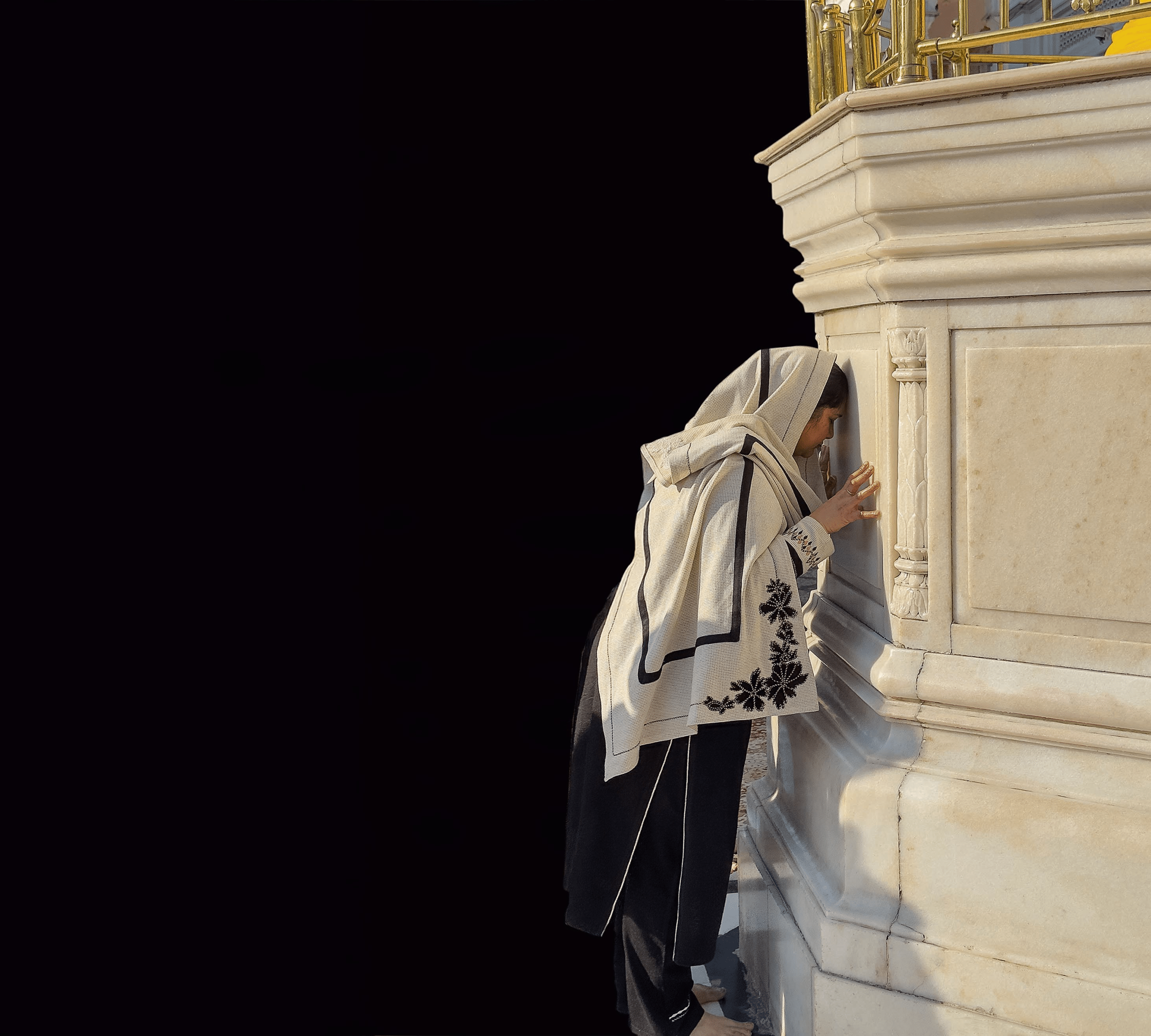
Yet some of the book’s most powerful images are not of gold, marble or intricate craftsmanship. They are of people—pilgrims bowing before the Nishan Sahib, children sitting quietly in the complex, worshippers moving through the parikrama and volunteers working together at the langar.
The concluding chapter is devoted to Langar Sahib, one of the world’s most enduring traditions of collective service. Every day, volunteers cook, serve and clean as thousands of visitors sit together and share a meal. No one is asked about caste, creed, wealth, religion or nationality. In that shared space, equality is not presented as an abstract ideal; it is practised repeatedly and on an extraordinary scale.
The process of documenting the shrine also produced moments when photography itself became secondary. One such experience occurred during Hola Mohalla, while the photographer was following the Palki Sahib procession.
As the procession approached the entrance of Sri Harmandir Sahib, the growing crowd of devotees gently pushed the photographer towards a corner. The movement made it nearly impossible to continue taking pictures, but there was no sense of frustration. The moment demanded participation rather than documentation.
Later, when the Palki Sahib emerged through the Darshani Deori on its return towards Kotha Sahib, the waiting sangat showered the procession with flower petals. Chants of “Sri Waheguru” rose throughout the complex as millions of fragrant petals descended upon the devotees.
Standing behind the Palki Sahib, surrounded by prayer, movement and flowers, the photographer experienced what was described as the most sublime moment of the entire project—a feeling as though the Gurus themselves were offering their blessings.
Historical and textual guidance for the volume was provided by Dr Inderjit Singh Gagoani of Khalsa College, Amritsar, while the Shiromani Gurdwara Parbandhak Committee extended support during its preparation.
The book has been priced at ₹1,46,900, a figure chosen to correspond with the year 1469, the birth year of Guru Nanak Dev. Its first and final copies are to be auctioned, with the proceeds intended for the management of the Golden Temple.
Ultimately, the volume attempts to capture something that no photograph can fully contain. Sri Harmandir Sahib is at once a place of history, art, worship and community. But above all, it remains a living expression of the belief that the Divine is not the possession of any one people or faith.
Its gold may draw the eye, but it is its message of humility, service and universal belonging that continues to illuminate the world.