


AI Generated Summary
- As thousands bowed their heads in gratitude during the Shukrana Samagam, Rasokhana once again demonstrated that its greatest legacy lies not only in its impressive structures or vast langar, but in its enduring message of compassion, service and harmony — values that remain as relevant today as they were a century ago.
- For many in the Doaba region and beyond, it represents a living embodiment of a centuries-old syncretic tradition that blends multiple religious streams under the unifying principle that God is one.
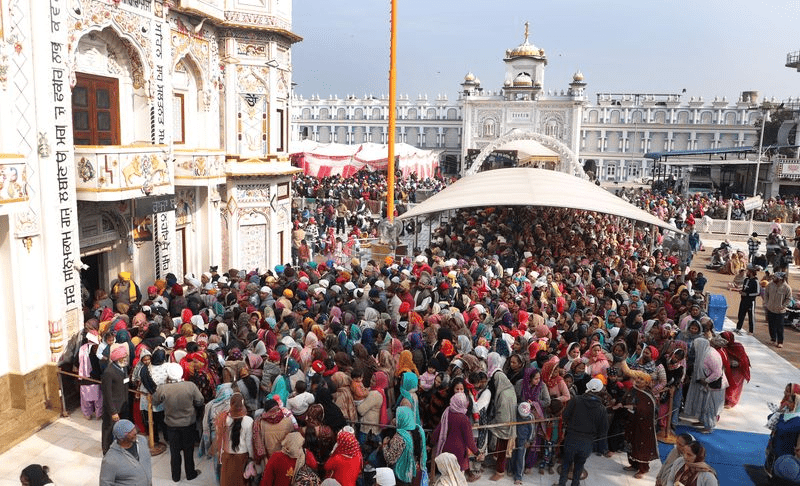
- By mid-morning, the line stretched right up to the main entrance, reflecting the scale of participation in the annual Shukrana Samagam and the deep reverence the shrine commands across communities.
As dawn broke on Sunday, a steady stream of devotees began converging on the sprawling Rasokhana Shri Nabh Kanwal Raja Sahib complex, forming long queues outside the Angeetha Sahib that only grew thicker with every passing hour. By mid-morning, the line stretched right up to the main entrance, reflecting the scale of participation in the annual Shukrana Samagam and the deep reverence the shrine commands across communities.
Set amid nearly 30 acres of land, Rasokhana is far more than a place of worship. For many in the Doaba region and beyond, it represents a living embodiment of a centuries-old syncretic tradition that blends multiple religious streams under the unifying principle that God is one.
The shrine is associated with Shri Nabh Kanwal Raja Sahib, born Bhagwan Dass in 1862 in Bullwoal village. Remembered as a spiritual guide who emphasised generosity, humility and universal brotherhood, he spent his life preaching the oneness of all faiths. He passed away in 1940 at Mazara Nau Abaad near Banga, but his teachings continue to shape the ethos of Rasokhana.
At the heart of the complex stands the Angeetha Sahib, the gilded central gurdwara marking the site of Raja Sahib’s last rites. An eternal flame burns there, drawing devotees who bow in silence before moving on to the surrounding halls and sheds that house one of the region’s largest langar operations. Organisers say the community kitchen feeds thousands daily, with expenditures running into crores, ensuring that no visitor leaves hungry.
The oldest structure on the premises is the Rasokhana building itself, established in 1916 by Raja Nabh Kanwal. Over the decades, the complex has expanded steadily, and new buildings — including a white marble structure adorned with intricate inlay work — are currently under construction.
What sets Rasokhana apart, however, is its visual and spiritual message. The entrance wall of the Angeetha Sahib displays images of Lord Shiva, Lord Ram, Bal Gopal, Guru Nanak Dev, Guru Gobind Singh and other revered figures, reflecting the belief that all divine paths lead to the same truth.
Members of the shrine committee often quote verses attributed to Raja Sahib that express this philosophy, describing Ram, Krishna, Gorakh, Gobind and even the Sufi mystic Mansoor as manifestations of the same supreme reality.
Amrik Singh of Bullwoal, a committee member, says Raja Sahib consistently taught that the world’s prophets and gurus were different forms conveying a single divine message. “People from every religion come here because they feel included. Through Raja Sahib’s teachings, many are introduced to the Guru Granth Sahib and to the idea of universal oneness,” he explains.
Raja Sahib drew inspiration from the Udasi tradition within Sikhism and believed that no one should be denied food or shelter. Guided by this conviction, he established several gurdwaras in the region during his lifetime, while his followers went on to set up many more across India and abroad.
As thousands bowed their heads in gratitude during the Shukrana Samagam, Rasokhana once again demonstrated that its greatest legacy lies not only in its impressive structures or vast langar, but in its enduring message of compassion, service and harmony — values that remain as relevant today as they were a century ago.