


AI Generated Summary
- Waste generated while cleaning the pig sheds is collected in a tank fitted with a mud motor and is then transferred to the fish ponds.
- He learnt scientific fish farming at the Fisheries Training Centre and Fish Seed Farm in Kapurthala and underwent piggery training at Guru Angad Dev Veterinary and Animal Sciences University (GADVASU), Ludhiana.
- Water from the fish ponds, enriched with nutrients, is used to irrigate the paddy and wheat grown on the farm.
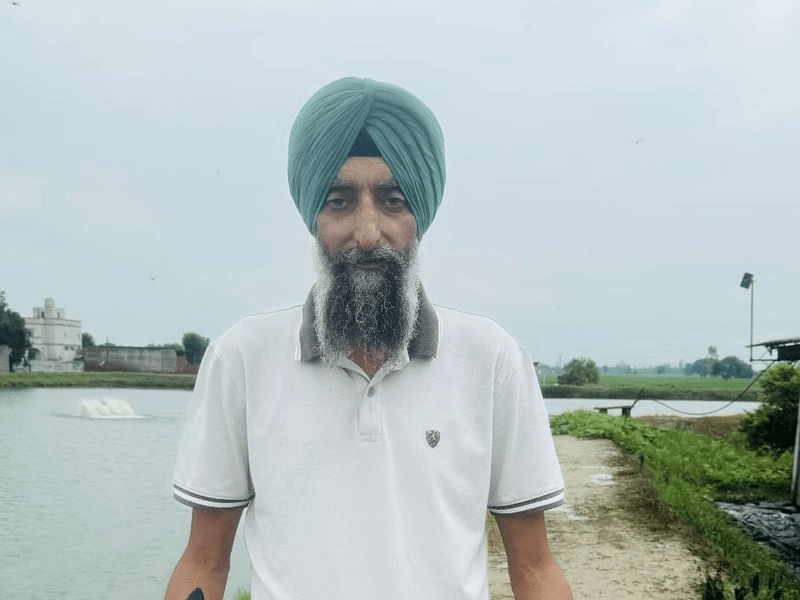
Combining fish culture, piggery and traditional crops, 48-year-old Parminderjit Singh has created a system where the waste from one activity becomes an input for another
On his farm in Kalewal village of Kapurthala district, Parminderjit Singh has found a way to make different agricultural activities work together. Pig waste nourishes his fish ponds, water from the ponds irrigates his fields, and the resulting cycle helps him cut input costs while generating income beyond the traditional paddy-wheat rotation.
The 48-year-old farmer, who comes from a family traditionally engaged in growing paddy and wheat, has gradually diversified his operations to include piggery and fish farming. His efforts have also earned him the Chief Minister’s Award for his scientific approach to agriculture.
Singh’s experiment with diversification began in 2017 when he took up pig farming. The COVID-19 pandemic, however, made the operation difficult to manage and he eventually discontinued it. Two years after the pandemic began, he returned to piggery and simultaneously ventured into fish farming.
“I wanted to try something new and adopt modern farming practices,” Singh said, recalling his decision to move beyond conventional crop cultivation.
Today, fish farming occupies four acres of his land and yields around 10 tonnes annually. Singh follows composite fish culture, raising Katla, Rohu, Common Carp and Grass Carp together. His produce is sold at the fish market in Jalandhar.
But what makes his farm distinctive is the way its different components have been linked to minimise waste and expenditure.
The piggery, spread across 1.5 kanals, has been incorporated into the fish farming operation through a simple waste-management system. Waste generated while cleaning the pig sheds is collected in a tank fitted with a mud motor and is then transferred to the fish ponds.
The organic matter provides nutrients to the ponds and serves as a supplementary source of feed, reducing Singh’s dependence on commercially purchased fish feed. Instead of becoming a disposal problem, the piggery waste thus becomes a productive farm input.
The same principle extends to his crop fields.
Water from the fish ponds, enriched with nutrients, is used to irrigate the paddy and wheat grown on the farm. This allows nutrients generated within the farming system to be returned to the soil, while also making productive use of pond water.
Singh has supplemented practical experience with formal training. He learnt scientific fish farming at the Fisheries Training Centre and Fish Seed Farm in Kapurthala and underwent piggery training at Guru Angad Dev Veterinary and Animal Sciences University (GADVASU), Ludhiana.
Scientific monitoring is now a regular part of his fish farming operation. Testing kits are used to keep track of critical water-quality parameters, including dissolved oxygen, pH and ammonia levels, helping maintain suitable conditions in the ponds.
Piggery, Singh points out, is considerably more labour-intensive than it may appear. Animal health has to be monitored from an early stage, with attention to procedures such as teeth clipping in piglets, maintaining iron levels, deworming and timely vaccination.
Despite the additional work involved, he believes diversification can offer farmers a way to improve the economics of agriculture, particularly when different enterprises are designed to complement one another.
For Singh, integrated farming is not merely about adding more activities to a conventional farm. Its advantage lies in connecting them — converting waste into an input, lowering dependence on purchased resources and creating additional avenues of income from the same agricultural holding.
“There is a lot of scope in this field,” he said.