


AI Generated Summary
- The disbursement marks one of the first instances in the country where verified reductions in agricultural greenhouse gas emissions and improvements in soil carbon have resulted in direct payments to farmers.
- Instead of treating these measures solely as environmental interventions, the programme seeks to create an additional source of farm income by quantifying the climate benefits generated on agricultural land and converting them into tradable carbon credits.
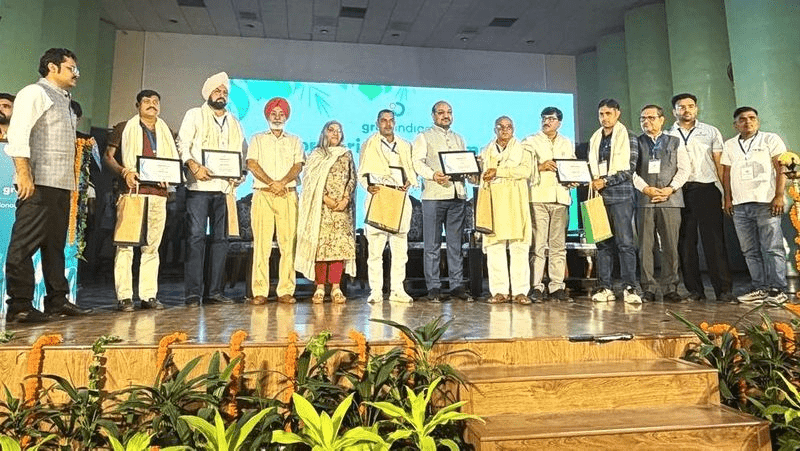
- The first round of payments was initiated at Punjab Agricultural University (PAU) in Ludhiana by M L Jat, Director General of the Indian Council of Agricultural Research (ICAR).
Over 2,500 cultivators receive Rs 2.9 crore as regenerative farming practices generate verified carbon credits
India’s emerging agricultural carbon market has begun translating climate-friendly farming practices into direct income for cultivators, with more than 2,500 farmers in Punjab and Haryana receiving over Rs 2.9 crore through the sale of carbon credits.
The disbursement marks one of the first instances in the country where verified reductions in agricultural greenhouse gas emissions and improvements in soil carbon have resulted in direct payments to farmers.
The first round of payments was initiated at Punjab Agricultural University (PAU) in Ludhiana by M L Jat, Director General of the Indian Council of Agricultural Research (ICAR).
The farmers are part of Aadi, a farmer-carbon initiative launched by Grow Indigo in 2019 with technical guidance from ICAR. Under the programme, cultivators have shifted towards practices such as direct-seeded rice (DSR), reduced tillage and improved management of crop residue.
Instead of treating these measures solely as environmental interventions, the programme seeks to create an additional source of farm income by quantifying the climate benefits generated on agricultural land and converting them into tradable carbon credits.
For the first monitoring period, covering farming activity between 2019 and 2022, changes in greenhouse gas emissions and soil carbon were measured and independently verified before credits were issued.
The initial issuance covered around 30,000 acres and generated more than 50,000 carbon credits. Depending on the number of credits attributable to their fields, individual farmers received payments ranging from approximately Rs 3,000 to Rs 15,000.
Farmers who entered the programme after 2022 are expected to become eligible for payments during subsequent monitoring and verification cycles.
Aadi has since expanded well beyond the two northern states. The programme now covers more than two million acres and has enrolled over one lakh farmers across seven states. It has also become the first major farmer-focused programme in India to issue agricultural carbon credits using Verra’s VM0042 methodology.
The significance of the initiative extends beyond carbon emissions. Agricultural practices promoted under the programme are also intended to address two persistent environmental challenges confronting Punjab and neighbouring farming regions — groundwater depletion and the burning of crop residue.
During the 2019-22 monitoring period, fields participating in the programme are estimated to have conserved around 45 billion litres of water. More than two lakh tonnes of crop residue were also prevented from being burnt, avoiding an estimated 1,000 tonnes of PM2.5 emissions.
Such outcomes are particularly relevant for Punjab, where the rice-wheat cropping system has placed considerable pressure on groundwater reserves, while seasonal stubble burning has remained a major air-quality concern across northern India.
Government data indicates that farm-fire incidents in Punjab have fallen sharply in recent years, declining from more than 83,000 in 2020 to fewer than 5,000 in 2025.
Some farming communities have also demonstrated that residue-burning can be avoided consistently at scale. Ransinh Kalan village in Moga district, for instance, has reportedly managed crop residue without burning across 1,310 acres for six consecutive years.
The carbon-credit model introduces a financial dimension to this transition. Practices such as DSR and reduced tillage can conserve resources and lower emissions, but their adoption may require farmers to alter established cultivation methods. Carbon payments are designed to compensate participating cultivators for the measurable environmental benefits produced through those changes.
For India, where agriculture is dominated by small and marginal holdings, the first payments will also provide an early test of whether carbon markets can develop into a meaningful supplementary income stream for farmers.
The amounts currently received remain modest compared with overall cultivation costs and farm earnings. However, the expansion of monitoring to larger areas and subsequent credit-issuance cycles could determine whether agricultural carbon finance develops from a limited climate initiative into a scalable component of rural income.
The Punjab and Haryana disbursements therefore represent more than the sale of the first batch of credits. They signal the emergence of a system in which improvements in soil management, water conservation and emissions reduction can acquire a measurable financial value — with a share of that value reaching the farmer who produces it.
