


AI Generated Summary
- A movement that has spent four decades using Canadian streets, gurdwaras, and ballot-theatre to prosecute a foreign territorial claim is now hitching that claim to the most serious unity vote this federation has faced in a generation.
- A state that will not name the ideology behind its worst mass murder, for fear of a handful of constituencies, has already traded a piece of its security for a piece of its map.
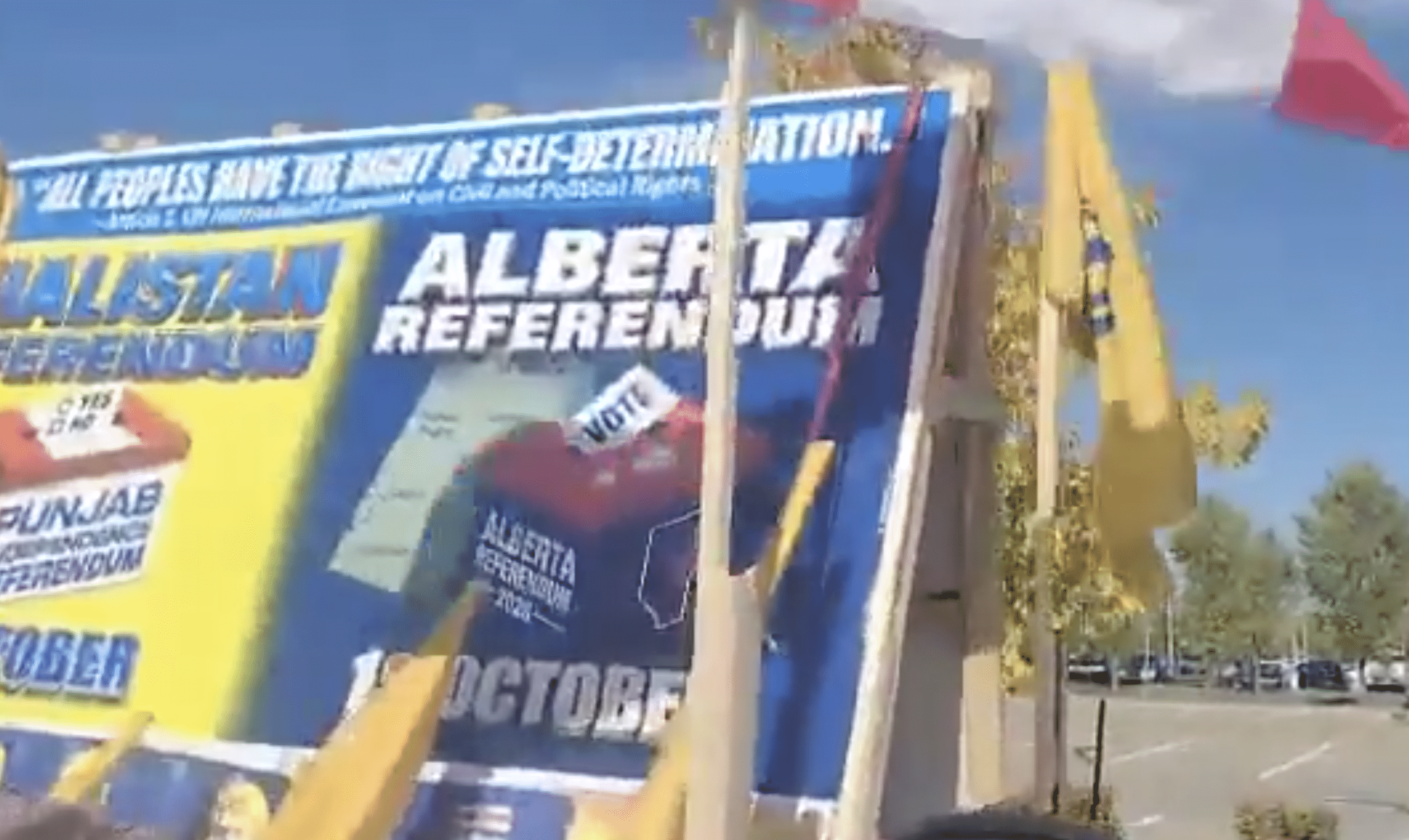
- Days before Albertans vote on October 19 on whether their government should begin the constitutional process toward a binding independence referendum, billboards near Airdrie have been advertising an “Alberta Referendum on Independence of Punjab,” set for Edmonton on October 18.
Days before Albertans vote on October 19 on whether their government should begin the constitutional process toward a binding independence referendum, billboards near Airdrie have been advertising an “Alberta Referendum on Independence of Punjab,” set for Edmonton on October 18.
First India, now Canada. #Khalistani extremists are now actively promoting the balkanization of Canada, and the Alberta Referendum efforts are proof of where this agenda is heading. https://t.co/MojMkRVQ3f
— Tim Somerwille (@TimSomerwille) October 3, 2026
The sponsor is Sikhs for Justice, the U.S.-based Khalistan outfit banned in 2019. The group has publicly framed a Khalistan convoy in Calgary as promoting both the Punjab referendum and Alberta independence, and has praised Ottawa for letting Albertans “exercise their right to self-determination.” An Alberta independence speaker has been reported at a Khalistan rally saying the spectacle inspires his own cause. The dates are adjacent on purpose. The confusion is the tactic.
This is how a fringe operates once a host country has taught it that sovereignty is a suggestion. Sikhs for Justice’s votes are unofficial, non-binding, and irrelevant to the Government of India. They are not irrelevant to Canada. A movement that has spent four decades using Canadian streets, gurdwaras, and ballot-theatre to prosecute a foreign territorial claim is now hitching that claim to the most serious unity vote this federation has faced in a generation. Separatism is contagious precisely because it is procedural. Once you grant that any motivated diaspora may stage a referendum on someone else’s map, you have conceded the premise Alberta’s own hardliners need: that borders are a campaign, not a settlement.
Canada has seen what this current produces when it is indulged. On June 23, 1985, a bomb planted by Canada-based Khalistani extremists destroyed Air India Flight 182 over the Atlantic, killing all 329 people on board, 268 of them Canadian citizens, 82 of them children. A second device the same day killed two baggage handlers at Tokyo’s Narita airport. The plot was run by Babbar Khalsa, led by Talwinder Singh Parmar, whom Canadian agencies had been watching; an explosives test in the British Columbia woods was heard and not stopped. Justice John Major’s public inquiry later called the institutional failure a cascading series of errors. In June 2026, four decades on, the Canadian Security Intelligence Service finally said in plain language what the evidence had always shown: the bomb was planted by Canada-based Khalistani extremists, and it remains the deadliest terrorist attack in Canadian history. CSIS’s recent assessments still list that milieu as a national-security threat, a small group that uses Canada to fundraise, promote, and plan violence aimed chiefly at India.
The violence did not end with the Kanishka. Journalist Tara Singh Hayer, a witness prepared to testify in the Air India case, was murdered in Surrey in 1998. Plots, intimidation of moderate Sikhs, and public celebration of political assassination have recurred in Canadian parades and on Canadian stages. The 2023 killing of Hardeep Singh Nijjar in Surrey, and the diplomatic rupture that followed, showed how thoroughly this politics now sits inside the bilateral relationship. Ottawa can dispute New Delhi’s methods. It cannot honestly dispute that it allowed a banned foreign separatist ecosystem to mature on its soil.
The reason was arithmetic. Ridings in Brampton, Surrey, and Calgary reward parties that treat Khalistan advocacy as just another ethnic file. Leaders pose at events where the martyr imagery includes convicted terrorists. Symbolic referendums are waved through as speech. The distinction CSIS itself draws — between peaceful campaigning and the violent fringe — is real, and it is the distinction Ottawa has refused to enforce. A state that will not name the ideology behind its worst mass murder, for fear of a handful of constituencies, has already traded a piece of its security for a piece of its map.
Fringe secessionists are dangerous to the host, not only to the target. They import a doctrine that the nation is provisional. They launder foreign intelligence rivalries into domestic policing. They intimidate co-ethnics who dissent, which is a sovereignty problem in any country that claims a monopoly on coercion. And they look for the next open constitutional wound. Alberta’s October 19 question asks whether the province should remain in Canada or start the legal path to a separation vote. It is a Canadian argument, conducted under Canadian law, among Canadian voters. A Punjab referendum staged in Edmonton the day before is an attempt to borrow the legitimacy of that argument for a cause that has already killed hundreds of Canadians.
Nations do not stay sovereign by being polite to movements that reject the sovereignty of others. Canada can protect Sikh religious life, speech, and political participation without licensing a separatist franchise. That means enforcing terror designations, denying platforms to groups that glorify the Air India bombers, and refusing to let a foreign referendum share a news cycle with a vote on Confederation. Alberta is deciding a question about Canada. Ottawa should not let anyone else write the caption.