


AI Generated Summary
- A postgraduate in political science from Guru Nanak Dev University, Singh had been teaching while preparing for the civil services when his father, Rajinder Singh, expressed an interest in developing an orchard.
- He believes the fruit could command prices of about $8 to $9 per kg in international markets, though establishing an export business would require developing the necessary supply chain and market linkages.
- What started as an effort to help his retired father realise his dream of having an orchard has evolved into an experiment in crop diversification — and, potentially, a new livelihood model beyond Punjab’s traditional crops.
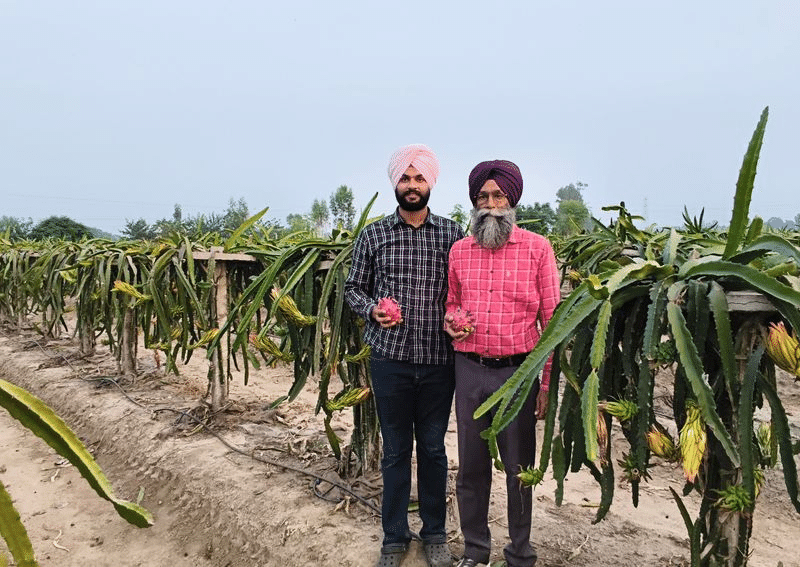
What began as a retired father’s wish to own an orchard has grown into a six-acre farming venture for 27-year-old Gurjodh Singh of Bholath, who left his teaching job to take up dragon fruit cultivation.
Today, Singh grows the red-fleshed ‘American Beauty’ variety and supplies the fruit to retail markets in Jalandhar, Ludhiana and Chandigarh. But the venture had a difficult beginning, with nearly half of the produce from the family’s first attempt getting damaged.
A postgraduate in political science from Guru Nanak Dev University, Singh had been teaching while preparing for the civil services when his father, Rajinder Singh, expressed an interest in developing an orchard. Dragon fruit caught their attention because of its commercial potential and comparatively modest water requirement.
With little practical knowledge of the crop, the father-son duo initially turned to online videos to understand its cultivation. In 2022, they planted dragon fruit on one acre of land.
The first harvest proved to be a learning experience rather than a commercial success.
“It took us almost a year to get our first sample fruits,” Singh said. Understanding irrigation requirements and protecting the plants from extreme weather were among the early challenges. Nearly 50 per cent of the produce was damaged during their initial attempt.
Rather than abandon the crop, Singh began looking for scientific guidance.
He approached Punjab Agricultural University, where principal fruit scientist Jaswinder Singh Brar was conducting trials related to dragon fruit cultivation. Singh subsequently sought assistance from Krishi Vigyan Kendra, Kapurthala, to improve his farming practices.
The technical guidance helped him understand several aspects of managing the relatively unfamiliar crop, including irrigation, fungal infections and protection from sunburn during periods of intense heat. He also learnt about intercropping and ways to improve the productivity of the orchard.
Armed with greater experience, Singh gradually expanded the plantation from one acre to six acres.
He now primarily cultivates the ‘American Beauty’ variety, distinguished by its pink skin and red-pink flesh. According to Singh, the variety offers a longer shelf life, is relatively less susceptible to cracking and commands good demand in the market.
The fruit currently sells for around Rs 150 to Rs 200 per kg in the retail markets where Singh supplies his produce.
For the young farmer, the economics have strengthened the case for diversifying beyond Punjab’s conventional wheat-paddy cycle. He estimates that dragon fruit cultivation can generate two to three times the returns per acre compared with traditional wheat and paddy farming.
Singh is now setting his sights beyond Punjab.
One of his ambitions is to eventually enter overseas markets, particularly in Europe and Latin America. He believes the fruit could command prices of about $8 to $9 per kg in international markets, though establishing an export business would require developing the necessary supply chain and market linkages.
His plans also extend beyond selling fresh fruit.
Singh is exploring value-added products that could provide farmers with additional revenue and reduce dependence on the fresh-produce market. Farmers in southern India, he said, have already experimented with products such as dragon fruit jam, jelly, juice and dried chips.
He now wants to study the processing machinery and techniques needed to produce such products commercially.
For Singh, the journey from teaching and civil-services preparation to agriculture has ultimately taken shape around a simple family aspiration. What started as an effort to help his retired father realise his dream of having an orchard has evolved into an experiment in crop diversification — and, potentially, a new livelihood model beyond Punjab’s traditional crops.