


AI Generated Summary
- the story of a proud holy man, a thirsty companion, a boulder sent hurtling down a mountainside — and a raised hand that, according to tradition, stopped it.
- On the hill lived a hermit remembered in Sikh tradition as Wali Kandhari — also rendered in some accounts as Vali Kandhai — who had access to a source of fresh water.
- Nearly five centuries after Guru Nanak’s travels carried him through the region, a boulder bearing what devotees believe to be the imprint of his palm remains at the heart of one of Sikhism’s most revered shrines — Gurdwara Panja Sahib.
Nearly five centuries after Guru Nanak’s travels carried him through the region, a boulder bearing what devotees believe to be the imprint of his palm remains at the heart of one of Sikhism’s most revered shrines — Gurdwara Panja Sahib.
There are places where history is preserved in manuscripts and monuments, and there are places where faith believes it has been preserved in stone.
At Hasan Abdal, in present-day Pakistan, stands Gurdwara Panja Sahib, a shrine whose name comes from panja — the palm of a hand. At its centre is a rock bearing a hand-shaped impression that Sikh tradition associates with Guru Nanak, the founder of Sikhism.
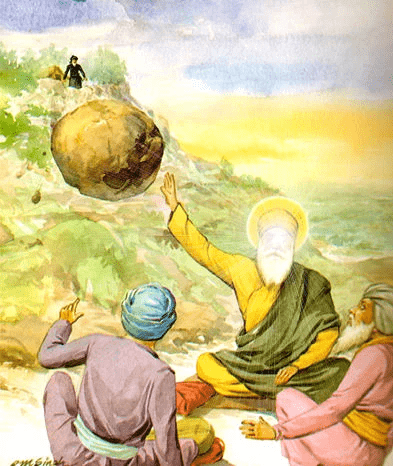
Behind that imprint lies one of the best-known episodes connected with Guru Nanak’s travels: the story of a proud holy man, a thirsty companion, a boulder sent hurtling down a mountainside — and a raised hand that, according to tradition, stopped it.
The story begins during Guru Nanak’s extensive journeys, or udasis, undertaken to carry his spiritual message across regions, communities and religious traditions. Accompanying him on many of these travels was Bhai Mardana, his lifelong companion and a musician who played the rabab as Guru Nanak sang his compositions.
During their travels, the two are believed to have reached Hasan Abdal, where they rested near the foot of a hill. On the hill lived a hermit remembered in Sikh tradition as Wali Kandhari — also rendered in some accounts as Vali Kandhai — who had access to a source of fresh water.
Mardana was thirsty.
According to the traditional account, Guru Nanak asked him to approach the hermit and request water. Wali Kandhari, however, refused. Mardana returned empty-handed.
Guru Nanak sent him again.
Again, the request was rejected.
The episode was no longer merely about thirst. It had become a confrontation between two radically different ideas of spiritual authority: one that guarded what it possessed and another that saw the divine as belonging to everyone.
Tradition holds that Guru Nanak then asked Mardana to lift a stone near where they were sitting. Fresh water began to flow from the earth.
As water appeared below, the spring on the hill is said to have diminished.
For Wali Kandhari, the event was an affront to his authority. Looking down from the hill and seeing Guru Nanak below, the enraged hermit is said to have dislodged a massive boulder and sent it crashing down the slope towards him.
Those around Guru Nanak could see the danger.
The Guru did not run.
As the rock hurtled towards him, Sikh tradition says Guru Nanak simply raised his right hand.
The boulder struck his palm — and stopped.
The stone yielded where the man would not.
Devotees believe the impression of Guru Nanak’s hand remained embedded in the rock. It is this panja, or palm print, from which Panja Sahib derives its name.
But the power of the story lies not merely in the miracle.
What followed is perhaps its more important moment.
Guru Nanak did not retaliate against the hermit who had allegedly tried to kill him. There was no punishment, humiliation or triumphant display of power. Faced with the Guru’s composure and compassion, tradition says Wali Kandhari’s pride collapsed. Humbled, he sought forgiveness.
The enemy was not destroyed; the enmity was.
That distinction gives the centuries-old narrative its enduring moral force.
The boulder becomes more than an object stopped in its descent. It represents anger, ego and the impulse to dominate. The open palm becomes its opposite — restraint, fearlessness and compassion.
In that reading, the miracle at Panja Sahib is not simply that a hand stopped a stone.
It is that compassion stopped anger without becoming angry itself.
Today, Gurdwara Panja Sahib at Hasan Abdal is among the most important Sikh pilgrimage sites in Pakistan and draws devotees from across the world. The sacred rock associated with Guru Nanak is preserved at the shrine, with water flowing around it as pilgrims gather to pray and remember the episode.
For generations of Sikhs, the handprint has served as a tangible connection with the travels and teachings of Guru Nanak.
Yet the story also carries a message that extends beyond the boundaries of a shrine.
Guru Nanak repeatedly challenged distinctions built around status, caste, religious authority and possession. Spirituality, in his vision, could not be separated from humility and service to others. The person who claimed closeness to God while denying another human being something as basic as water had misunderstood the very spirituality he claimed to possess.
That is why, beneath the drama of the rolling boulder, the Panja Sahib story is ultimately a parable about power.
Wali Kandhari possessed the mountain and its spring, yet remained imprisoned by his pride. Guru Nanak possessed neither, yet could offer water without claiming ownership over it.
One guarded.
The other gave.
And when hostility came rolling down the mountain, the Guru answered not with another stone, but with an open hand.
Centuries later, that image remains extraordinarily potent: a boulder, a palm and a moment in which strength is defined not by the ability to strike back, but by the capacity to remain compassionate when confronted by rage.
At Panja Sahib, Sikh tradition remembers that lesson in stone.
