


AI Generated Summary
- After Guru Gobind Singh Ji left for his heavenly abode, Mata Sundri Ji played a major role in keeping the Sikh community united and preserving Sikh traditions and discipline.
- After the martyrdom of the younger Sahibzadas, Mata Gujri Ji too left for her heavenly abode while remaining in the will of the Guru.
- She also played a vital role in the upbringing of young Gobind Rai Ji, instilling in him the values of Gurbani, service, fearlessness, and humanity.
Mothers have always played a highly significant role in Sikhism. From Mata Gujri Ji, Bebe Nanaki Ji, Mata Sundri Ji, Mata Sahib Kaur Ji, Mata Khivi Ji, Bibi Bhani Ji, Mai Bhago Ji, to Maharani Jind Kaur, Sikh history remembers countless women with deep respect and honor.
It was Guru Nanak Dev Ji who first strongly advocated for the dignity and respect of women. He gave women the highest place in society and said:
“So kyo manda aakhiye jit jamme rajaan”
“Why call her inferior, from whom even kings are born?”
Through these words, Guru Nanak Dev Ji questioned why society fails to honor the very woman who gives birth to humanity. Following him, all Sikh Gurus continued to uplift women and emphasized their importance and dignity. This is why Sikh history is filled with remarkable women whose contributions remain unforgettable.
It was Bebe Nanaki Ji who first recognized the divine light within Guru Nanak Dev Ji. Therefore, society must always respect and honor women. Let us now look at some of the extraordinary women and mothers whose contributions hold a special place in Sikhism.
The Great Contribution of Mata Gujri Ji in Sikhism
Mata Gujri Ji is among the most respected and inspiring personalities in Sikh history. She was the mother of Guru Gobind Singh Ji and the wife of Guru Tegh Bahadur Ji. Her life stands as a symbol of sacrifice, patience, faith, and unwavering devotion to the Guru’s house.
Mata Gujri Ji endured the hardships and struggles faced by the Guru’s family with immense courage. When Guru Tegh Bahadur Ji attained martyrdom to protect religion and humanity, she remained steadfast and gave strength to the Sikh community. She accepted the will of Waheguru in every situation without losing hope.
She also played a vital role in the upbringing of young Gobind Rai Ji, instilling in him the values of Gurbani, service, fearlessness, and humanity. These teachings later became the foundation of the Khalsa Panth.
One of the most emotional chapters of Sikh history came when the younger Sahibzadas were pressured to abandon their faith. Mata Gujri Ji inspired her grandsons to remain firm in Sikhi. Even while imprisoned in the cold tower, she never lost courage or faith.
After the martyrdom of the younger Sahibzadas, Mata Gujri Ji too left for her heavenly abode while remaining in the will of the Guru. Her sacrifice is counted among the greatest sacrifices in Sikh history.
Her life teaches us that no matter how difficult circumstances become, one should never lose faith in Waheguru or abandon the path of truth.
The Great Contribution of Mata Sundri Ji in Sikhism
Mata Sundri Ji is remembered as one of the most respected and inspiring women in Sikh history. She was the wife of Guru Gobind Singh Ji and a revered mother figure for the Sikh community.
After Guru Gobind Singh Ji left for his heavenly abode, Mata Sundri Ji played a major role in keeping the Sikh community united and preserving Sikh traditions and discipline. Her life reflected service, sacrifice, patience, and deep devotion to the Guru.
Despite enduring the martyrdom of the four Sahibzadas and countless Sikhs, she never lost courage. She motivated Sikhs to remain committed to Gurbani and the principles of the Khalsa Panth.
During a difficult phase for the Sikh community, Mata Sundri Ji guided Sikhs from Delhi through hukamnamas and continuous encouragement, helping maintain unity within the Panth.
She taught that a true Sikh never abandons faith and principles during hardships. Her life symbolizes the strength and leadership of Sikh women.
The Great Contribution of Mata Sahib Kaur Ji in Sikhism
Mata Sahib Kaur Ji holds a unique and honored place in Sikh history. She is respectfully known as the “Mother of the Khalsa.” Her contribution extends far beyond that of a maternal figure; she became the spiritual mother of the Khalsa Panth.
During the historic Vaisakhi of 1699, when the Khalsa Panth was created, Mata Sahib Kaur Ji added patashas (sugar crystals) into the Amrit. Through this act, a profound message was given that along with bravery, the Khalsa should also possess sweetness, compassion, and humility.
Following this sacred service, she was honored as the Mother of the Khalsa. Even after Guru Gobind Singh Ji’s departure, she continued to inspire Sikhs to walk on the Guru’s path and uphold Khalsa discipline.
Her life remains a shining example of humility, devotion, sacrifice, and spiritual strength.
The Great Contribution of Bibi Bhani Ji in Sikhism
Bibi Bhani Ji is remembered as one of the greatest women in Sikh history. She was the daughter of Guru Amar Das Ji and the wife of Guru Ram Das Ji.
Her life was the ultimate example of selfless service, humility, and devotion toward the Guru’s house.
A famous incident from Sikh history describes how Guru Amar Das Ji was meditating when one leg of his wooden seat broke. To prevent his meditation from being disturbed, Bibi Bhani Ji supported it with her hand. A nail pierced her hand and blood flowed, yet she continued her service without complaint.
Pleased with her devotion, Guru Sahib blessed her that the Guru Gaddi would continue through her lineage. Thus, Bibi Bhani Ji became an important link in the continuation of Sikh leadership.
Her life teaches that selfless service to the Guru is among the greatest blessings.
The Great Contribution of Mata Khivi Ji in Sikhism
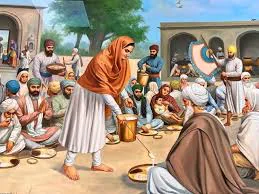
Mata Khivi Ji is one of the most remarkable women in Sikh history. She played a major role in strengthening the Langar tradition in Sikhism.
Her life embodied service, equality, humility, and compassion. She personally managed the Langar and served food lovingly and respectfully to everyone without discrimination.
The Sikh scriptures themselves mention the sweetness of Mata Khivi Ji’s Langar and her noble nature, which reflects her greatness. She taught that Langar is not merely food, but a symbol of equality, brotherhood, and humanity.
Even today, the Langar tradition practiced in Gurdwaras worldwide reminds Sikhs of her unmatched service and dedication.
The Great Contribution of Mai Bhago Ji in Sikh History
Mai Bhago Ji is remembered as the great warrior woman who inspired Sikhs with courage, faith, and dedication to righteousness.
She was skilled in horse riding, weaponry, and warfare. Her greatest contribution came during the siege of Anandpur Sahib when some Sikhs abandoned Guru Gobind Singh Ji and returned home out of fear.
Mai Bhago Ji strongly rebuked them and reminded them of their duty toward the Guru. Inspired by her words, they returned to the battlefield alongside her.
In the Battle of Khidrana, later known as Muktsar Sahib, Mai Bhago Ji displayed extraordinary bravery. Forty Sikhs attained martyrdom there and came to be known as the “Chali Mukte.”
Her life proved that women are equally capable of protecting faith and standing fearlessly for truth.
The Great Contribution of Maharani Jind Kaur Ji in Sikh History
Maharani Jind Kaur was one of the bravest women in Sikh history. She was the youngest queen of Maharaja Ranjit Singh and the mother of Maharaja Duleep Singh.
After Maharaja Ranjit Singh’s passing, the Sikh Empire entered a period of instability. During this difficult time, Maharani Jind Kaur courageously took charge and protected the Sikh Empire during her son’s minority.
She openly opposed British conspiracies and fought fearlessly for the independence of the Sikh Empire. The British considered her a major threat and eventually imprisoned her. Yet even in captivity, her spirit remained unbroken.
Her life symbolizes courage, patriotism, leadership, and unwavering determination.
The Need of the Present Time
Today, society needs mothers who can inspire their children from an early age to serve humanity, the nation, and the community. Most importantly, children must be taught how to respect women.
A child who learns respect for women from their mother in childhood can never dishonor or mistreat any woman in life.
In today’s society, where crimes and violence against women are increasing and even innocent children are not spared, the only true solution is moral upbringing. Every mother should consider it her duty to teach children the values of dignity, respect, and humanity toward women.
Such teachings can help build a stronger, safer, and more compassionate society.