


AI Generated Summary
- The parallels are particularly evocative for Punjab, and Jalandhar in particular — a city that was closely linked with India’s only men’s Hockey World Cup triumph five decades ago and continues to remain a vital contributor to the national game.
- Pakistan were the opponents when India captured the World Cup in 1975, and a win against the same rival in the 2026 tournament has stirred hopes of another memorable campaign.
- From Ajit Pal Singh and his teammates in 1975 to Manpreet, Hardik, Mandeep and Sukhjeet in 2026, the names may have changed, but the city’s imprint on Indian hockey remains firmly in place.
India’s emphatic 5-3 victory over arch-rivals Pakistan at the ongoing Hockey World Cup 2026 has rekindled memories of one of the finest chapters in the country’s sporting history. With India advancing to the next round, hopes are rising that the present team can emulate the celebrated World Cup-winning side of 1975.
The parallels are particularly evocative for Punjab, and Jalandhar in particular — a city that was closely linked with India’s only men’s Hockey World Cup triumph five decades ago and continues to remain a vital contributor to the national game.
India lifted the World Cup for the first time in 1975 after defeating Pakistan in a memorable final at Kuala Lumpur, Malaysia. The golden anniversary of that triumph was commemorated by Hockey India in New Delhi last year, bringing renewed attention to the players who created history.
Jalandhar had a prominent presence in that champion side. Four members of the 1975 squad had strong links with the city. Late Olympian Varinder Singh was among those who represented India during the tournament, alongside Onkar Singh, Mohinder Munshi and legendary captain Ajit Pal Singh. Their contribution helped establish a hockey tradition that has endured for generations.
Fifty-one years later, that connection remains remarkably strong.
The current Indian squad features a sizeable Punjab contingent, including captain Harmanpreet Singh, former skipper Manpreet Singh, Hardik Singh, Germanpreet Singh, Jugraj Singh, Sukhjeet Singh, Dilpreet Singh and Mandeep Singh.
Of these, Manpreet, Hardik, Mandeep and Sukhjeet have direct roots in Jalandhar. Several of the other Punjab players, too, have been closely associated with the city during their development as hockey players.
At the heart of this continuing tradition is the Surjit Hockey Stadium, which has long served as an important training ground for emerging talent. Over the years, the stadium and Jalandhar’s wider hockey ecosystem have helped nurture players who went on to represent Punjab and India at the highest level.
Former India captain Manpreet Singh remains one of the most prominent examples of the city’s contribution. Having recently become India’s most-capped hockey player, the veteran midfielder brings vast international experience to the side and continues to play an important role in the national team’s campaign.
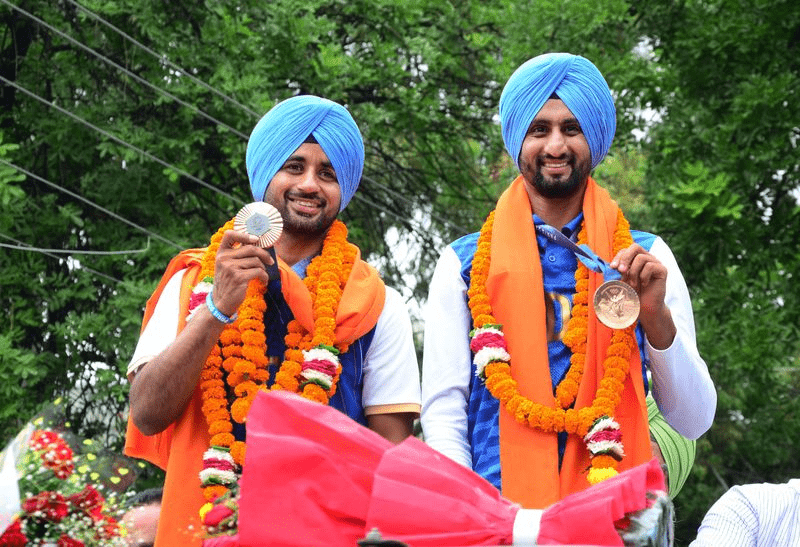
Equally compelling is the journey of Jalandhar-born forward Sukhjeet Singh. His career once appeared under serious threat after he suffered partial paralysis, but a determined recovery brought him back to competitive hockey. He eventually earned a place in the Indian team and represented the country at the Paris Olympics, where India won the bronze medal.
Hardik Singh and Mandeep Singh have similarly emerged from Jalandhar’s rich hockey culture to become familiar names on the international stage.
The presence of another generation of players from the region underlines how Punjab’s relationship with Indian hockey has survived changing eras. Jalandhar, in particular, has managed to retain its position as both a breeding ground for players and an important centre of the sport.
India’s victory over Pakistan has inevitably added another layer of nostalgia. Pakistan were the opponents when India captured the World Cup in 1975, and a win against the same rival in the 2026 tournament has stirred hopes of another memorable campaign.
There is still a considerable distance to travel before comparisons with the 1975 champions can be complete. But as India moves into the next stage of the tournament, the echoes of Kuala Lumpur are difficult to ignore.
For Jalandhar, the story carries an added sense of continuity. From Ajit Pal Singh and his teammates in 1975 to Manpreet, Hardik, Mandeep and Sukhjeet in 2026, the names may have changed, but the city’s imprint on Indian hockey remains firmly in place.