


AI Generated Summary
- Taking aim at Pakistan’s role as a non-permanent member of the Security Council, the Indian envoy said a country that uses UN platforms to advance what he called a divisive and hostile agenda could not be expected to discharge its responsibilities to the global community in good faith.
- In unusually pointed language, the Indian ambassador said Pakistan had developed “a unique way of respecting the will of its people,” listing the imprisonment of a former prime minister, the banning of his political party and the role of the military in reshaping the country’s constitutional framework.
- He cited the April 2025 terror attack in Pahalgam, in which 26 civilians were killed in what India described as a religion-based assault, as a stark reminder of the continuing threat posed by cross-border terrorism.
India delivered a forceful message at the United Nations Security Council on Tuesday, sharply criticising Pakistan’s internal political developments and linking them to what New Delhi described as Islamabad’s long-standing pattern of cross-border terrorism.
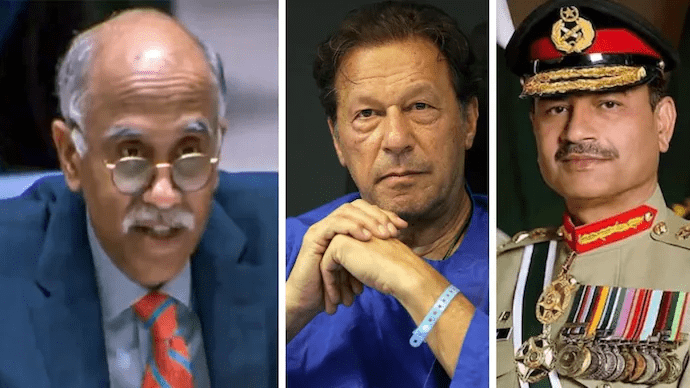
Addressing an open debate on “Leadership for Peace,” India’s Permanent Representative to the UN, Ambassador Harish Parvathaneni, accused Pakistan of undermining democratic norms at home while continuing to pursue a hostile agenda against its neighbours. He said recent developments in Pakistan revealed a troubling picture of political repression and military overreach.
At the centre of India’s remarks was the incarceration of former Pakistani Prime Minister Imran Khan, who has been in custody since August 2023 in connection with a high-profile corruption case involving foreign gifts. The Indian envoy also referred to Khan’s prosecution under Pakistan’s anti-terrorism laws following violent protests on May 9, 2023, after the former leader’s arrest.
Parvathaneni noted that concerns over Khan’s detention had drawn international attention, including comments from a UN Special Rapporteur who raised alarm about alleged inhuman treatment of the former prime minister while in Adiala Jail. These developments, he argued, highlighted a broader erosion of democratic freedoms in Pakistan.
In unusually pointed language, the Indian ambassador said Pakistan had developed “a unique way of respecting the will of its people,” listing the imprisonment of a former prime minister, the banning of his political party and the role of the military in reshaping the country’s constitutional framework. He referred to the 27th constitutional amendment, which altered the balance between civilian and military authority and granted lifetime immunity to the Chief of Defence Forces, as evidence of what he described as a “constitutional coup.”
India also pushed back strongly against Pakistan’s repeated references to Jammu and Kashmir during UN discussions. Parvathaneni dismissed these interventions as “unwarranted” and said they reflected Islamabad’s persistent fixation on India rather than a genuine commitment to international peace and security. He reiterated New Delhi’s position that Jammu and Kashmir, along with Ladakh, are integral parts of India.
Taking aim at Pakistan’s role as a non-permanent member of the Security Council, the Indian envoy said a country that uses UN platforms to advance what he called a divisive and hostile agenda could not be expected to discharge its responsibilities to the global community in good faith.
The speech also revisited India’s long-standing accusations that Pakistan remains a hub for extremist groups operating across borders. Parvathaneni pointed to decades of violence, including wars and terror attacks, which he said had violated the spirit of bilateral agreements between the two countries.
Defending India’s recent decision to place the Indus Waters Treaty in abeyance, the ambassador said New Delhi had entered the agreement more than six decades ago in good faith. That trust, he argued, had been repeatedly undermined by Pakistan’s actions. He cited the April 2025 terror attack in Pahalgam, in which 26 civilians were killed in what India described as a religion-based assault, as a stark reminder of the continuing threat posed by cross-border terrorism.
According to Parvathaneni, India’s decision to suspend its obligations under the treaty would remain in place until Pakistan “credibly and irrevocably” ends its support for terrorism in all forms.
Beyond the sharp exchange over Pakistan, India used the forum to renew its call for sweeping reforms of the UN Security Council. Describing the Council’s structure as outdated, the Indian envoy said an institution designed eight decades ago was no longer equipped to deal with today’s geopolitical realities.
Quoting UN Secretary-General António Guterres, Parvathaneni said global governance could not remain anchored in systems created for a bygone era. He urged member states to move beyond procedural discussions and begin time-bound, text-based negotiations on Security Council reform, particularly to ensure greater representation for regions that remain under-represented or excluded.
India reiterated its commitment to a more inclusive, transparent and accountable UN system, highlighting its contributions to peacekeeping operations and its long-standing demand for reforms that reflect contemporary global power realities.