


AI Generated Summary
- As the city prepares for Lohri, these fading workshops serve as a reminder that heritage does not survive in monuments alone, but in the hands of those who refuse to let tradition slip away, one thread at a time.
- For a few days, the air fills again with the smell of paste and colour, the rhythmic winding of thread and the familiar chatter of customers.
- It is a fleeting revival that brings back memories of a time when every neighbourhood hosted its own adda and kite string was crafted at home.
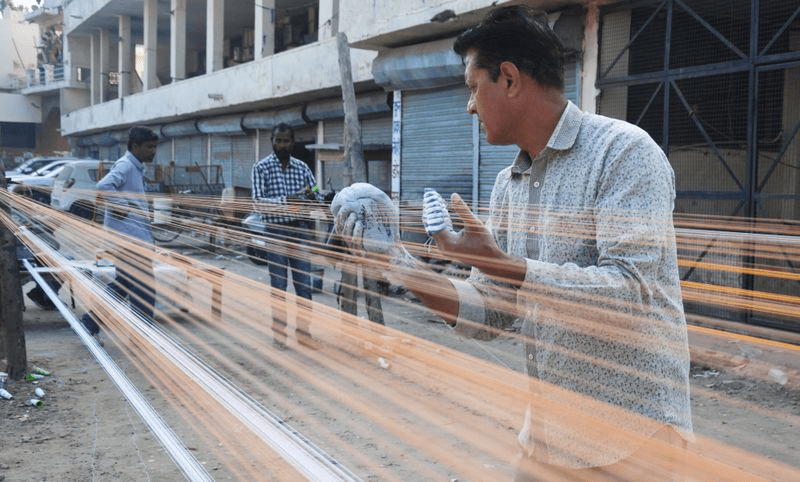
Not long ago, the festive skyline of the city told its own story. As Lohri approached, rooftops filled with flying kites and streets echoed with the hum of spinning wheels, where cotton thread was patiently strengthened, coloured and transformed into charakhri dor. At the heart of this ritual were the dor da adda—humble, wooden-posted workshops that once lined almost every locality.
Today, those addas are disappearing.
Once the lifeblood of the city’s kite-flying culture, these traditional hubs have nearly vanished from the urban landscape. What were once bustling lanes devoted to handmade kite string have been reduced to a handful of quiet corners in places such as Daresi Ground, Dugri and Sunet.
Yet, as Lohri draws near, these surviving addas stir back to life. For a few days, the air fills again with the smell of paste and colour, the rhythmic winding of thread and the familiar chatter of customers. It is a fleeting revival that brings back memories of a time when every neighbourhood hosted its own adda and kite string was crafted at home.
“Making and selling traditional dor is in our blood,” says one dor maker at Daresi, his hands moving instinctively over the thread. “We cannot abandon it as long as we are alive. Earlier, entire lanes turned into addas. Now, this art is limited to a few places.”
Veterans of the trade say the decline has been slow but relentless. Gopal Chand, who sets up an adda near Pakhowal during the festive season, explains that demand peaks briefly around Lohri before fading again. “For a few days, the adda regains its old vibrancy. It feels like the old days,” he says. “But overall, demand has fallen sharply. Chinese string has taken away our business. Strict enforcement is needed to stop its sale.”
Others point to multiple factors behind the erosion of the craft. Synthetic strings, factory-made reels, safety concerns and changing leisure habits have all played their part. “We are continuing this not for profit, but for passion,” says Satti Ram, another traditional dor maker. “This is a legacy. Every spool carries stories of generations who celebrated Lohri with kites soaring high.”
From Jodhan, another artisan recalls a time when kite enthusiasts from different cities would travel here to buy the finest handmade strings. “That pride is gone now,” he says. “The market is flooded with factory-made and Chinese dor. It feels like the end of an era.”
At Daresi, one of the oldest surviving addas, second-generation dor maker Vijay Kumar listens to such stories with quiet regret. He remembers his father speaking of advance bookings for their hand-crafted cotton strings, prepared painstakingly with glass powder and glue. “All of that has been replaced,” he says softly. “Chinese dor has changed everything.”
Yet, not everyone has turned away. Some residents still seek out traditional dor, even at a higher price. “For me, it’s not just about flying kites,” says a customer browsing spools ahead of Lohri. “It’s about keeping alive the memories of our childhood and the heritage of our festive skies.”
The dor da adda was never merely a place of trade. It was a meeting point—binding together skill, celebration and identity. As the city prepares for Lohri, these fading workshops serve as a reminder that heritage does not survive in monuments alone, but in the hands of those who refuse to let tradition slip away, one thread at a time.