


AI Generated Summary
- Organised by the university’s School of Punjabi Studies in collaboration with the Ministry of Culture and Sahitya Akademi, the event brought together scholars, critics, and family members to reflect on the theme “Literature Written by Navtej Singh.
- Highlighting his literary lineage, Prof Harvinder Singh Saini, Dean Academic Affairs, remarked that Navtej Singh inherited a rich legacy from his father, Gurbaksh Singh Preetlari, a pioneer of Punjabi literature and founder of Preetlari.
- Marking the birth centenary of one of Punjabi literature’s most influential voices, a literary symposium at Guru Nanak Dev University paid tribute to Navtej Singh Preetlari, celebrating his enduring contribution to modern storytelling and progressive thought.
Marking the birth centenary of one of Punjabi literature’s most influential voices, a literary symposium at Guru Nanak Dev University paid tribute to Navtej Singh Preetlari, celebrating his enduring contribution to modern storytelling and progressive thought.
Organised by the university’s School of Punjabi Studies in collaboration with the Ministry of Culture and Sahitya Akademi, the event brought together scholars, critics, and family members to reflect on the theme “Literature Written by Navtej Singh: Dissemination and Relevance.”
Born in Sialkot in 1925, Navtej Singh “Preetlari” emerged as a defining figure in post-Partition Punjabi literature. His writings, known for their emotional depth and realism, moved away from romanticised narratives and instead confronted harsh social and economic realities. He passed away in 1981 at the age of 56, leaving behind a legacy that continues to shape literary discourse.
Speakers at the symposium highlighted how Navtej Singh used literature as a medium for awareness and reform. His association with progressive ideology found expression in his editorial work for Preetlari, a literary magazine that gained prominence in post-Partition Punjab for its bold and thought-provoking content.
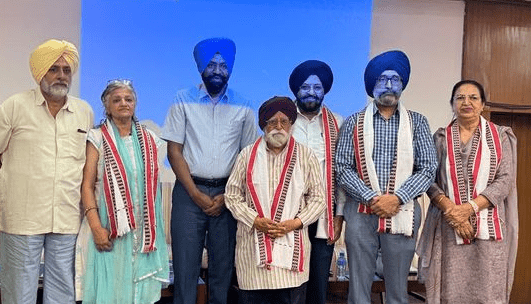
Dr Manjinder Singh, Head of the School of Punjabi Studies, noted that the gathering was an effort to revisit the relevance of Navtej Singh’s writings in contemporary times. Among the attendees were his family members, including Hirdepal Singh and Poonam Preetlari, along with noted literary figures.
Dr Ravel Singh, convener of the Punjabi Advisory Board of Sahitya Akademi, described Navtej Singh as a writer who had the rare ability to translate human suffering into compelling narratives. “His works reflect a progressive outlook and capture the deeper tragedies of society without becoming preachy,” he said.
Highlighting his literary lineage, Prof Harvinder Singh Saini, Dean Academic Affairs, remarked that Navtej Singh inherited a rich legacy from his father, Gurbaksh Singh Preetlari, a pioneer of Punjabi literature and founder of Preetlari. “He not only upheld that legacy but expanded its horizons,” he added.
The symposium also featured a screening of a short film based on Navtej Singh’s celebrated story Bashira, produced by his granddaughter Ratika Singh. The film offered a visual interpretation of the psychological and social upheavals during Partition, a recurring theme in his work.
Family members and critics alike underscored the writer’s focus on the lived experiences of the lower-middle class. Hirdepal Singh observed that Navtej Singh brought Punjabi storytelling closer to reality by addressing economic struggles and human vulnerabilities. “He guided readers through his narratives as if holding their hand,” he said.
Poonam Preetlari echoed similar sentiments, noting that his stories vividly portrayed mental conflicts and financial hardships with striking intensity. Literary critic Khaled Hussien added that Navtej Singh challenged entrenched stereotypes, superstition, and religious fanaticism through his writing.
His Partition narratives, speakers noted, went beyond documenting historical trauma. They also examined the erosion of shared cultural and spiritual traditions, particularly the syncretic Sufi ethos that once defined the region.
As discussions concluded, participants agreed that Navtej Singh “Preetlari” remains a vital voice in Punjabi literature—one whose work continues to resonate for its honesty, social critique, and humanism.
