


AI Generated Summary
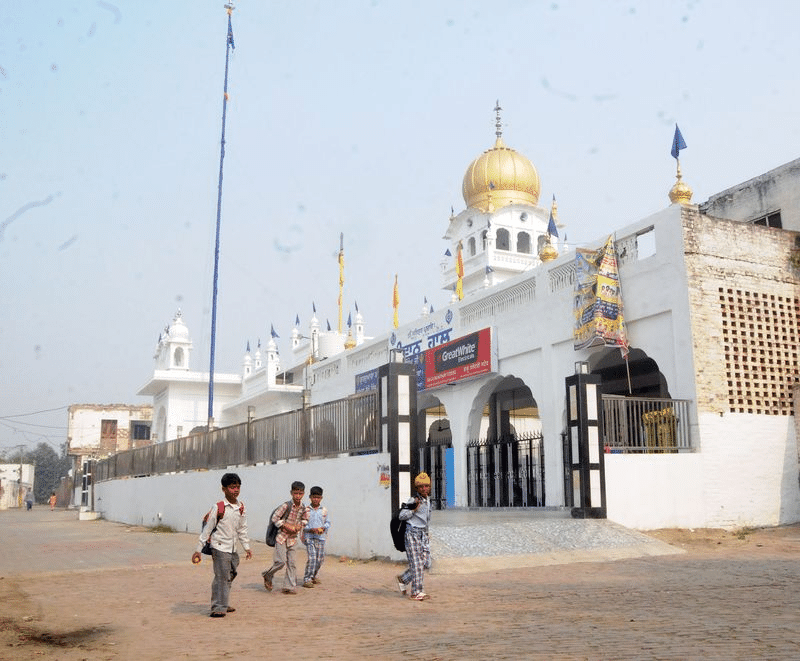
- A gurdwara dedicated to Baba Balaka Singh stands as a centre of reverence, while a commemorative gate at the village entrance welcomes visitors with a reminder of its illustrious past.
- One of the notable achievements of this period was the upgrading of educational facilities in the late 1990s, when a senior secondary school was established in the village, which already had a government middle school.
- Nearly three centuries after his martyrdom, the legacy of Shaheed Baba Balaka Singh continues to hold a special place in the hearts of residents of Sanghna village.
Nearly three centuries after his martyrdom, the legacy of Shaheed Baba Balaka Singh continues to hold a special place in the hearts of residents of Sanghna village. Remembered for his courage in the Sikh resistance against Mughal forces during the early 18th century, the warrior remains an enduring symbol of bravery, sacrifice and the region’s martial heritage.
The village has preserved his memory through several landmarks and traditions. A gurdwara dedicated to Baba Balaka Singh stands as a centre of reverence, while a commemorative gate at the village entrance welcomes visitors with a reminder of its illustrious past. A large portrait of the warrior further reflects the pride villagers take in their historical association with him.
Every year, around mid-October, residents organise a fair in his honour, bringing together devotees and members of the local community to pay tribute to his sacrifice.
The warrior’s association with Sanghna is also celebrated in a traditional Punjabi saying: “Sanghna Sekhon Singh Balaka, Dhav Ghav Madhbir Chalaka.” The verse recalls his Sekhon lineage and praises his remarkable courage and tactical skills on the battlefield. The Sekhon clan continues to form a significant part of the village’s population.
According to local historical accounts, Baba Balaka Singh attained martyrdom during a fierce confrontation between Sikh warriors led by Baba Tara Singh of Wan village and Mughal forces in December 1726.
The conflict reportedly began when Chaudhary Sahib Rai, a Muslim landlord from Naushehra village, launched an attack on Baba Tara Singh’s jatha. After the Sikh warriors successfully resisted the assault, Sahib Rai sought military assistance from Lahore.
He approached Moman Khan, a prominent Mughal military commander associated with campaigns against the growing Sikh resistance in Punjab. Reinforced by a cavalry force said to number more than 2,000, Sahib Rai returned to confront the Sikh fighters.
As the battle unfolded, Baba Balaka Singh is remembered as one of the first warriors to charge towards the opposing forces. He reportedly struck down several adversaries before an arrow pierced his chest, bringing his courageous stand to an end.
The fighting continued after his martyrdom. Traditional accounts describe Baba Tara Singh attacking Taqi Khan, forcing him to retreat, while Moman Khan was also reportedly killed during the confrontation.
News of Baba Balaka Singh’s death deeply affected the people of Sanghna. Villagers subsequently brought his ashes back to his native village and preserved them at a site that later became the location of the gurdwara dedicated to his memory.
Sanghna’s contribution to Sikh history, however, extends beyond the sacrifice of Baba Balaka Singh. Baba Nand Singh, another figure associated with the village, is credited in local tradition with establishing the Sanghania Misl, which later came to be associated with the renowned Ramgarhia Misl.
The village has also produced individuals who made notable contributions to religious service. Kartar Singh and Labh Singh went on to lead the Nandgarh Kar Sewa tradition at Anandpur Sahib. Kartar Singh is particularly remembered for donating four acres of his land for the construction of a hall at the village gurdwara.
Alongside its historical and religious significance, Sanghna has witnessed important developments in education and public infrastructure.
Former village sarpanch Balkar Singh played a prominent role in local administration, serving in the panchayat leadership from 1992 to 2013. During his tenure, efforts were made to improve essential services, including the establishment of a veterinary hospital.
One of the notable achievements of this period was the upgrading of educational facilities in the late 1990s, when a senior secondary school was established in the village, which already had a government middle school.
Balkar Singh’s family’s involvement in local governance also continued when his wife, Manjinder Kaur, was elected to the Sanghna Colony Abadi Panchayat following the reservation of the position for women.
For Sanghna’s residents, these developments represent the village’s journey from a place remembered for its contribution to Sikh military history to a community working towards social progress.
Yet, amid changing times, Baba Balaka Singh remains central to its collective identity. The annual gathering, memorial structures and stories passed down through generations ensure that the sacrifice of the 18th-century warrior is not forgotten.
For the people of Sanghna, his legacy is more than a chapter of history. It is a continuing source of pride, connecting the village’s present with a past marked by courage, faith and sacrifice.