


AI Generated Summary
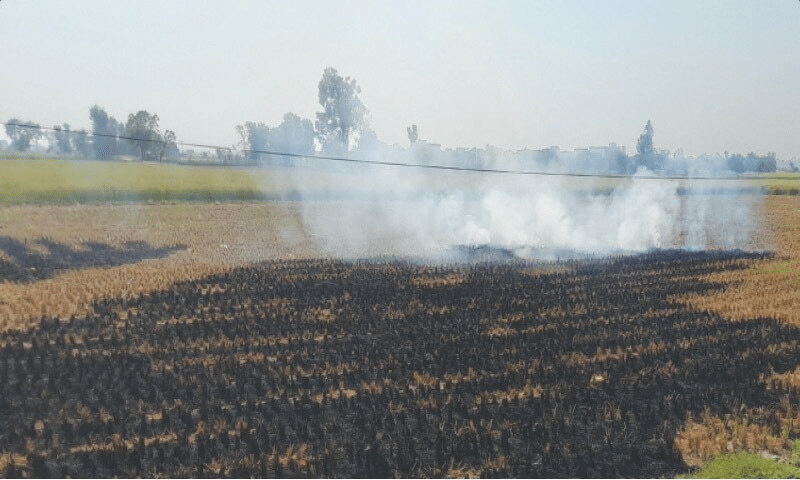
- A sharp rise in agricultural residue burning in Pakistan’s Punjab has emerged as a significant contributor to deteriorating air quality across the India-Pakistan border, highlighting the transboundary nature of South Asia’s recurring winter pollution crisis.
- According to environmental health specialists at PGIMER Chandigarh, the increasing concentration of farm fires in Pakistan’s border districts is contributing to the region’s deteriorating atmospheric conditions.
- Satellite observations over the past week have recorded 3,328 farm fires in Pakistan, compared with 1,031 in Indian Punjab, indicating that burning incidents across the border were more than three times higher.
A sharp rise in agricultural residue burning in Pakistan’s Punjab has emerged as a significant contributor to deteriorating air quality across the India-Pakistan border, highlighting the transboundary nature of South Asia’s recurring winter pollution crisis.
Satellite observations over the past week have recorded 3,328 farm fires in Pakistan, compared with 1,031 in Indian Punjab, indicating that burning incidents across the border were more than three times higher.
The consequences are particularly visible in Lahore, where the Air Quality Index (AQI) has exceeded 200, while Amritsar has recorded readings around 153. Experts warn that smoke from agricultural fires, combined with unfavourable weather conditions, is worsening pollution across several cities in Punjab and Haryana.
According to environmental health specialists at PGIMER Chandigarh, the increasing concentration of farm fires in Pakistan’s border districts is contributing to the region’s deteriorating atmospheric conditions.
November presents particularly challenging meteorological conditions across the Indo-Gangetic Plain. Weak winds, falling temperatures and limited atmospheric circulation prevent pollutants from dispersing effectively, trapping smoke and particulate matter close to the ground.
The situation is further complicated by agricultural pressures. Recent rainfall has delayed paddy harvesting, leaving farmers with limited time to clear their fields before wheat sowing. Consequently, crop-residue burning could intensify during the first fortnight of November.
However, agricultural fires are only one component of the broader pollution problem. Construction dust, vehicular emissions, industrial activities and waste burning also contribute significantly to declining air quality.
The latest findings underscore an important reality: air pollution does not recognise political boundaries. While India and Pakistan pursue separate strategies to control stubble burning, atmospheric pollution remains a shared environmental and public-health challenge.
Addressing the crisis requires stronger satellite monitoring, affordable crop-residue management alternatives and greater regional cooperation to reduce emissions before winter smog reaches dangerous levels.