


AI Generated Summary
- In Payal, a small town in Punjab’s Ludhiana district, women worship the mythological king of Lanka, tie rakhis to his idol and seek his blessings for protection, challenging the conventional narrative of good and evil associated with Dussehra.
- .
In Payal, a small town in Punjab’s Ludhiana district, women worship the mythological king of Lanka, tie rakhis to his idol and seek his blessings for protection, challenging the conventional narrative of good and evil associated with Dussehra.
Every year, as towering effigies of Ravana go up in flames across India, symbolising the triumph of good over evil, a small town in Punjab offers a strikingly different interpretation of the festival. Here, the ten-headed king of Lanka is neither condemned nor consigned to the flames. Instead, he is revered as a guardian, a learned figure and, for many women, a brother who protects them from harm.
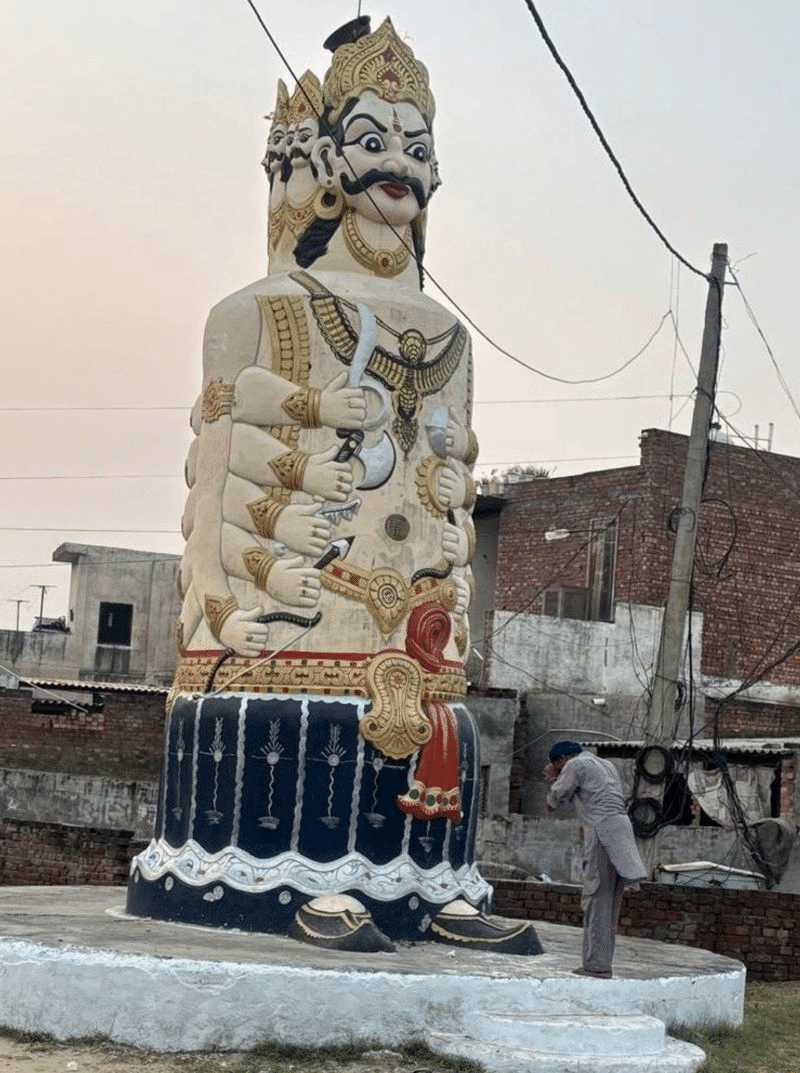
In Payal, located in Ludhiana district, an imposing idol of Ravana has become the centre of an unusual tradition of devotion. While much of the country celebrates Dussehra by burning effigies of Ravana, Meghnad and Kumbhkaran, women and young girls in this town approach the mythological king with prayers, offerings and an enduring sense of faith.
For these devotees, Ravana represents something considerably different from the familiar antagonist of the Ramayana. He is regarded as a protective presence, believed to ward off the evil eye, fulfil wishes and offer reassurance in times of difficulty.
One of the most distinctive aspects of this tradition is the practice of tying rakhis to Ravana’s idol. Ordinarily associated with Raksha Bandhan, when sisters tie a sacred thread around their brothers’ wrists as a symbol of affection and protection, the ritual takes on an unusual significance here. Women symbolically accept Ravana as a brother, placing their trust in his ability to safeguard them.
Rekha, a local devotee who has worshipped the idol for more than 18 years, describes her relationship with Ravana in deeply personal terms. To her, he is a brotherly figure who offers protection and listens to her prayers. She says many women in the locality share this belief, with some expressing discomfort over the widespread practice of burning Ravana’s effigies during Dussehra.
Their devotion is not necessarily rooted in a rejection of the Ramayana. Rather, it reflects an alternative understanding of a complex mythological character whose identity extends beyond his role as Rama’s adversary.
In Hindu traditions, Ravana is also described as a formidable scholar, an accomplished devotee of Lord Shiva and a ruler possessing considerable knowledge. His intellectual abilities and religious devotion coexist in the epic narrative with his arrogance, abuse of power and abduction of Sita.
It is this complexity that appears to resonate with devotees in Payal. They acknowledge Ravana’s reputation as a learned figure and question whether his symbolic destruction should overshadow the moral failures of individuals living in contemporary society.
For Rekha, the contradiction is particularly apparent in the treatment of women. She questions the relevance of ceremonially destroying a mythological villain while real perpetrators of violence and sexual abuse continue to threaten women’s safety.
Her argument draws attention to a larger social concern: whether the annual celebration of righteousness is adequately reflected in society’s everyday conduct.
The origins of Payal’s unusual practice are traced by local devotees to a dream experienced by a resident several decades ago. According to an account passed down in the community, the individual felt compelled to construct a statue of Ravana after seeing it in a dream.
The decision was reportedly met with strong disapproval. Worshipping a figure conventionally associated with evil was considered unacceptable by many, and the family responsible for establishing the idol faced criticism.
Over time, however, what began as a controversial act gradually developed into a local religious tradition. The idol attracted devotees, particularly women, who began associating it with protection, answered prayers and personal well-being.
Today, the practice stands as an example of the remarkable diversity within India’s religious and cultural landscape.
Although Dussehra is predominantly associated with Rama’s victory over Ravana, interpretations of the king of Lanka have never been entirely uniform. Across different regions and communities, Ravana’s identity has been shaped by local histories, oral traditions and distinct religious perspectives.
In some traditions, his scholarship and devotion receive greater emphasis, while others interpret his character through the broader themes of power, pride, knowledge and moral responsibility.
Payal’s practice belongs to this wider landscape of regional belief, where inherited narratives are sometimes reinterpreted through the experiences and concerns of local communities.
What makes the tradition particularly noteworthy is the prominent role of women in sustaining it. Their relationship with Ravana is not merely ceremonial. It is expressed through the familiar cultural language of kinship, transforming a figure traditionally associated with fear into one associated with security.
The practice also reveals how religious symbols can acquire meanings that differ substantially from their conventional interpretations. A character condemned in one setting may become an object of reverence in another, without necessarily displacing the larger religious narrative.
For the women of Payal, the significance of Ravana’s idol lies less in theological debate than in the personal faith they have developed around it. The belief that their troubles may diminish through prayer continues to draw devotees to the site.
There is also a broader cultural paradox in the town’s observance. On Dussehra, when communities elsewhere gather to watch Ravana’s symbolic defeat, women in Payal continue to seek his blessings. The same mythological figure becomes, simultaneously, a representation of evil to be destroyed and a guardian to be honoured.
The contrast raises questions about the relationship between mythology, morality and social practice. Can a character associated with wrongdoing also be remembered for knowledge and devotion? Can religious traditions accommodate different interpretations of the same figure? And does the symbolic destruction of evil carry meaning unless accompanied by a commitment to confronting injustice in everyday life?
Payal’s devotees may not frame their worship in these philosophical terms, but their tradition brings such questions into focus.
As flames engulf Ravana’s effigies in towns and cities across India, the idol in Payal remains standing, surrounded by the faith of women who see in the king of Lanka not an enemy, but a protector.
In a country where mythology is continually retold through regional customs and collective memory, this small Punjab town offers a reminder that the meanings attached to religious figures are rarely as uniform as the rituals surrounding them.
For much of India, Dussehra marks the destruction of Ravana. In Payal, it is his enduring presence that gives devotees a sense of protection.