


AI Generated Summary
- He has also received the Best Artist Award in sculpture from the Kalaratnam Foundation of Art Society, Bareilly, and the Best Entry Award at an international exhibition on Covid-19 organised by the Indian Royal Academy of Art and Culture, Karnataka.
- Surrounded by an institution where art and nature have historically shared an intimate relationship, Mastana found an environment remarkably suited to the sensibility he had developed as a child.
- Mastana went on to study at the Government College of Art in Chandigarh before securing a scholarship to pursue his master’s degree at Visva-Bharati, Santiniketan.
Long before galleries, awards and art institutions became part of his world, Mohinder Mastana’s first subjects were the birds that fluttered around his childhood home in Una. He watched them closely — their wings, postures and movements — and then tried to recreate what he saw with clay dug out from the fields around his home.
Decades later, that childhood fascination continues to inhabit his work.
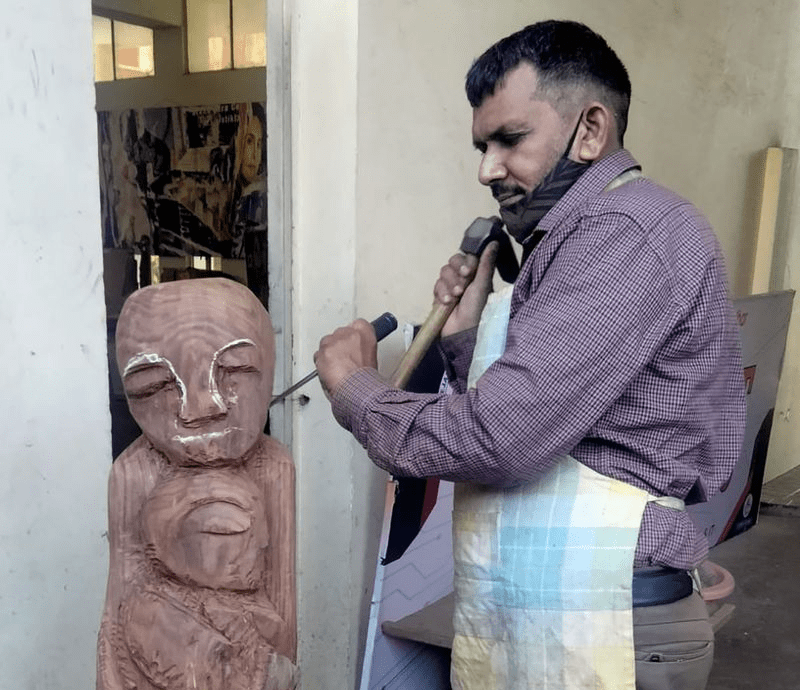
Now 54, Mastana is an accomplished sculptor and Head of the Department of Sculpture at Apeejay College of Fine Arts, Jalandhar. Over a career spanning more than two-and-a-half decades, his works have travelled to galleries and exhibitions across the country, earning him numerous awards and recognition.
Yet, despite the geographical distance between his beginnings and the art spaces he inhabits today, nature has remained a recurring presence in his artistic vocabulary.
Birds appear repeatedly in Mastana’s sculptures, but rarely as isolated subjects. They inhabit distinctly human worlds — balancing on ladders, resting upon irregular vessels or appearing alongside figures absorbed in contemplation. Elsewhere, his sculptures capture intimate human experiences: a mother holding her child close, solitary figures immersed in thought, or seemingly ordinary moments transformed into studies of emotion and reflection.
For Mastana, sculpture became a language through which he could interpret both the natural world and human experience.
An early push towards art
His path towards becoming a professional artist was shaped partly by his elder brother, who worked at the Government Museum and Art Gallery in Chandigarh.
Mastana recalls being exposed to sculptures and representations of birds during visits there. His brother would also notice students from the nearby Government College of Art visiting the museum to study and copy works. Recognising Mastana’s interest, he encouraged him to consider art not merely as a childhood pastime but as a profession.
That suggestion proved decisive.
Mastana went on to study at the Government College of Art in Chandigarh before securing a scholarship to pursue his master’s degree at Visva-Bharati, Santiniketan.
The two years he spent at Santiniketan would become formative in shaping his approach to sculpture.
Surrounded by an institution where art and nature have historically shared an intimate relationship, Mastana found an environment remarkably suited to the sensibility he had developed as a child. Among the great artists associated with Santiniketan, sculptor Ramkinkar Baij emerged as a particularly powerful influence.
“Creating in the lap of nature holds unparalleled charm,” Mastana says, recalling the impact Santiniketan had on him. Baij’s sculptures, in particular, stayed with the young artist and helped broaden his understanding of what the medium could accomplish.
Professional recognition followed relatively quickly. Soon after completing his master’s, Mastana exhibited his works at a gallery in Kolkata, where his sculptures found their first buyers.
He subsequently moved to Jalandhar after securing a teaching position.
Artist and teacher
For the past 26 years, Mastana has taught at Apeejay College of Fine Arts and now heads its Sculpture Department. Alongside teaching successive generations of students, he has continued his own practice, experimenting with clay, wood, metal and mixed media.
His works have been exhibited in Delhi, Kolkata, Gujarat, Mumbai and several other parts of the country. Among the significant milestones of his exhibition career are two appearances at Mumbai’s prestigious Jehangir Art Gallery, including an exhibition with his departmental colleague Basudeb Biswas.
Recognition has also arrived from institutions and organisations across Punjab, Maharashtra, Karnataka, Uttarakhand and Uttar Pradesh.
His honours include the Picasso Award by BM Fine Art and Culture, Kolkata; a Gold Award from AKM Kala Sangh, Punjab; an award in the professional category at Chandigarh University’s Kala Kumb International Art Exhibition in 2021; and the Bangiya Kala Rattan Award at the international virtual exhibition ‘Expressions-2021’.
He has also received the Best Artist Award in sculpture from the Kalaratnam Foundation of Art Society, Bareilly, and the Best Entry Award at an international exhibition on Covid-19 organised by the Indian Royal Academy of Art and Culture, Karnataka.
Other recognitions have come from the Indian Academy of Fine Arts, Amritsar; Virsa Vihar Society, Amritsar; Himprasth Society, Dehradun; and the Punjab State Annual Art Exhibition. In 2024, he received the KT Punjab State Cash Award from Kausa Trust, Amritsar. The Indian Academy of Fine Arts honoured him again in April 2026.
When technology meets tradition
After spending decades both making sculpture and teaching it, Mastana is also witnessing a transformation in the way younger artists encounter their craft.
The generation to which he belongs looked towards masters such as Auguste Rodin and Ramkinkar Baij for inspiration. Today’s students, he observes, grow up surrounded by online networks, digital imagery and, increasingly, artificial intelligence.
That shift, he believes, has brought new possibilities but also concerns.
“Our generation sought inspiration from Rodin and Baij. This one is caught in the web of online networks,” he says.
His larger worry is about depth — the sustained observation, engagement and patience traditionally demanded by art. Enrolment in art courses has declined, he says, and even established institutions sometimes struggle to attract enough students. He also feels that the insight visible in student work is not always what it once was.
Yet Mastana is far from declaring the future of sculpture bleak. Good work continues to emerge, he says, and he remains hopeful that more young people will discover the possibilities of an art form that demands an unusually intimate relationship between the artist, material and idea.
Sculpting — even without clay
For the moment, Mastana himself has been forced into an unexpected pause.
An accident followed by a fracture and surgery has temporarily prevented him from physically working on sculptures. But being away from the studio has not stopped the creative process.
Instead, a pen and diary have become his temporary tools.
“Inspiration can strike anywhere and it often strikes more in leisure,” he says. Unable to sculpt, he has been recording ideas as they arrive, filling his diary with thoughts and possibilities that can eventually take physical form once he returns to work.
Art has also found its way into the next generation of the family. Mastana has three daughters, one of whom is a painter.
Perhaps there is something fitting about the fact that, after decades of working with clay, metal and wood, Mastana still traces his artistic instinct back to something remarkably simple: a child watching birds outside his home and wondering if he could recreate them with his own hands.
The clay came from the fields of Una. The birds supplied the inspiration.
Everything else followed.