

AI Generated Summary
- Khalistan flags beside Pakistani crescents and Chinese red, all pointed at Indian territory that neither the people of Arunachal nor the overwhelming majority of Sikhs in Punjab have ever asked to be “liberated” into someone else’s map.
- The Vancouver announcement, like earlier letters to Xi and past coordination with Pakistani networks, reveals a movement whose principal product is not liberation but the visible proof of its own funding sources.
- The Gurus built a tradition of sant-sipahi—saint-soldier—whose martial edge existed to protect dharma and the oppressed, not to auction off border regions to whichever power currently offers funding or rhetorical cover.
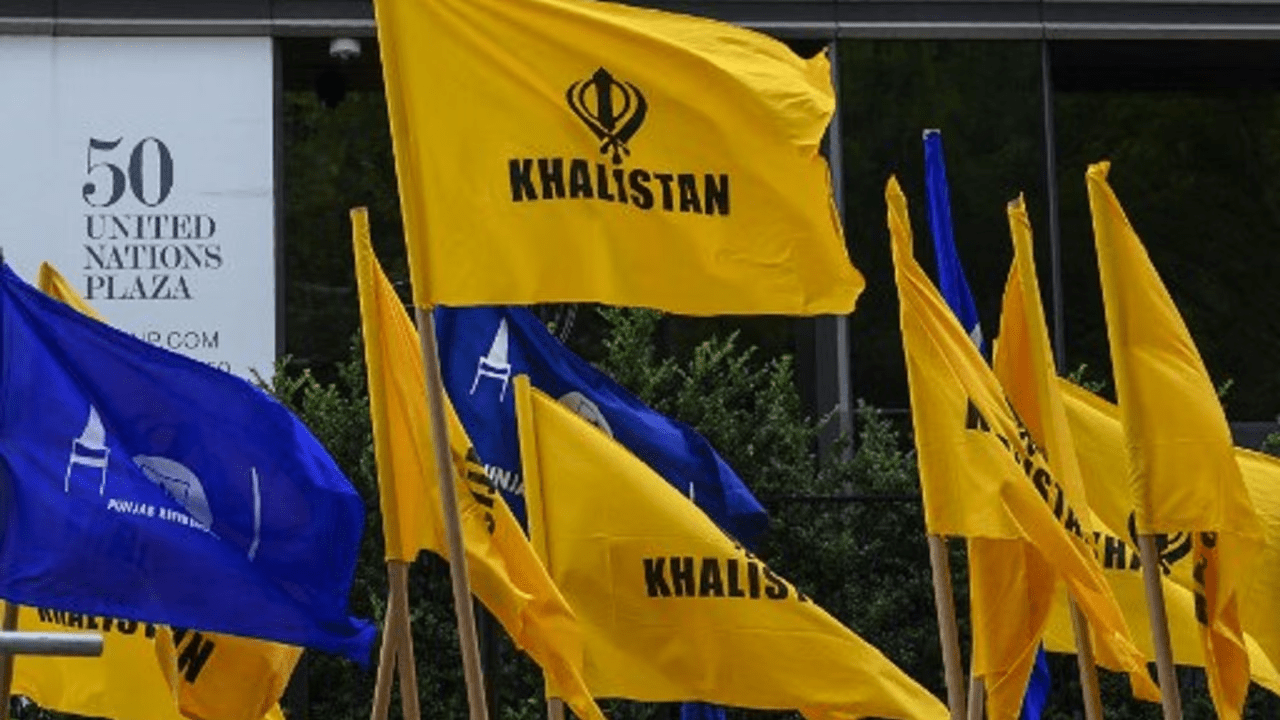
On 27 October 2026, Gurpatwant Singh Pannun of Sikhs for Justice publicly announced a “China — ANNEX Arunachal Pradesh” and Khalistan Freedom Rally outside the Chinese Consulate in Vancouver. He urged Sikh soldiers to “stop defending Namka Chu” and called on China to annex the Indian state as support for Punjab’s “liberation.” Social media accounts aligned with the group later claimed the gathering took place, with slogans such as “Chini–Sikh Bhai Bhai,” “China — ANNEX Arunachal Pradesh!,” and “Arunachal Pradesh is CHINA!,” alongside flags of China, Pakistan, and Khalistan. Independent Canadian media outlets did not widely cover any large-scale event at the Chinese consulate that day.
What is fully documented is the pattern. These same circles have long brandished ties to Pakistan’s Inter-Services Intelligence, with reports of funding networks, narco-routes, and efforts to revive a movement that has scant traction inside Punjab itself. When relations with India soured or opportunities arose—after Galwan, over maps that claimed Arunachal as “Zangnan,” or in earlier letters to Xi Jinping—they pivoted to Beijing, urging military action and equating Punjab with “occupied” territory. One week the script is anti-India via Pakistani channels; the next it is “Chini-Sikh brotherhood” in service of Chinese territorial claims. The only consistent element is the open display of whoever is currently writing the cheques.
This is not new. SFJ and related outfits have written to Chinese leaders seeking endorsement of their referendum while simultaneously relying on Pakistani support networks documented by intelligence assessments. The Vancouver announcement simply made the transactional nature impossible to miss: Khalistan flags beside Pakistani crescents and Chinese red, all pointed at Indian territory that neither the people of Arunachal nor the overwhelming majority of Sikhs in Punjab have ever asked to be “liberated” into someone else’s map.
Contrast this with the teachings that actually define the Sikh tradition. Guru Nanak’s first proclamation after his experience of the Divine was Ik Onkar—One Creator. He declared “Na koi Hindu na Mussalman,” not to erase identities but to insist that labels matter less than the light within. The Guru Granth Sahib repeatedly affirms the equality of all: “Recognize the light in all, and do not ask about caste.” Guru Gobind Singh put it plainly in Akal Ustat: “Maanas ki jaat sabhe eke pahchanbo”—recognize all of mankind as one. The Khalsa was forged not to serve foreign empires but to defend the weak and stand against tyranny, as when Guru Tegh Bahadur gave his life for the religious freedom of Kashmiri Pandits.
The Gurus built a tradition of sant-sipahi—saint-soldier—whose martial edge existed to protect dharma and the oppressed, not to auction off border regions to whichever power currently offers funding or rhetorical cover. They rejected the idea that any land or people could be bargained away for the convenience of an external patron. To publicly call for the annexation of Arunachal while associating with Pakistani networks is not an extension of that tradition; it is its inversion. It substitutes the Gurus’ vision of universal brotherhood with the narrowest of geopolitical mercenary calculations.
The absurdity is compounded by the absence of any serious constituency. Inside Punjab the demand for Khalistan remains marginal; outside it thrives mainly where diaspora fundraising, foreign intelligence interest, and social-media amplification can be combined. The Vancouver announcement, like earlier letters to Xi and past coordination with Pakistani networks, reveals a movement whose principal product is not liberation but the visible proof of its own funding sources. For a community whose scripture begins with oneness and whose history records repeated stands against invaders who sought to divide and dominate, this particular farce is not merely strategically empty. It is a betrayal of the very brotherhood the Gurus taught.