


AI Generated Summary
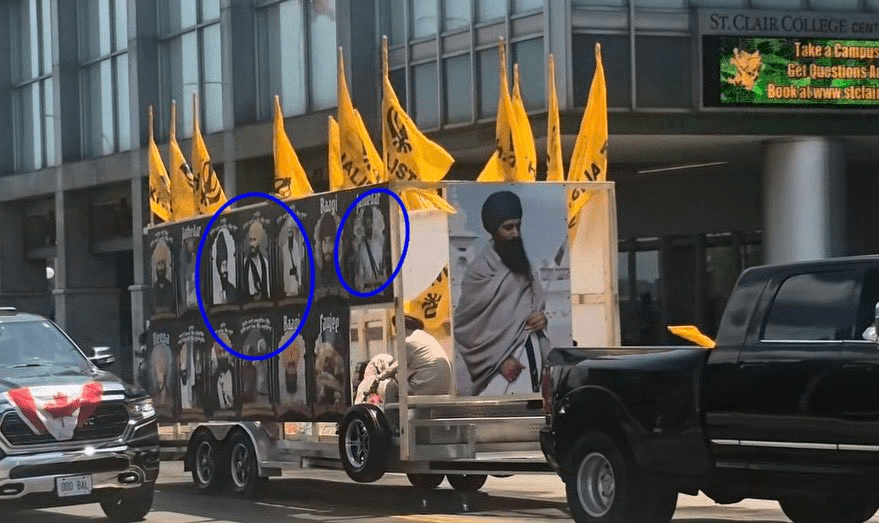
- A public parade in Windsor, Ontario, has sparked national debate after a float displaying portraits of prominent Khalistani militant figures appeared during the event, renewing questions about the limits of free expression in Canada and the country’s response to extremist symbolism.
- The appearance of the portraits during a public procession has triggered criticism from community groups, security observers, and political commentators, many of whom argue that glorifying individuals linked to terrorism undermines the memory of victims and raises concerns about extremist activity in Canada.
- Among the figures displayed was Talwinder Singh Parmar, widely identified as the mastermind behind the 1985 bombing of Air India Flight 182, one of the deadliest acts of terrorism in Canadian history.
A public parade in Windsor, Ontario, has sparked national debate after a float displaying portraits of prominent Khalistani militant figures appeared during the event, renewing questions about the limits of free expression in Canada and the country’s response to extremist symbolism.
The float reportedly featured images of Talwinder Singh Parmar, Sukhdev Singh Babbar, and Gurbachan Singh Manochahal — all associated with Babbar Khalsa International (BKI), an organization listed as a terrorist entity under Canadian law.
Among the figures displayed was Talwinder Singh Parmar, widely identified as the mastermind behind the 1985 bombing of Air India Flight 182, one of the deadliest acts of terrorism in Canadian history. The attack killed 329 people, the majority of them Canadian citizens, and remains a defining tragedy in the country’s security history.
The appearance of the portraits during a public procession has triggered criticism from community groups, security observers, and political commentators, many of whom argue that glorifying individuals linked to terrorism undermines the memory of victims and raises concerns about extremist activity in Canada.
The controversy comes at a sensitive moment, coinciding with the 40th anniversary of the Air India bombing and amid renewed warnings from the Canadian Security Intelligence Service (CSIS). In its 2025 assessment, CSIS highlighted ongoing concerns surrounding Khalistani extremist networks and activities operating within Canada.
Critics are now questioning whether public displays honoring figures connected to banned organizations should be protected under freedom of expression laws or treated as a form of extremist glorification. While Canada’s Charter of Rights and Freedoms guarantees broad protections for speech and assembly, legal experts note that those freedoms are not unlimited, particularly when issues involving hate speech, incitement, or support for terrorism arise.
Others defend the displays as political expression, arguing that controversial or provocative symbolism alone does not necessarily violate Canadian law unless it can be shown to promote violence or terrorist activity directly.
The incident has once again placed Canada’s handling of extremism under scrutiny, especially in light of long-standing concerns raised by both domestic agencies and international partners regarding separatist extremist movements operating from Canadian soil.
As debate intensifies, many Canadians — particularly families affected by the Air India tragedy — are asking whether honoring individuals associated with terrorism in public spaces crosses a line between free speech and the normalization of violent extremism.
