

AI Generated Summary
- The result, documented by journalists covering Vancouver’s drug wars, is a diaspora gangland where rivalries between criminal factions — the Bambiha gang, the Bishnoi gang, and Khalistan-affiliated networks — play out in shootings, ransoms, and targeted assassinations that span continents.
- ” A structurally identical phenomenon has taken root in South Asia and its diaspora communities worldwide — except here, the camouflage is Sikhism, and the criminal networks operate under the banner of Khalistan.
- By 2018, an estimated 30,000 Sikhs were involved in the US trucking industry, dominating California’s long-haul sector according to the Los Angeles Times — an industry now routinely implicated in fentanyl, cocaine, and methamphetamine seizures.
When drug cartels in Latin America began draping themselves in evangelical Christianity to launder their moral reputations alongside their money, criminologists coined the term “narco-evangelism.” A structurally identical phenomenon has taken root in South Asia and its diaspora communities worldwide — except here, the camouflage is Sikhism, and the criminal networks operate under the banner of Khalistan.
This is not a statement about the Sikh faith, which carries a centuries-old tradition of pluralism and dignity. It is a statement about organized crime. The Khalistani criminal networks are, at their operational core, crime syndicates — engaged in drug and weapons smuggling, extortion, kidnapping, ransom, contract killings, money laundering, and human trafficking. Their religious and secessionist framing is a sophisticated cover, not a cause.
The roots of this nexus trace back to the Cold War’s most consequential covert operation. When the Soviet Army entered Afghanistan in 1979, the CIA — in coordination with Britain’s MI6 and Pakistan’s Inter-Services Intelligence (ISI) — launched Operation Cyclone, funneling weapons and funds to Afghan Mujahideen fighters. The ISI, serving as the operational distributor, quietly encouraged these groups to supplement Western funding through drug smuggling. By 1989, Afghanistan had become the world’s largest supplier of illicit heroin, and Pakistan its second largest. The Golden Crescent — encompassing Afghanistan, Iran, and Pakistan — had become the world’s most consequential narcotics corridor.
Punjab, sharing a porous border with Pakistan, sat directly in the shadow of this corridor. Drug and weapons flows that funded the Afghan jihad spilled naturally into Indian territory, where armed networks in the name of Khalistan found both a ready supply chain and operational cover. For smugglers connected to these networks, the ISI’s patronage minimized security risks. Kalashnikovs arrived alongside heroin. The costs of weapons were covered by narcotics profits. A criminal economy, cloaked in the language of Sikh sovereignty, was born.
What followed was not a political movement corrupted by crime — it was a criminal enterprise that appropriated political symbolism. As factionalism splintered these networks after their initial leadership was eliminated in the mid-1980s, dozens of armed organizations emerged: the Babar Khalsa International, Khalistan Commando Force, Khalistan Zindabad Force, International Sikh Youth Federation, and many more. Each competed for territory, drug routes, and extortion franchises. Punjab — the land of the Green Revolution — became, as the phrase goes, Udta Punjab: a gangland of over 100 criminal gangs, according to police estimates from 2017.
The global expansion of these networks followed a predictable arc. When security operations dismantled their territorial control in Punjab in 1993, the networks relocated their center of gravity to the Sikh diaspora, particularly Canada. The reasons were structural: weak money-laundering oversight, a political financing system vulnerable to organized bloc voting, and a multicultural policy environment that made scrutiny of religious community organizations politically costly. Criminal networks penetrated Sikh temples, which became nodes for money laundering, human smuggling, and political lobbying. Temple donation receipts provided tax cover for illicit funds. Community institutions became shields.
Canada’s international student program, ironically, served as an additional pipeline. Punjab-based criminal gangs, flush with narcotics profits, financed student visas — including fraudulently obtained English language test scores — to embed operatives and expand their North American footprint. The result, documented by journalists covering Vancouver’s drug wars, is a diaspora gangland where rivalries between criminal factions — the Bambiha gang, the Bishnoi gang, and Khalistan-affiliated networks — play out in shootings, ransoms, and targeted assassinations that span continents.
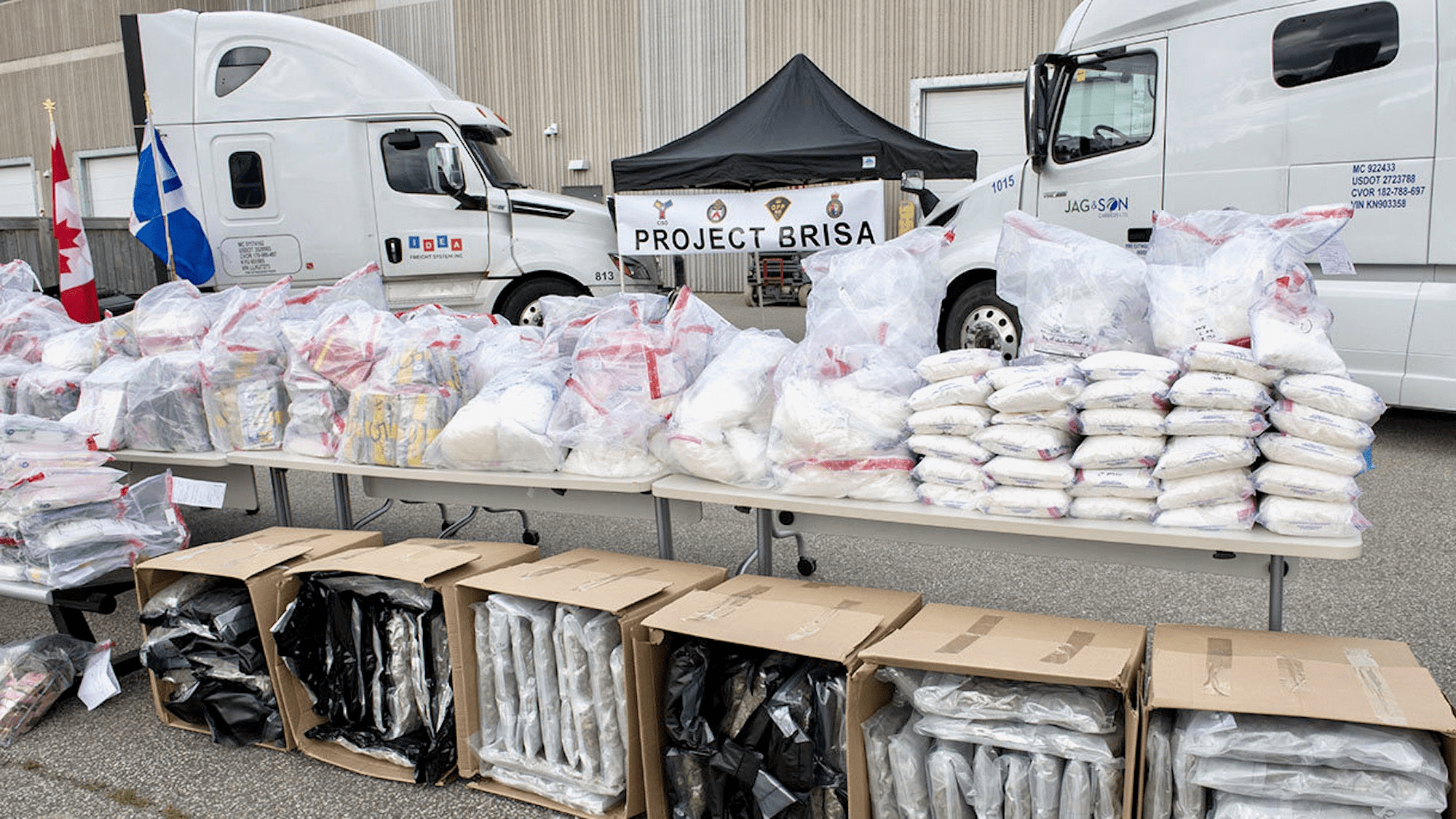
The trucking industry provides perhaps the starkest illustration of operational scale. Ground transportation — long-haul trucks — has become the dominant mode of drug delivery in North America, accounting for over 60% of narcotics entering the United States. A Toronto Star investigation in 2012 documented a broker system within Sikh trucking networks in Ontario, where community ties were leveraged to ensure drivers would not disappear with drug shipments worth millions. By 2018, an estimated 30,000 Sikhs were involved in the US trucking industry, dominating California’s long-haul sector according to the Los Angeles Times — an industry now routinely implicated in fentanyl, cocaine, and methamphetamine seizures.
Pakistan’s role throughout has been consistent: official diplomatic cheerleading for Khalistani referendums in Western capitals, ISI facilitation of cross-border terror logistics, and sanctuary for designated terrorists. Pakistani consular officials have attended Khalistani referendum events in Canada. The Canada-Pakistan-Khalistan triangle is not a conspiracy theory — it is a documented operational relationship.
The scholarship and media ecosystem surrounding Khalistan has largely failed to see through the camouflage. By accepting the framing of minority rights, self-determination, and religious persecution, analysts have inadvertently served as public relations infrastructure for narco-terrorist networks. Justice John Major, who led Canada’s Air India inquiry, was direct: intelligence existed, warnings were issued, and institutional failure allowed the bombing of Flight 182 — killing 329 people — to proceed.
The lesson from Latin America’s decades-long reckoning with narco-terrorism is clear: crime syndicates that wrap themselves in faith and ethnicity are no less criminal for the wrapping. They are, in fact, more dangerous — because the camouflage grants them political protection that their violence alone never could.
Snakes in the backyard, as Secretary of State Hillary Clinton warned Pakistan, eventually bite whoever shelters them.