


AI Generated Summary
- Investment protection raises genuine legal complexity, particularly around the treatment of portfolio capital — a question better addressed through a parallel bilateral investment agreement than by allowing it to hold up the wider deal.
- A trusted business travel arrangement, covering pre-cleared professionals and frequent commercial travellers, would reduce transaction costs and signal that the agreement is designed to function in practice rather than exist on paper.
- Services trade — and by extension the entire knowledge economy that both sides seek to cultivate — depends on the ability of professionals, investors, and researchers to move between the two countries without bureaucratic friction.
Few bilateral economic relationships carry as much unrealised potential as the one between India and Canada. The underlying logic has always been compelling: India’s vast market, sustained growth, and deep services base on one side; Canada’s patient capital, technological sophistication, and world-class institutional investors on the other. What has been missing is not the commercial case. It is the political will to conclude the deal.
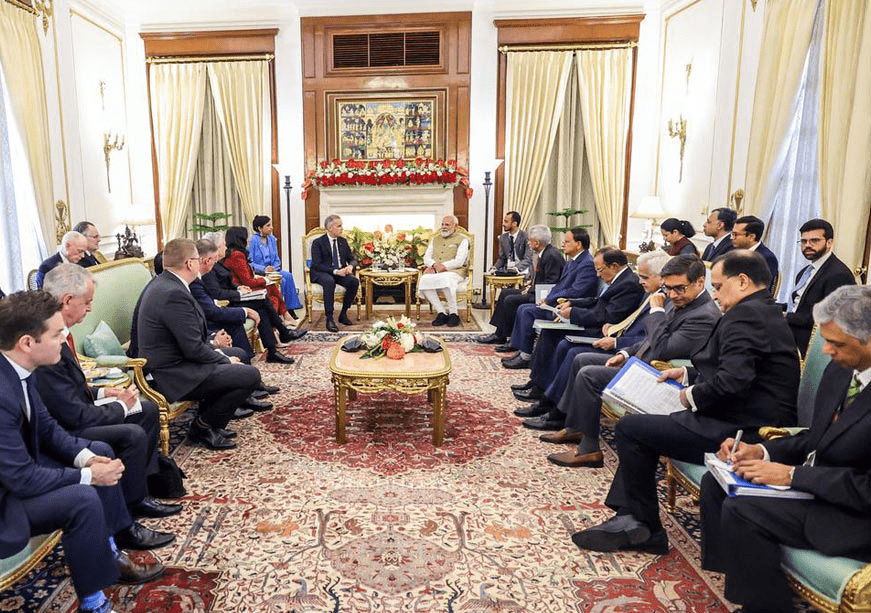
That moment may finally be arriving. Efforts to finalise a Comprehensive Economic Partnership Agreement (CEPA) by year-end deserve to be taken seriously — not as another round of optimistic rhetoric, but as a genuine inflection point. If both governments approach the negotiation with pragmatism rather than perfectionism, the benefits are within reach.
The most immediate prize is trade expansion. The stated target of reaching US$50 billion in bilateral trade by 2030 is ambitious but achievable. What makes it credible is the breadth of sectors where complementarity already exists: energy, technology, education, agriculture, and financial services. These are not adjacencies requiring elaborate manufacturing of common ground. They are live channels of commerce that a formal framework would deepen and accelerate.
“The two countries need not a perfect agreement in which every difficult issue is resolved simultaneously — they need one that is commercially useful, politically defensible, and institutionally sustainable.”
Beyond trade volumes, the agreement’s most transformative potential lies in what it would do for investment. Canada’s pension funds — among the largest and most sophisticated long-horizon investors in the world — have a demonstrated appetite for Indian infrastructure, listed assets, and financial vehicles. These are not speculative actors chasing short-term returns. They are patient institutions that require exactly what a well-drafted CEPA can provide: predictability, transparency, and credible institutional process. A deal that delivers these conditions would unlock flows of capital that dwarf anything achievable through diplomatic goodwill alone.
Mobility matters too. Services trade — and by extension the entire knowledge economy that both sides seek to cultivate — depends on the ability of professionals, investors, and researchers to move between the two countries without bureaucratic friction. A trusted business travel arrangement, covering pre-cleared professionals and frequent commercial travellers, would reduce transaction costs and signal that the agreement is designed to function in practice rather than exist on paper.
None of this requires waiting for every difficult question to be resolved. Agriculture remains sensitive. Some tariff lines will need long transition periods. Investment protection raises genuine legal complexity, particularly around the treatment of portfolio capital — a question better addressed through a parallel bilateral investment agreement than by allowing it to hold up the wider deal. These are not reasons for paralysis. They are reasons for intelligent sequencing: close what is ready, stage what is sensitive, and create review mechanisms for what remains contested.
The error of past negotiations was treating completeness as a precondition for closure. Trade agreements are not concluded when everything is resolved — they are concluded when enough is agreed to move. India and Canada have that threshold well within reach. The choice now is straightforward: a workable agreement concluded this year, or another lost year in a relationship that has already squandered too many. The case for acting is overwhelming. The cost of delay has already been paid once. It should not be paid again.
