


AI Generated Summary
- Today, he balances academic work as the Paul and Patricia Saunders Professor of National Security Law at Georgetown University Law Center with his role as a partner in the Washington, DC office of Milbank LLP, where he focuses on complex litigation and arbitration.
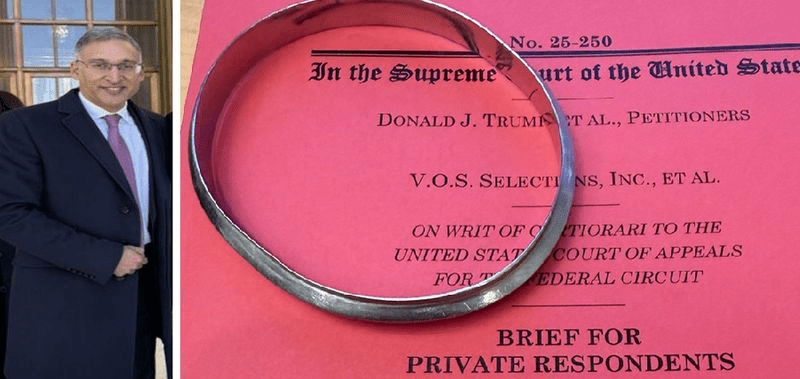
- During the heated tariff hearings in November 2025, Katyal shared a glimpse of his personal world with the public by posting an image of a kada resting atop a legal brief tied to the case.
- In the tense corridors of the US Supreme Court, where legal arguments often shape global economic realities, an unexpected symbol quietly accompanied one of the most consequential challenges to former President Donald Trump’s tariff policy — a traditional Punjabi kada.
In the tense corridors of the US Supreme Court, where legal arguments often shape global economic realities, an unexpected symbol quietly accompanied one of the most consequential challenges to former President Donald Trump’s tariff policy — a traditional Punjabi kada. For Indian-American lawyer Neal Katyal, the steel bracelet was more than an accessory; it was a reminder of heritage, resilience, and constitutional faith.
Katyal emerged as a central figure in the legal fight against Trump’s sweeping tariffs, arguing that the measures — imposed under the 1977 International Emergency Economic Powers Act (IEEPA) — stretched presidential authority beyond constitutional limits. His arguments ultimately contributed to a landmark ruling that questioned the legality of the tariffs and reaffirmed the judiciary’s role as a check on executive power.
“Presidents are powerful, but our Constitution is more powerful still,” Katyal remarked after the court proceedings, framing the case not merely as a trade dispute but as a test of constitutional balance.
Born in Chicago to Indian immigrant parents — a paediatrician mother and an engineer father — Katyal often describes himself as the “son of immigrants.” His academic journey took him from Dartmouth College to Yale Law School, setting the stage for a career that would span academia, government service, and high-stakes litigation.
During the heated tariff hearings in November 2025, Katyal shared a glimpse of his personal world with the public by posting an image of a kada resting atop a legal brief tied to the case. In a message reflecting on his family’s journey to the United States, he wrote about thinking of his father and hoping for a constitutional victory. The gesture resonated widely, symbolising how cultural roots can quietly inform professional conviction.
The kada, one of the five articles of Sikh faith, represents strength, unity, and moral responsibility — values Katyal’s supporters say were evident in his courtroom strategy. For many observers, the image captured the intersection of identity and public service in modern America.
Katyal’s legal pedigree extends beyond this case. He served as Acting Solicitor General of the United States during the Barack Obama administration and has argued numerous cases before the Supreme Court. Today, he balances academic work as the Paul and Patricia Saunders Professor of National Security Law at Georgetown University Law Center with his role as a partner in the Washington, DC office of Milbank LLP, where he focuses on complex litigation and arbitration.
The tariff battle may be remembered for its constitutional implications, but it also offered a quieter narrative — one of an immigrant family’s legacy, carried forward in a courtroom thousands of miles from Punjab. As debates over executive authority and global trade continue, Katyal’s story stands as a reminder that personal history and national law often meet in unexpected ways.