


AI Generated Summary
- Her work has earned accolades both in India and abroad, including the Outstanding Sikh Women Award by the SGPC during the tricentenary celebrations of the Khalsa, honours from the Indo-Canadian Times and the Punjabi Cultural Society of Chicago, the Shiromani Adakara Award from Bhasha Vibhag, Punjab, and the prestigious Sangeet Natak Akademi Award for acting, conferred by the President of India.
- Neena Tiwana’s portrayal of a spirited Sardarni in the film Long Da Lishkara turned her into a household name, while her appearances in the television series Saanjhi Deewar and the Hindi film Haat – The Bazar further broadened her artistic footprint.
- Following Harpal Tiwana’s death in a car accident in 2002, the actress continued to champion his vision, with her son Manpal Tiwana noting that she played a key role in reviving productions such as Sirhindi Di Deewar, Long Da Lishkara and Diva Bale Saari Raat.
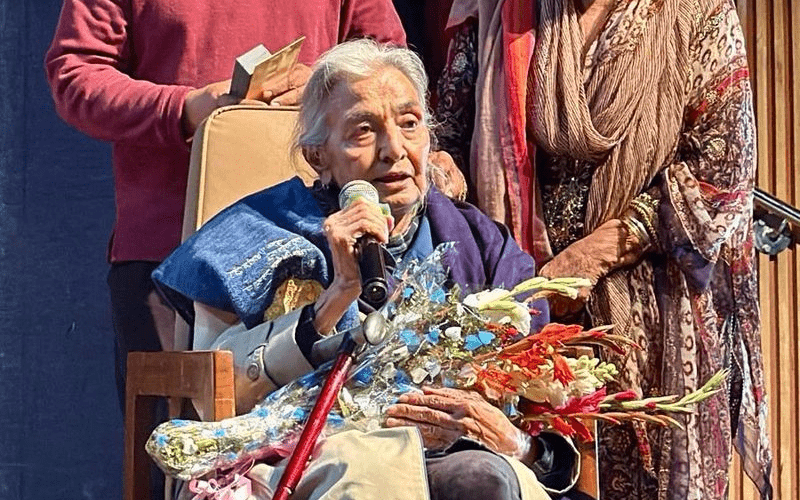
Veteran Punjabi theatre artist Neena Tiwana has once again been recognised for her enduring contribution to the performing arts, receiving the Punjab Gaurav Award from the Punjab Art Council, Government of Punjab. The honour was presented by Padma Shri Nirmal Rishi, who described Tiwana as both a mentor and a guiding force in her own artistic journey.
A pioneer of modern Punjabi theatre, Tiwana’s career spans more than six decades, during which she has remained deeply committed to nurturing stage culture in the region. She and her late husband, acclaimed director Harpal Tiwana, were among the earliest Punjabi students to graduate from the National School of Drama in 1965, where they trained under legendary theatre director Ebrahim Alkazi.
Over the years, Tiwana became a familiar face on stage, portraying strong lead characters in several landmark productions directed by her husband. Among the most remembered works are Kanak Di Balli, Loha Kut, Chamkaur Di Garhi, Antigone, Nasha Kursi Da, Mela Munde Kudiyan Da, Garam Bazar, Long Da Lishkara, and the celebrated Diva Bale Saari Raat. Many of these productions later found new life as films, expanding their reach beyond theatre audiences.
The Tiwana duo is widely credited with shaping a professional Punjabi theatre movement that attracted paying audiences and strengthened the cultural landscape of the state. Neena Tiwana’s portrayal of a spirited Sardarni in the film Long Da Lishkara turned her into a household name, while her appearances in the television series Saanjhi Deewar and the Hindi film Haat – The Bazar further broadened her artistic footprint.
Her work has earned accolades both in India and abroad, including the Outstanding Sikh Women Award by the SGPC during the tricentenary celebrations of the Khalsa, honours from the Indo-Canadian Times and the Punjabi Cultural Society of Chicago, the Shiromani Adakara Award from Bhasha Vibhag, Punjab, and the prestigious Sangeet Natak Akademi Award for acting, conferred by the President of India.
Beyond the stage, Tiwana has also turned to writing, authoring Oh Jo Si, a book dedicated to her late husband’s life and artistic legacy. Although health concerns have recently limited her acting engagements, she remains active in the field and is currently working on a new book exploring acting techniques and performance craft.
Following Harpal Tiwana’s death in a car accident in 2002, the actress continued to champion his vision, with her son Manpal Tiwana noting that she played a key role in reviving productions such as Sirhindi Di Deewar, Long Da Lishkara and Diva Bale Saari Raat. Together, the Tiwanas also helped shape the early careers of several prominent artists, including Om Puri, Raj Babbar, Nirmal Rishi, Gurdas Maan and Girja Shankar.
Reflecting on her lifelong association with theatre, Tiwana said that bringing characters to life on stage remains a deeply fulfilling experience. Even as she steps back from performing, her influence continues to resonate across generations of actors and audiences, reaffirming her place as one of Punjabi theatre’s most enduring voices.
