


AI Generated Summary
- Reporting on the event said it was organized by the Baku Initiative Group, an entity linked to the Azerbaijani state, and that the gathering included a minute of silence for Hardeep Singh Nijjar, which strongly signaled that the event was not just a generic minority-rights forum but one that legitimated Khalistan messaging.
- Several outlets described the meeting as the first major conference of its kind hosted in Azerbaijan and as a platform for internationalizing the Khalistan narrative.
- After the 2025 G7 meeting, India and Canada signaled a reset in ties, including the restoration of high commissions and a gradual reopening of dialogue channels.
The Khalistan movement has long depended on diaspora hubs, especially in Canada and the UK, where activists could organize, fundraise, and lobby with relatively low friction. India has argued for years that Canada in particular allowed anti-India separatist elements to operate openly, and by mid-2025 Ottawa’s own intelligence service publicly said Canada-based Khalistani extremists were using Canadian soil to promote, fundraise, and plan violent activities. That assessment marked a significant policy shift because it validated, at least in part, India’s long-standing complaint that foreign jurisdictions were being used as operational rear areas for a separatist and extremist agenda.
The immediate context for the Azerbaijan turn is the cooling of the Canada-centered ecosystem. After the 2025 G7 meeting, India and Canada signaled a reset in ties, including the restoration of high commissions and a gradual reopening of dialogue channels. More broadly, Canadian authorities have begun framing Khalistani extremism as a national security problem, which makes Canada a less permissive platform than before for visible separatist mobilization. That does not mean the network has disappeared; it means its center of gravity is shifting toward jurisdictions where political, diplomatic, or narrative advantages still exist.
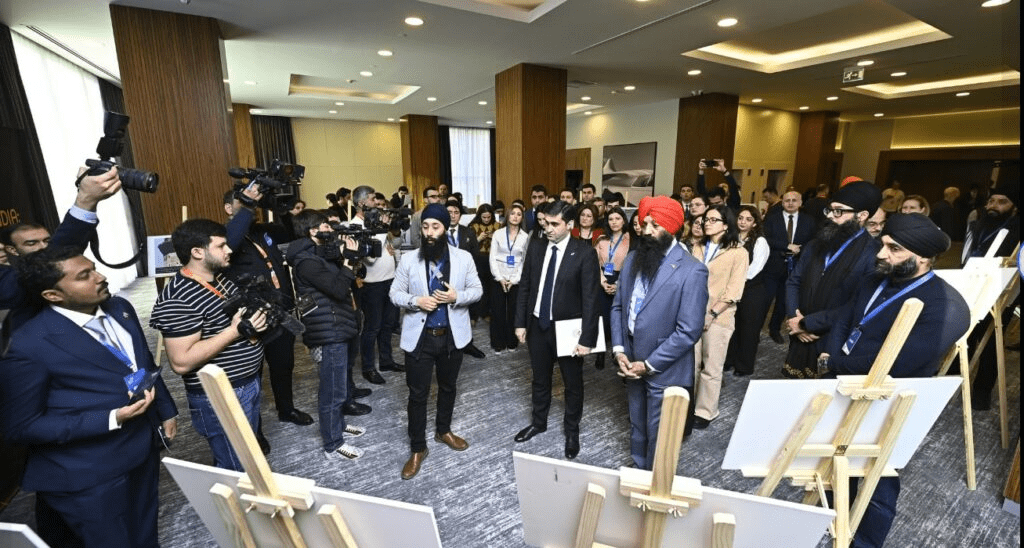
Azerbaijan became prominent after a January 2026 conference in Baku titled “Racism and Violence Against Sikhs and Other National Minorities in India: The Reality on the Ground” brought together Khalistani-linked figures and Pakistani representatives. Reporting on the event said it was organized by the Baku Initiative Group, an entity linked to the Azerbaijani state, and that the gathering included a minute of silence for Hardeep Singh Nijjar, which strongly signaled that the event was not just a generic minority-rights forum but one that legitimated Khalistan messaging. Several outlets described the meeting as the first major conference of its kind hosted in Azerbaijan and as a platform for internationalizing the Khalistan narrative.
The choice of Azerbaijan is strategically interesting. Azerbaijan has developed closer alignment with Pakistan and Turkey, often described in regional commentary as a “Three Brothers” alignment, and that alignment has become more visible in Indian reporting since the Armenia-Azerbaijan conflict and India’s own regional balancing choices. From India’s perspective, Baku offers a politically sympathetic venue where anti-India narratives can be wrapped in the language of human rights, decolonization, and minority protection. That framing is useful because it allows separatist messaging to travel through respectable-looking conference formats, think-tank branding, and NGO terminology rather than through explicit militant rhetoric.
There are three reasons Azerbaijan is attractive as a platform. First, it offers geopolitical cover: if the event is hosted by a government-linked body, participants can claim they are engaging in advocacy rather than separatism. Second, it provides plausible deniability for Pakistan and other sympathizers, because the message can be advanced through third-country venues instead of directly through Pakistani institutions. Third, it helps keep the issue alive after Canada’s tightening environment, allowing diaspora activists to preserve visibility even if mainstream Canadian politics becomes less accommodating.
The network composition also matters. Reporting on the Baku event identified participants from Canada, the UK, and elsewhere, including individuals described as Khalistani activists or associates of slain leader Hardeep Singh Nijjar. That indicates the movement’s transnational character: the base is no longer a single country, but a layered ecosystem of diaspora organizers, advocacy groups, online channels, and state-tolerant venues. In this sense, Azerbaijan is not replacing Canada so much as supplementing a broader, more fragmented global infrastructure.
For India, the concern is less about one conference than about the normalization of such platforms. If the Baku model works, it gives separatist groups a repeatable template: use a state-linked venue, invite diaspora activists, frame the issue as minority rights, and seek international media or institutional follow-on. That can influence opinion in parts of Europe and North America, complicate India’s diplomatic messaging, and create the appearance of a broader human-rights campaign even when the core objective remains separatist agitation. In security terms, narrative platforms can matter because they help sustain fundraising, recruitment, and legitimacy.
Still, the evidence base should be handled carefully. Much of the reporting on Azerbaijan’s role is commentary-heavy and often written from an Indian policy or security perspective. The facts that are relatively solid are the existence of the Baku conference, the involvement of government-linked institutions, the attendance of diaspora-linked Sikh/Khalistani figures, and the broader shift in Canada’s posture. What is less directly proven in public reporting is a centrally coordinated operational command structure linking Azerbaijan, Pakistan, and Khalistani groups in a single hierarchy. The more cautious conclusion is that there is convergence of interests, not necessarily a single master plan.
The Azerbaijan episode suggests the Khalistan movement is adapting to pressure in Canada by moving into friendlier international spaces rather than declining outright. For India, the challenge is to counter not just separatist activity but the venues that launder it into legitimate-looking discourse. For Azerbaijan, the reputational cost may grow if Baku becomes widely seen as a host for anti-India mobilization rather than as a neutral diplomatic player. For Canada, the lesson is that when domestic enforcement becomes stronger, transnational networks often relocate instead of disappear.
In short, Azerbaijan is emerging as a narrative platform for Khalistani activism precisely because Canada has become a more contested and less reliable base. The pattern points to a broader transnationalization of the issue, where influence operations, diaspora politics, and state alignments overlap in ways that make the conflict harder to contain.