


AI Generated Summary
- It is the exact opposite of encouraging children to imitate assassination in the middle of a public street.
- There is a vast moral difference between teaching a child courage and teaching a child contempt.
- Freedom of expression is a cornerstone of democratic society, but it has never meant freedom to normalize violence among children without scrutiny.
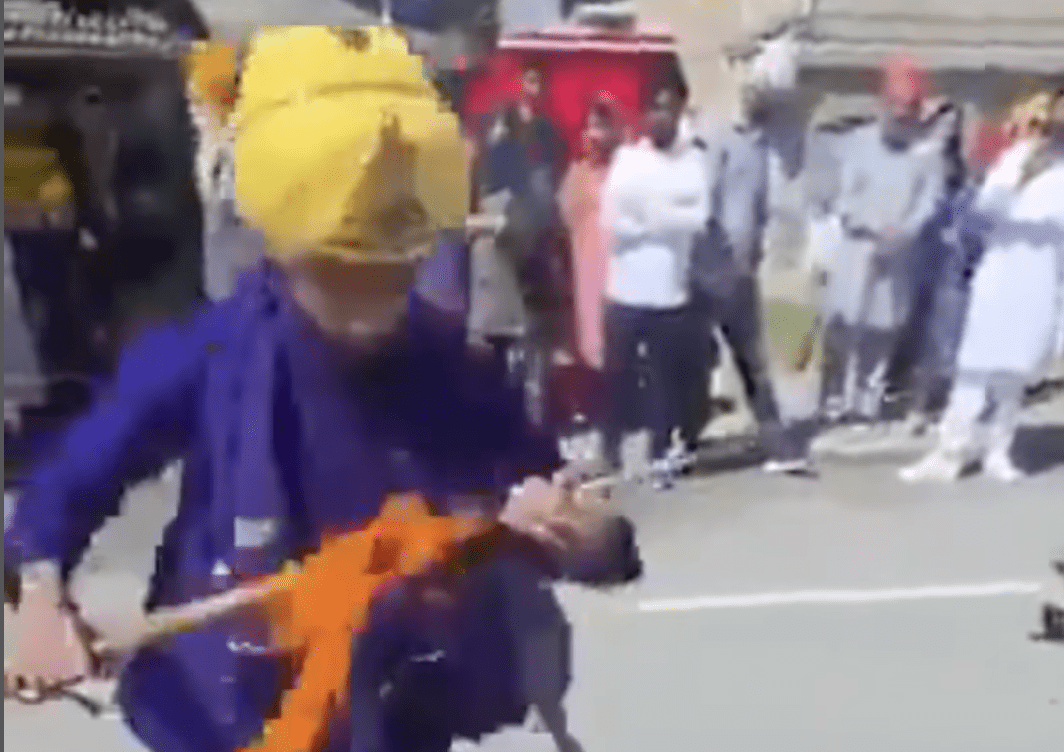
The most disturbing image from a recent demonstration in Canada was not of angry slogans, provocative placards, or political rhetoric. It was of a barefoot child repeatedly stabbing an effigy of India’s Prime Minister while adults stood around applauding.
Regardless of one’s political beliefs, this should horrify every Sikh.
Not because it concerns Narendra Modi alone. Not because it is about India alone. But because it represents something far more dangerous: the deliberate teaching of hatred to children. The normalization of violence. The transformation of political grievance into inherited rage.
And that is profoundly anti-Sikh.
Sikhi has never been a faith that teaches children whom to hate. It teaches them whom to serve.
Guru Nanak Dev Ji rejected divisions of caste, creed, and kingdom. Guru Arjan Dev Ji embraced martyrdom but never vengeance. Guru Tegh Bahadur Ji laid down his life to protect another community’s freedom of conscience. Guru Gobind Singh Ji created the Khalsa not as an army of revenge, but as saint-soldiers—individuals who would raise the sword only when every other path had failed.
“When all peaceful means have been exhausted, it is righteous to draw the sword.”
That principle is often quoted but seldom understood. It is a doctrine of restraint, not aggression. It is the exact opposite of encouraging children to imitate assassination in the middle of a public street.
There is a vast moral difference between teaching a child courage and teaching a child contempt.
One produces citizens.
The other produces extremists.
The Sikh tradition has never glorified hatred as inheritance. Our Gurus consistently warned against the five thieves—kaam, krodh, lobh, moh, and ahankaar. Of these, krodh (anger) is perhaps the easiest to weaponize politically. Angry adults create angry children because hatred is easier to pass down than wisdom.
That is precisely what makes such spectacles so disturbing.
Children do not arrive in this world carrying ideological baggage. They are taught it. When adults encourage a child to repeatedly stab an effigy while crowds cheer, they are not merely staging political theatre. They are rehearsing violence in the imagination of a young mind.
The target today may be an Indian leader.
Tomorrow it could be someone else.
The lesson remains the same: political disagreement deserves physical elimination.
That lesson is poisonous regardless of who the victim happens to be.
What makes this even more tragic is that it is being done in the name of Sikh identity.
The overwhelming majority of Sikhs around the world are law-abiding, hardworking citizens who contribute positively to every society they inhabit. They have built businesses, served in armed forces, entered public office, excelled in academia, and earned respect through seva and honest labour.
To reduce Sikh identity to perpetual political rage is not merely inaccurate—it is an insult to our history.
The Sikh faith survived persecution because it refused to surrender its moral compass. Our Gurus never taught us that dignity comes from cultivating permanent enemies. They taught resilience, compassion, sacrifice, and justice.
Justice is not hatred.
Resistance is not indoctrination.
Faith is not fanaticism.
Perhaps the most uncomfortable question is this: what kind of leadership celebrates such acts?
Any movement that requires children to perform symbolic violence to sustain itself has already betrayed its own moral bankruptcy. Genuine political causes persuade through ideas. They do not recruit through emotional conditioning of minors.
Children should be learning Gurbani, history, critical thinking, compassion, and service to humanity—not rehearsing symbolic executions before cheering adults.
Canada, too, must ask itself difficult questions.
A liberal democracy cannot selectively tolerate extremism because it arrives wrapped in the language of identity politics. Freedom of expression is a cornerstone of democratic society, but it has never meant freedom to normalize violence among children without scrutiny.
The responsibility of any democratic state is not merely to protect speech but also to protect future generations from organized radicalization, whatever its ideological source.
If this incident does not provoke national introspection, then the damage extends beyond one community or one country.
It becomes a failure of civilization itself.
For the Sikh community, however, the answer should already be clear.
The child in that video is not displaying Sikh values.
He is displaying values that Sikhi exists to overcome.
The tragedy is not simply that a child was taught to hate.
The tragedy is that adults applauded while he did it.
