


AI Generated Summary
- The goal is not merely to move drugs or weapons — it is to destabilize Punjab systematically, radicalize its youth, fund criminal-terror networks, and erode the social fabric of one of India’s most strategically significant border states.
- The Narcotics Control Bureau reported drone-related drug seizures along the India-Pakistan border jumping from a mere three cases in 2021 to 179 in 2024 — with 163 of those in Punjab alone.
- It is a data point in a pattern — one that points toward a persistent, evolving, and deeply resourced campaign against India’s internal stability.
The battlefield has changed. There are no soldiers crossing the border, no tanks rolling through the dust. Instead, the threat arrives silently at night — a commercial drone humming low over the fields of Punjab, dropping its payload and retreating before anyone raises an alarm. What it leaves behind tells the full story: military-grade grenades, pistols, packets of heroin. A war fought at arm’s length, with plausible deniability built into every delivery.
This is not a hypothetical scenario. It is happening now, and the numbers are staggering.
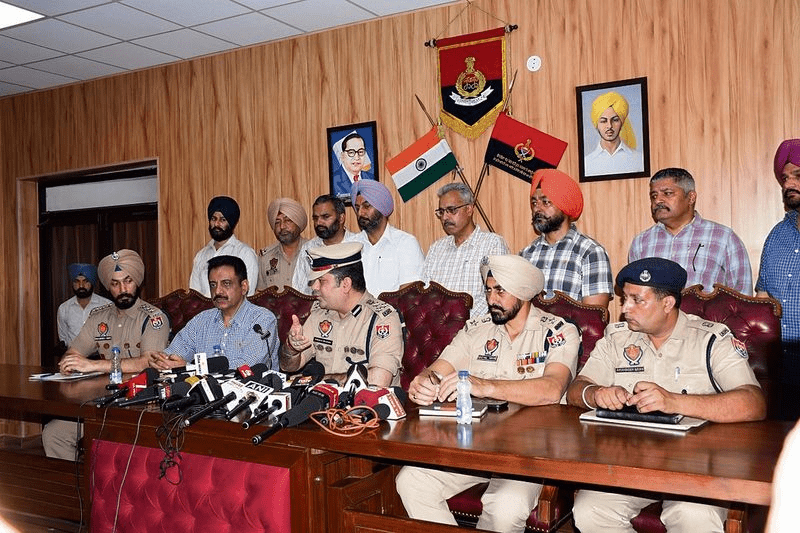
A recent operation by the Ludhiana Police Commissionerate and Counter Intelligence laid bare the mechanics of this threat. Four suspects were arrested after the recovery of two military-grade hand grenades and three sophisticated firearms — all believed to have been drone-dropped from across the Pakistani border. The weapons, manufactured in China and routed through Pakistan, were coordinated by foreign-based handlers operating from Germany, Dubai, and Malaysia. These handlers — identified as Zorawar Singh, Sahil Sondhi alias Chunj, Lakha, and Akashdeep alias Golden — recruited vulnerable young men through social media, offering modest payments for the simple task of collecting and delivering packages. The recruits often had no idea what they were carrying or where it was ultimately headed.
That willful opacity is by design. The network operates in compartments, ensuring that local foot soldiers remain largely ignorant of the terror modules they are feeding. The arrested men — Karandeep Singh, Baljeet Singh, Anuraj, and Ankush — were pawns in a much larger game: a carefully orchestrated infrastructure of drug trafficking, weapons smuggling, and terrorism financing that exploits the gap between what drones can do and what border security can currently stop.
The data confirms this is no isolated incident. The Narcotics Control Bureau reported drone-related drug seizures along the India-Pakistan border jumping from a mere three cases in 2021 to 179 in 2024 — with 163 of those in Punjab alone. In 2025, the Border Security Force seized 272 drones along the Punjab border, recovering over 367 kilograms of heroin, more than 10 kilograms of RDX, 12 hand grenades, and 200 arms. Drones that once confined themselves to the border’s edge are now flying deeper into Indian territory.
The strategic logic behind this escalation is clear. Pakistan’s ISI-linked networks have found in commercial drones a near-perfect instrument of hybrid warfare: low-cost, difficult to intercept, and offering blanket deniability to state sponsors. A drone carries no passport. It bears no insignia. It doesn’t require a handler to set foot on Indian soil. When seized, it traces back to a supply chain that winds through multiple countries, obscuring the trail at every turn. The goal is not merely to move drugs or weapons — it is to destabilize Punjab systematically, radicalize its youth, fund criminal-terror networks, and erode the social fabric of one of India’s most strategically significant border states.
India is not standing still. The BSF has ramped up vigilance, anti-drone systems like Punjab’s “Baaj Akh” have been deployed, and police intelligence operations regularly dismantle delivery modules. These efforts deserve recognition. But disrupting the next consignment, however vital, is not the same as dismantling the network that sent it. As long as handlers operate freely from European and Gulf cities, as long as Chinese-made weapons flow unchecked through Pakistani territory, and as long as affordable drone technology continues to outpace countermeasures, the threat will reconstitute itself.
What is required is a layered response. Technologically, India must invest in detection and neutralization systems that can match the rapidly evolving capabilities of modified commercial drones. Diplomatically, India must hold its interlocutors — Germany, the UAE, Malaysia — accountable for the networks operating on their soil. And internationally, sustained pressure must be mounted on Pakistan to dismantle, not merely deny, the ISI-linked infrastructure driving this campaign.
The Ludhiana case is not an aberration. It is a data point in a pattern — one that points toward a persistent, evolving, and deeply resourced campaign against India’s internal stability. Punjab’s fields should not become the delivery floors of an undeclared war. Recognizing the drone threat for what it truly is — a strategic offensive, not a policing problem — is the first step toward meeting it with the full weight it demands.