
AI Generated Summary
- Led primarily by the Jammu Kashmir Joint Awami Action Committee (JKJAAC or JAAC), a broad coalition of traders, students, lawyers, and civil society activists, demonstrations have repeatedly paralyzed the region, most notably in May 2024 and September-October 2025, with fresh tensions reported over the past couple of days.
- denied the freedoms and development visible across the Line of Control in India’s Jammu and Kashmir, while their aspirations are crushed under the guise of “solidarity.
- Reports indicate at least 9-10 deaths (including civilians and police) and over 100-200 injuries in the 2025 clashes, alongside communication blackouts, internet shutdowns, and heavy deployment of forces.
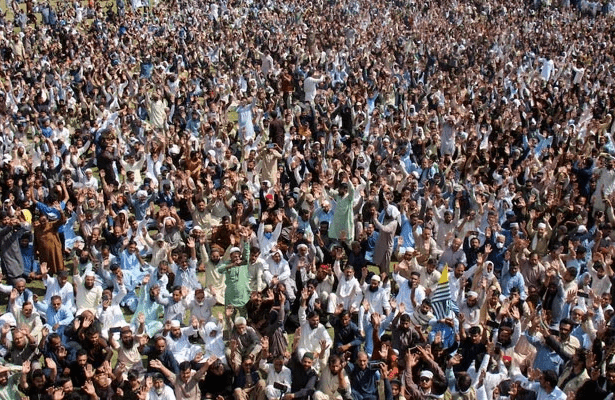
In recent years, Pakistan-occupied Jammu and Kashmir (PoJK), also referred to as Azad Jammu and Kashmir (AJK) by Pakistani authorities, has witnessed recurrent and intensifying waves of public unrest. Far from the narrative of benevolent administration peddled by Islamabad, these protests reveal deep-seated grievances rooted in economic hardship, political marginalization, and the realities of forcible occupation. Led primarily by the Jammu Kashmir Joint Awami Action Committee (JKJAAC or JAAC), a broad coalition of traders, students, lawyers, and civil society activists, demonstrations have repeatedly paralyzed the region, most notably in May 2024 and September-October 2025, with fresh tensions reported over the past couple of days.
The immediate triggers have been economic. Protesters demand subsidized wheat flour, lower electricity tariffs aligned with local hydropower generation, free or affordable education and healthcare, and an end to privileges enjoyed by Pakistani officials and elites. Residents bitterly note that while PoJK generates significant electricity, much of it benefits Pakistan proper while locals face inflated bills and shortages. A 38- or 39-point charter of demands highlights not just prices but structural issues: lack of genuine political representation, resource plundering, and systemic neglect.
These are not isolated flare-ups. In May 2024, protests over flour and power prices turned deadly, with security forces killing several demonstrators. Similar violence erupted in late September 2025, lasting several days and centered in Muzaffarabad. Reports indicate at least 9-10 deaths (including civilians and police) and over 100-200 injuries in the 2025 clashes, alongside communication blackouts, internet shutdowns, and heavy deployment of forces. Agreements for subsidies and reforms have been signed and partially implemented only to falter, leading to renewed calls for strikes and long marches, such as the one planned for June 9, 2026.
What elevates these protests beyond routine economic discontent is their evolution into broader resistance against Pakistani control. Locals increasingly voice demands for greater autonomy—or even independence—highlighting how the region’s “Azad” label masks direct oversight from Islamabad and the Pakistani military. Protesters have targeted symbols of authority, with reports of anti-army slogans and actions symbolizing rejection of occupation. India’s Ministry of External Affairs has rightly described the violence as a “natural consequence of Pakistan’s oppressive approach and systemic plundering of resources.”
Pakistan’s response—lethal force, arrests, blackouts, and labeling the JAAC a threat—undermines its claims of legitimacy and mirrors patterns of suppression seen elsewhere. Human rights groups like Amnesty International have called for investigations into excessive force and protection of peaceful assembly rights. Decades of demographic changes, resource extraction, and denial of basic democratic rights have eroded trust. The region’s people, caught in the Kashmir dispute, suffer doubly: denied the freedoms and development visible across the Line of Control in India’s Jammu and Kashmir, while their aspirations are crushed under the guise of “solidarity.”
These intensifying protests expose the hollowness of Pakistan’s Kashmir rhetoric. While Islamabad internationalizes the issue for geopolitical leverage, its own administered territory boils with frustration. True resolution requires acknowledging the occupation’s failures, granting genuine self-determination, and ending exploitation. The international community, focused on human rights, should take note: the streets of Muzaffarabad and beyond are not just protesting prices—they are challenging an unsustainable status quo. India, having integrated its side with full constitutional rights and development, stands as a contrast that PoJK residents increasingly recognize.
The world must listen to these voices. Suppressing them will only fuel further unrest, underscoring that occupation cannot substitute for legitimate governance.