


AI Generated Summary
- The Jathedar, currently on a four-day visit to Norway at the invitation of the management committee of Gurdwara Sri Guru Nanak Dev Ji in Oslo, visited Mata Gujri Ji Punjabi School in Drammen on Saturday, where he witnessed efforts being made to introduce young members of the Sikh diaspora to their ancestral language and heritage.
- At Gurdwara Sri Guru Nanak Niwas in Lier, he paid obeisance and participated in discussions with members of the local sangat on Gurmat principles, Sikh history and the role of religious institutions in community life.
- The visit brought renewed attention to the role of diaspora-run Punjabi schools and gurdwaras in passing on language, faith and cultural traditions to successive generations, particularly in countries where children grow up in multilingual and multicultural environments.
Emphasising the importance of preserving linguistic and cultural identity across generations, Akal Takht Jathedar Giani Kuldeep Singh Gargaj has urged Sikh families living abroad to ensure that their children remain connected to Punjabi, Gurbani and the rich traditions of Sikh history.
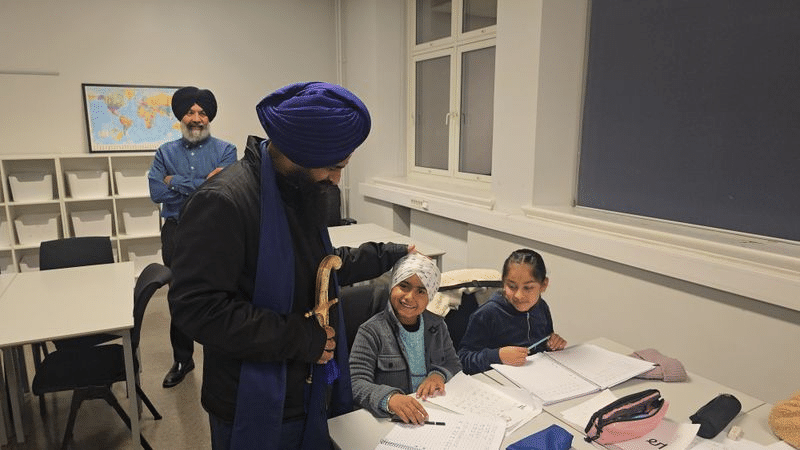
The Jathedar, currently on a four-day visit to Norway at the invitation of the management committee of Gurdwara Sri Guru Nanak Dev Ji in Oslo, visited Mata Gujri Ji Punjabi School in Drammen on Saturday, where he witnessed efforts being made to introduce young members of the Sikh diaspora to their ancestral language and heritage.
During his visit, he interacted with students from Classes I to IV, engaging them in conversations about Punjabi language, Sikh history and religious traditions. Impressed by their knowledge and enthusiasm, he commended the school authorities and teachers for creating an environment in which children growing up far from Punjab could develop an understanding of their cultural roots.
Addressing the educators, he highlighted the need for an approach to learning that combines linguistic proficiency with an awareness of Sikh philosophy and history. He observed that while academic education prepares children for professional and personal success, familiarity with their mother tongue and spiritual heritage contributes significantly to their overall development.
Placing particular emphasis on Gurmukhi, the Jathedar explained that knowledge of the script provides younger generations with a direct connection to Gurbani enshrined in Sri Guru Granth Sahib. He encouraged Sikh institutions to treat Punjabi language instruction as an essential component of community education, alongside established religious activities such as kirtan and katha.
He further underlined that the responsibility of safeguarding cultural continuity cannot rest with educational institutions alone. Parents, gurdwara management committees and community organisations, he said, must work collectively to ensure that children born and raised overseas retain a meaningful connection with their ancestral traditions.
The visit also provided an opportunity for the Jathedar to engage with the wider Sikh community in the Drammen region. At Gurdwara Sri Guru Nanak Niwas in Lier, he paid obeisance and participated in discussions with members of the local sangat on Gurmat principles, Sikh history and the role of religious institutions in community life.
Reflecting on the global presence of the Sikh community, he noted that gurdwaras established across different countries have become important centres for preserving religious practices, transmitting cultural knowledge and fostering a shared sense of belonging.
He particularly stressed the significance of regular weekly congregations, describing them as occasions that extend beyond religious observance. Such gatherings, he observed, strengthen interpersonal relationships, encourage mutual support and provide opportunities for families to remain actively involved in community life.
Recognising the challenges of maintaining cultural connections across geographical distances, the Jathedar also encouraged Sikh parents in Norway to take their children to Punjab periodically. Visits to historical religious sites, particularly Sri Darbar Sahib in Amritsar, he suggested, could help younger generations develop a deeper appreciation of their heritage through personal experience.
His engagements in Drammen formed part of a broader programme aimed at strengthening interaction with Sikh communities in Norway. During the remainder of his visit, he is scheduled to participate in a Gurmat congregation in Oslo and meet members of the local sangat.
The visit brought renewed attention to the role of diaspora-run Punjabi schools and gurdwaras in passing on language, faith and cultural traditions to successive generations, particularly in countries where children grow up in multilingual and multicultural environments.