


AI Generated Summary
- In the waterlogged heart of Upper Assam, where the Brahmaputra’s fury left villages submerged and lives upended in July 2026, a quiet act of faith cut through the despair.
- In the aftermath of one of Assam’s most severe floods in living memory, the Sikhs of Sivasagar and their supporters from outside offered more than food and shelter.
- In one naamghar in Sivasagar they recovered copies of the Bhagavad Gita and Naam Ghoxa from the mud, carefully setting the sacred texts aside while they cleared debris.
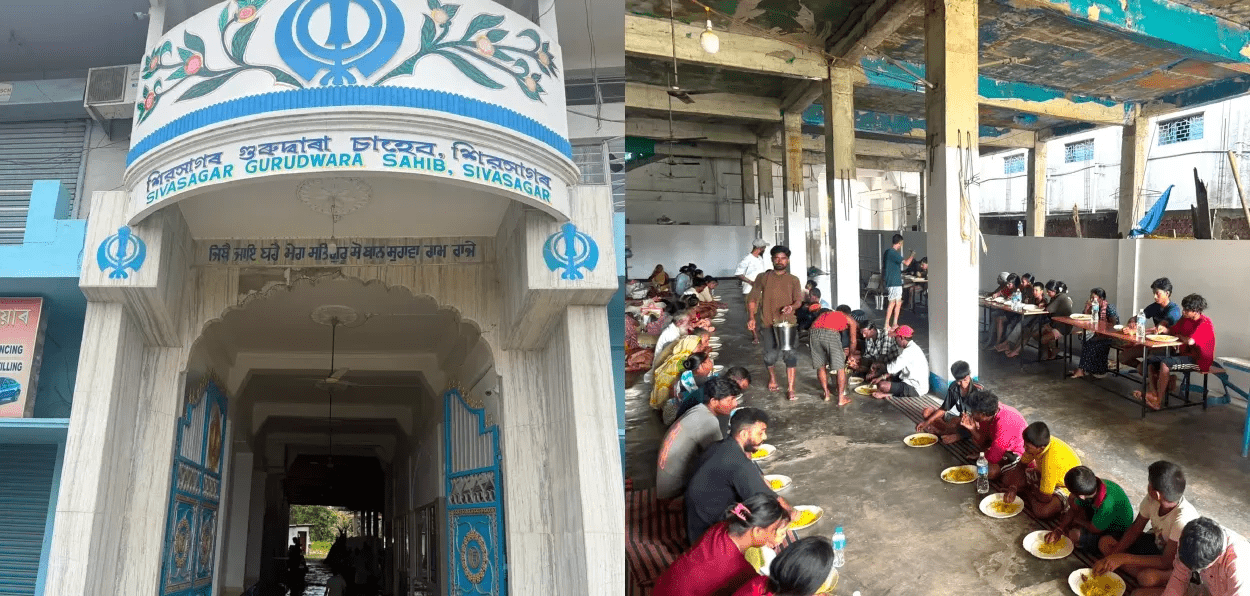
In the waterlogged heart of Upper Assam, where the Brahmaputra’s fury left villages submerged and lives upended in July 2026, a quiet act of faith cut through the despair. At Sivasagar Gurdwara Sahib near Station Chariali, the doors stayed open day and night. Nearly 200 flood-hit families found shelter within its walls. Volunteers prepared and served 1,500 to 2,000 fresh meals every day through the langar, without asking anyone’s name, caste, or religion.
The floods ranked among Assam’s worst in decades. Excess rainfall, in places nearly 500 per cent above normal, claimed at least 75 lives and affected more than three lakh people across seven districts. Sivasagar, Charaideo and Jorhat bore the heaviest brunt. Entire settlements disappeared under water and later under thick layers of silt. Electricity failed. Roads vanished. Yet inside the gurdwara, generators hummed, mobile phones charged, and fans turned so people could sleep.
Maninder Singh Khalsa, Joint State Secretary of the Gurdwara Management Committee, put it simply: “Our gurdwara has always run a langar, and serving humanity is our religion. Therefore, it is our duty to stand by the people of Sivasagar during this difficult time.” Only about 50 Sikh families live in the town. They managed everything—cooking through the night, arranging essentials, appealing to the administration for medical help while promising to supply the medicines themselves.
Help arrived from farther afield too. Groups of “Sikh riders” rolled in on tractors piled high with rations and relief materials. Their mission, as one account described it, was straightforward: serve humanity. They asked for nothing in return and left carrying only gratitude.
Global Sikhs, a humanitarian organisation, launched an emergency mission across Upper Assam. Volunteers cleaned flooded community centres, including temples and naamghars. In one naamghar in Sivasagar they recovered copies of the Bhagavad Gita and Naam Ghoxa from the mud, carefully setting the sacred texts aside while they cleared debris. They organised community kitchens and distributed food to the displaced. Khalsa Aid teams assessed needs on the ground and prepared further relief, continuing a long tradition of responding wherever disaster strikes.
This is sewa in its purest form—the Sikh principle of selfless service that recognises no boundary. In a region where communities of different faiths have long lived side by side, the gurdwara’s response became a living demonstration of that ideal. Local Marwari traders, social groups and ordinary residents joined in, contributing supplies. The small Sikh community’s efforts grew into one of the largest community-led relief centres in the district.
As floodwaters slowly receded, the practical challenges remained: damaged homes, silt-choked fields, the risk of disease. Yet the images that lingered were of shared plates of rice and dal, of strangers resting under the same roof, of volunteers working through exhaustion because the need was greater than their fatigue.
In the aftermath of one of Assam’s most severe floods in living memory, the Sikhs of Sivasagar and their supporters from outside offered more than food and shelter. They offered a reminder that compassion, when practised without calculation, still has the power to steady a community when the waters rise.