


AI Generated Summary
- For her, the exhibition is an ode to her mother, Shyama Bhasin-Kakar, and the Khukrana women of her lineage, custodians who preserved these as acts of care.
- For Delhi visitors seeking a deeper connection to Punjab’s heritage, Sut te Saah offers an intimate, poignant entry into a tradition that continues to breathe life into the past.
- Pieces like Vari-da-Bagh—started by a mother-in-law or grandmother-in-law at a son’s birth and finished over time for the future daughter-in-law—embody anticipation, nurture, and marital welcome.
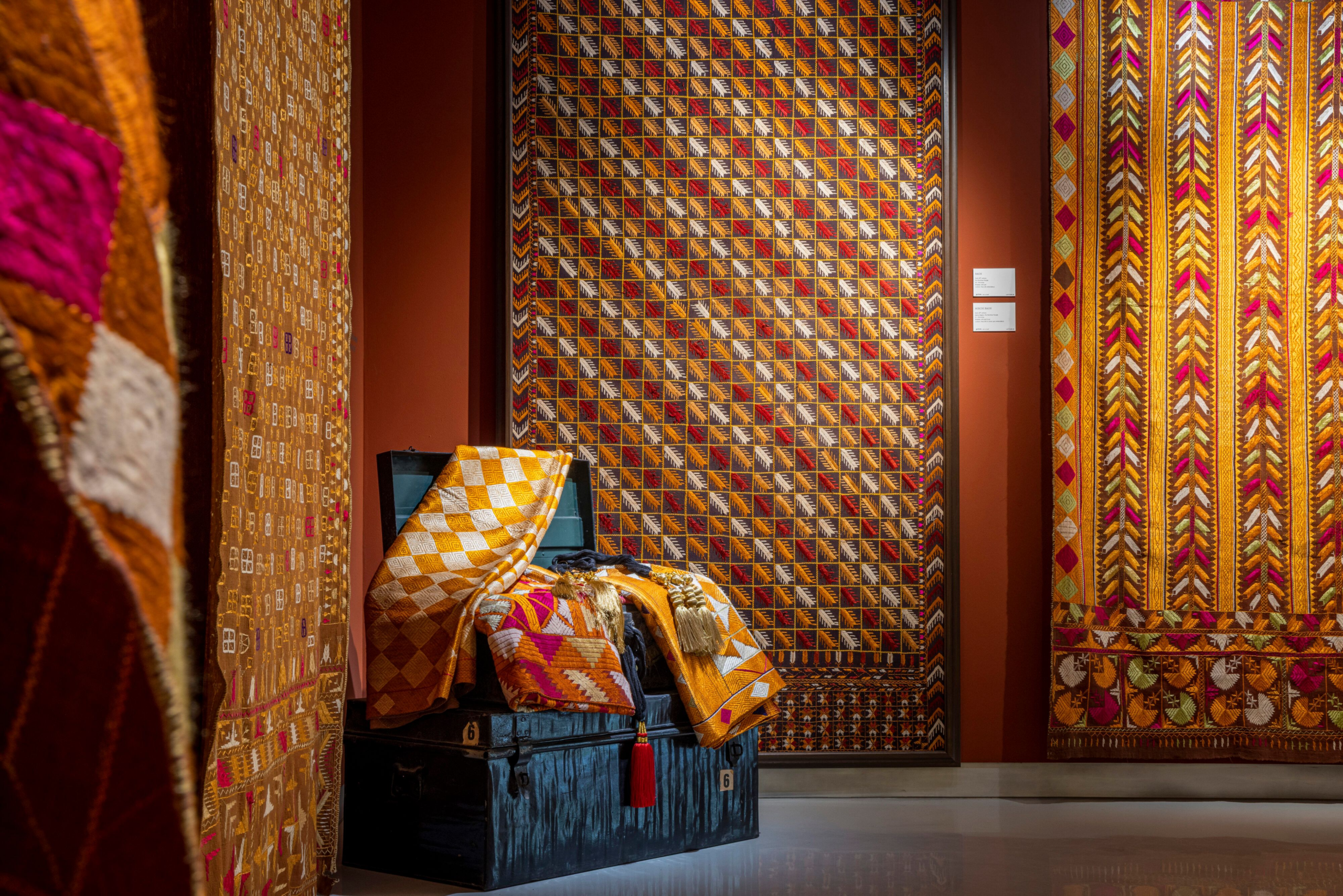
In the quiet elegance of Latitude 28 gallery in Delhi’s Defence Colony, an exhibition titled Sut te Saah: Stories Woven in Phulkari unfolds like a whispered family saga. Running from December 27, 2025, to January 26, 2026, this showcase—presented by gallerist Bhavna Kakar and curated by oral historian Shreya Sharma—brings together over 40 rare pre-Partition Phulkaris and Baghs from undivided Punjab. Drawn from the personal collections of designer Amit Hansraj and Brigadier Surinder and Shyama Kakar (Bhavna’s family), these textiles are far more than embroidered fabrics; they are living archives of women’s lives, emotions, rituals, and resilience.
The title Sut te Saah—literally “thread and breath”—draws from a poignant Punjabi folk verse: “Sut te saah ne rachan meri kahāṇī / Phulkari de phullāñ vich likhi zindagānī” (Thread and breath weave my story / Life is written in the flowers of Phulkari). It captures the essence of these pieces: each stitch a breath of labor, love, and memory, each motif a chapter in personal and collective histories.
Phulkari, meaning “floral work,” is a traditional embroidery from Punjab, typically worked on hand-spun cotton or khaddar using the simple darn stitch. Women artisans—often in domestic settings—created these with vibrant silk threads, transforming everyday cloth into vibrant expressions of joy, faith, and transition. Baghs (meaning “garden”) represent a denser, more ceremonial variant, often fully covered in embroidery with intricate geometric patterns and borders, reserved for weddings and significant rituals.
The exhibition is structured narratively rather than typologically, divided into conceptual sections that mirror life’s arc:
- Sankraman (Transition): Focusing on moments of passage like birth and marriage, this includes the striking Chope—a vibrant ochre piece from the late 19th-early 20th century, originating in Mandi Bahauddin district. Traditionally begun by a maternal grandmother on her granddaughter’s birth and completed over years, the Chope was gifted during wedding rituals, symbolizing continuity and blessing.
- Vishvaas ate Katha (Belief and Narrative): Here, textiles carry faith, folklore, and oral traditions. Pieces like Vari-da-Bagh—started by a mother-in-law or grandmother-in-law at a son’s birth and finished over time for the future daughter-in-law—embody anticipation, nurture, and marital welcome. Darshan Dwar motifs evoke gateways to the divine, often donated to temples or gurdwaras.
- Rihaish (Dwelling and Everyday Life): Everyday motifs—belan (rolling pin), chillies, flowers, wheat stalks—stitch domestic worlds into cloth, showing Phulkari’s role in routine and community.
These works hail from Punjab’s Majha, Doaba, and Malwa regions, reflecting a pre-Partition syncretism where women across communities embroidered similar forms. Partition disrupted this continuity, scattering families and transforming heirlooms into vessels of memory and loss. Bhavna Kakar reflects personally: growing up with these textiles as lived presences—draped over army trunks, repurposed into cushions—they marked transitions rather than being static artifacts. For her, the exhibition is an ode to her mother, Shyama Bhasin-Kakar, and the Khukrana women of her lineage, custodians who preserved these as acts of care.
Curated with sensitivity, Sut te Saah foregrounds women’s authorship—challenging views of Phulkari as casual pastime—while weaving in Punjabi boliyan (folk songs) and oral histories that once accompanied the stitching. The pieces reveal quiet resilience: labor-intensive, emotionally charged, and passed through generations as inheritance rather than commodity.
In an era of fast fashion, this exhibition invites pause—to see thread as breath, cloth as chronicle. It honors not just craft but the interior worlds of women who inscribed their stories into every flower and geometric bloom. For Delhi visitors seeking a deeper connection to Punjab’s heritage, Sut te Saah offers an intimate, poignant entry into a tradition that continues to breathe life into the past.
