


AI Generated Summary
- When complete, it will feature a 350-metre Heritage Street lined with sculptures and 3D murals depicting his life, a 30-metre Tricolour mast, a 700-seat auditorium, a digital courtroom recreation, and a model of his Banga birth home across the border.
- Visitors walk through rooms displaying his blood-stained newspaper, the signed Bhagavad Gita he read in jail, a page of the judgment with his handwritten notes, and a small urn said to hold his ashes.
- Across the border in Pakistan, a new Bhagat Singh Gallery opened in Lahore’s historic Poonch House in late 2024, while his ancestral haveli in Faisalabad is being restored as national heritage.
On 23 March 1931, three young men, Bhagat Singh, Shivaram Rajguru, and Sukhdev Thapar, walked to the gallows in Lahore Central Jail with heads held high. They were 23, 22, and 24. Their bodies were cremated in secret on the banks of the Sutlej at Hussainiwala; their ashes scattered to prevent any shrine. Yet, 95 years later, that very spot has become the National Martyrs Memorial, where thousands gather every year on Martyrs’ Day. Across the border in Pakistan, a new Bhagat Singh Gallery opened in Lahore’s historic Poonch House in late 2024, while his ancestral haveli in Faisalabad is being restored as national heritage. The revolutionary’s story is no longer just history, it is living heritage, preserved in brick, bronze and collective memory.
Born on 27 September 1907 in Banga village (now in Pakistan’s Faisalabad district) to a politically active Sikh family, Bhagat Singh grew up breathing rebellion. His father Kishan Singh and uncle Ajit Singh had been jailed during the 1907 canal agitation. The Jallianwala Bagh massacre when he was 12 left an indelible scar. He studied at Lahore’s National College, founded by Lala Lajpat Rai, and devoured Marx, Lenin, Bakunin and Trotsky. By 1926 he had helped form the Naujawan Bharat Sabha and joined the Hindustan Republican Association, later re-christened the Hindustan Socialist Republican Association (HSRA) at his suggestion. He rejected both colonial rule and religious dogma; his essay Why I Am an Atheist, written in prison, remains a searing manifesto against blind faith.
His actions electrified a generation. On 17 December 1928, Singh and Rajguru shot Assistant Superintendent John P. Saunders in Lahore, avenging Lala Lajpat Rai’s death after a brutal lathi charge. The next year, on 8 April 1929, Singh and Batukeshwar Dutt tossed low-intensity bombs into the Central Legislative Assembly in Delhi, scattering leaflets that screamed “Inquilab Zindabad!”—Long Live the Revolution. They surrendered immediately, turning the courtroom into a stage for their ideology. During the 116-day hunger strike in Lahore jail, Singh demanded political prisoners be treated as war prisoners, not criminals. Public sympathy surged. Nehru called them heroes; even Jinnah defended their rights in the Assembly.
Convicted in the Lahore Conspiracy Case by a special tribunal that bypassed normal justice, the trio was hanged hours earlier than announced on 23 March 1931. Singh’s last words, scribbled on a prison wall, still resonate: “They may kill me, but they cannot kill my ideas. They can crush my body, but they will not be able to crush my spirit.”
Today, that spirit is enshrined in stone and story. In Khatkar Kalan—his family’s ancestral village in Shaheed Bhagat Singh Nagar district, Punjab—stands the Shaheed-e-Azam Bhagat Singh Museum, opened in 1981. Visitors walk through rooms displaying his blood-stained newspaper, the signed Bhagavad Gita he read in jail, a page of the judgment with his handwritten notes, and a small urn said to hold his ashes. Adjacent is the original family home, now protected under the Punjab Ancient Monuments Act. In July 2025, Punjab Chief Minister Bhagwant Singh Mann laid the foundation for a Rs 51.7-crore Bhagat Singh Heritage Complex here. When complete, it will feature a 350-metre Heritage Street lined with sculptures and 3D murals depicting his life, a 30-metre Tricolour mast, a 700-seat auditorium, a digital courtroom recreation, and a model of his Banga birth home across the border.
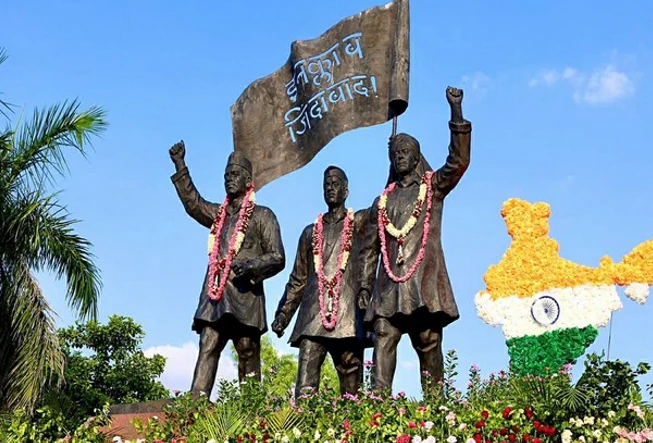
At Hussainiwala, the Martyrs Memorial—rebuilt after the 1971 war—includes life-size statues of the trio gazing towards Pakistan, a poignant reminder of shared subcontinental history. A bronze statue stands in Parliament House, Delhi; schools, streets and even a Lahore chowk bear his name. Films such as Shaheed (1963) and Rang De Basanti (2006), postage stamps, and the immortal song Sarfaroshi ki Tamanna keep his voice alive for new generations.
Bhagat Singh was no mere terrorist, as the British labelled him. He was a socialist visionary who believed revolution must remake society, not just replace rulers. In an era of rising majoritarianism and inequality, his insistence on reason over religion, equality over hierarchy, and courage over compromise feels urgently contemporary. As India and Pakistan quietly honour the same icon across a contested border, the young revolutionary’s greatest triumph endures: empires crumble, but ideas refuse to die. Inquilab Zindabad.