


AI Generated Summary
- The solution was the cypher, a longstanding tradition in hip-hop culture in which rappers gather in a circle, perform over instrumental beats and respond creatively to one another’s verses.
- Its journey from informal Sunday gatherings to a collaboration with Mass Appeal India, the music label associated with American rap legend Nas, reflects the changing landscape of independent music in the country.
- What began as a small gathering of three aspiring rappers in Chandigarh has grown into a grassroots platform for emerging musicians, attracting international attention and opening new doors for independent artistes.
What began as a small gathering of three aspiring rappers in Chandigarh has grown into a grassroots platform for emerging musicians, attracting international attention and opening new doors for independent artistes.
Long before independent hip-hop began finding a wider audience across India, three young musicians in Chandigarh were experimenting with a simple idea: creating a space where aspiring rappers could perform, exchange ideas and develop their craft without depending on established music labels.
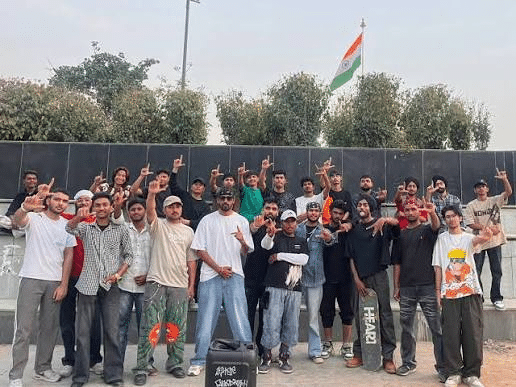
Nearly a decade later, that initiative, known as Lehar, has evolved into a growing community of rappers, lyricists and music producers. Its journey from informal Sunday gatherings to a collaboration with Mass Appeal India, the music label associated with American rap legend Nas, reflects the changing landscape of independent music in the country.
Founded in 2017 by Randhir Singh Sandhu, popularly known as Srganah, alongside Dinesh Kumar, or Slim Nesh, and Mandeep Singh, known professionally as Dox, Lehar emerged at a time when India’s underground hip-hop scene had limited access to mainstream platforms.
Sandhu, who hails from Batala and was studying at DAV College in Chandigarh, had been independently releasing rap music on YouTube. His eventual connection with the other two musicians, who were pursuing similar creative interests, laid the foundation for what would become a larger cultural initiative.
Rather than focusing exclusively on producing commercially successful songs, the founders wanted to establish an environment where musicians could learn from one another, experiment with different styles and find an audience.
The solution was the cypher, a longstanding tradition in hip-hop culture in which rappers gather in a circle, perform over instrumental beats and respond creatively to one another’s verses.
Lehar’s earliest cyphers took place in Chandigarh’s Sector 17. Initially, participation was limited to the three founders themselves. However, the consistency of the weekly sessions gradually attracted other young musicians, transforming a modest gathering into a recurring platform for local talent.
Unlike conventional music competitions, these sessions placed greater emphasis on participation and artistic development than on rankings or commercial appeal. For emerging rappers without recording equipment, industry connections or opportunities to perform publicly, they offered a valuable introduction to the music community.
Building a Music Community Beyond Chandigarh
As participation increased, Lehar began extending its activities beyond Chandigarh, establishing a presence in Delhi and organising occasional sessions across Punjab, Haryana, Himachal Pradesh and Uttarakhand.
Much of this expansion occurred organically, with participating musicians and listeners sharing performances through social media and encouraging others to attend.
For Delhi-based rapper MC Amrit, the introduction came through a Facebook announcement promoting a cypher at Connaught Place. What began as curiosity developed into regular participation, providing opportunities to practise and perform alongside other musicians.
Amrit has since continued releasing independent music, including his recent track Custom Khoon.
The platform has also played a role in helping artistes navigate the transition from amateur performances to professional music careers.
Dox, one of Lehar’s original founders, subsequently established himself as a full-time songwriter and music producer, contributing to tracks including Deewana and Superstar.
Another beneficiary of the community is Jagsifat, who performs under the name conVIth. After leaving his software development career in January 2024 to pursue music professionally, he became a regular participant in Lehar’s Chandigarh sessions.
His performances gained considerable visibility through short videos circulated on Instagram, illustrating how grassroots gatherings can complement digital platforms in helping independent musicians reach new listeners.
For artistes such as Rana Ji from Nayagaon, the advantages were equally practical. Access to fellow musicians, recording resources and performance opportunities helped overcome some of the financial and logistical barriers commonly faced by newcomers.
Rana Ji now collaborates with Chandigarh-based musician J-Punk as part of the hip-hop duo Bad Flow.
An International Collaboration Marks a Turning Point
Lehar’s growing influence reached a significant milestone in 2025 with the release of the Lehar Chandigarh Mixtape, developed in collaboration with Mass Appeal India.
The project brought together 19 rappers across 10 tracks, incorporating Punjabi, Hindi, Haryanvi and English. Its multilingual character reflected the diverse cultural and linguistic influences shaping northern India’s independent hip-hop scene.
The collaboration also connected a regional grassroots initiative with an internationally recognised music organisation.
According to Sandhu, the development followed an unexpected telephone call from Nas, the acclaimed American rapper and founder of Mass Appeal.
For a movement that began with independently uploaded YouTube performances and a handful of participants meeting in a public square, the association represented a remarkable expansion in visibility.
The mixtape also provided a professionally supported release platform for musicians who had largely developed their skills outside conventional industry structures.
Among its contributors was conVIth, whose track Shinobiz demonstrated the emerging talent associated with Lehar. The duo Bad Flow also appeared on the project.
Beyond the individual recordings, the collaboration highlighted the commercial music industry’s increasing interest in independent regional performers and locally developed creative communities.
The Growing Influence of Grassroots Hip-Hop
Lehar’s development coincides with broader changes in India’s music industry, where digital distribution, short-form video and independent releases have reduced some of the traditional barriers between musicians and listeners.
Although hip-hop gained greater mainstream visibility following the release of the Hindi film Gully Boy in 2019, regional communities had already been cultivating their own approaches to the genre.
Lehar represents one such effort, rooted in the idea that artistic communities can develop independently of commercial institutions before attracting wider recognition.
Its progress, however, has not been uninterrupted.
The Covid-19 pandemic disrupted physical gatherings and temporarily weakened the momentum of its regular sessions. The subsequent growth of music-related content on Instagram nevertheless helped introduce its performances to new audiences, contributing to renewed interest in the post-pandemic period.
Despite these developments, sustaining a professional career in independent music remains difficult. Limited financial resources, uneven access to production facilities and the challenge of converting online popularity into dependable income continue to affect emerging artistes.
The success of individual performers does not necessarily translate into financial security for the wider community.
That reality makes the continued existence of accessible platforms such as Lehar particularly relevant.
While commercial recognition may arrive for only a fraction of participating musicians, regular cyphers provide something less dependent on industry trends: an opportunity to practise, collaborate and be heard.
From three aspiring rappers performing for one another in Chandigarh to a multilingual project associated with an internationally recognised label, Lehar’s evolution demonstrates how local artistic initiatives can develop a reach far beyond their origins.
Its most enduring contribution may ultimately lie not in a particular album or collaboration, but in the network of musicians it continues to bring together—ensuring that the next generation of independent voices has somewhere to begin.