


AI Generated Summary
- At Ross Street, police shut the oldest gurdwara in North America on an anniversary weekend because they expected blood over a dispute that was sold as maryada and functioned as a struggle for who would speak for Khalistan inside the Guru’s house.
- The capture is the scandal, because it uses the one space the Gurus reserved for naam to advance a cause they never licensed as a substitute for faith.
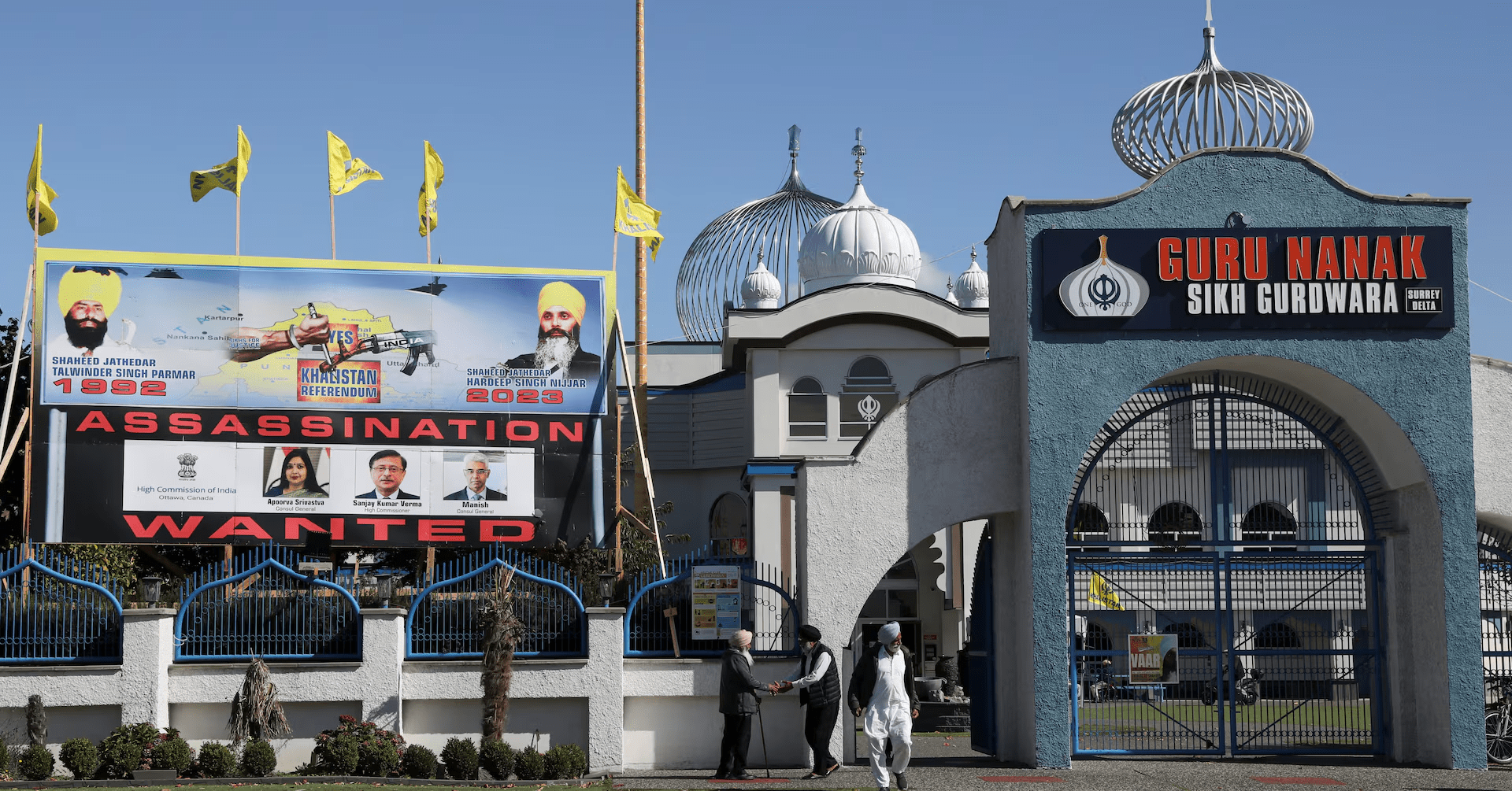
- After Hardeep Singh Nijjar became president in 2019, The Globe and Mail and The New York Times reported that portraits of those the movement calls shaheed went into the dining hall, Khalistan flags multiplied, and Parmar looked out over a public road.
A gurdwara is the Guru’s door. It exists so the living Word can be heard, so strangers can eat as equals, and so sewa can be done without a flag attached. It was not built to host an extremist campaign.
That is the whole argument. A minority of gurdwaras — not Sikhism, not the sangat, not the institution itself — have been captured for the Khalistan project. The capture is the scandal, because it uses the one space the Gurus reserved for naam to advance a cause they never licensed as a substitute for faith.
In Greater Vancouver, organisations committed to Khalistan moved to take the largest temples after 1984. The International Sikh Youth Federation took the Scott Road gurdwara in 1986 and held it for more than a decade. The World Sikh Organisation’s hard line became the atmosphere at other halls. Families who did not want a separatist sermon with their kirtan left. Others stayed and kept quiet. When a rival slate finally won Scott Road back in 1998, a man helping to assemble the opposition was attacked with a sword. At Ross Street, police shut the oldest gurdwara in North America on an anniversary weekend because they expected blood over a dispute that was sold as maryada and functioned as a struggle for who would speak for Khalistan inside the Guru’s house.
A former officer later described the moral wreckage of those years in a line that still fits: toughs received temple blessings by day, and averted eyes by night. Both factions used muscle. The Khalistan side used the Guru’s name.
That is the pattern. Not “Sikhs are political.” A separatist minority treating the darbar as ground to be held.
A poster is a sermon
In a gurdwara, what hangs on the wall teaches.
Canadian reporting has, for years, documented portraits and parade floats honouring Talwinder Singh Parmar — Babbar Khalsa founder, named by the Major inquiry as the leader of the conspiracy that destroyed Air India Flight 182 on 23 June 1985 and killed 329 people, most of them Canadians. Families of the dead have said the displays reopen the wound. Jagmeet Singh eventually called a Parmar photograph something that “re-traumatizes” the bereaved. Justin Trudeau said mass murderers should not be glorified. In some halls the face stayed up anyway.
At Guru Nanak Sikh Gurdwara in Surrey, the change was explicit. After Hardeep Singh Nijjar became president in 2019, The Globe and Mail and The New York Times reported that portraits of those the movement calls shaheed went into the dining hall, Khalistan flags multiplied, and Parmar looked out over a public road. Congregants said they were shocked. Some were afraid. In the autumn after his death, chants for Parmar and for the Khalistan Tiger Force were heard at the same complex. Ajaib Singh Bagri, acquitted in the Air India trial and infamous for a speech about killing 50,000 Hindus, was reported as staging a return there.
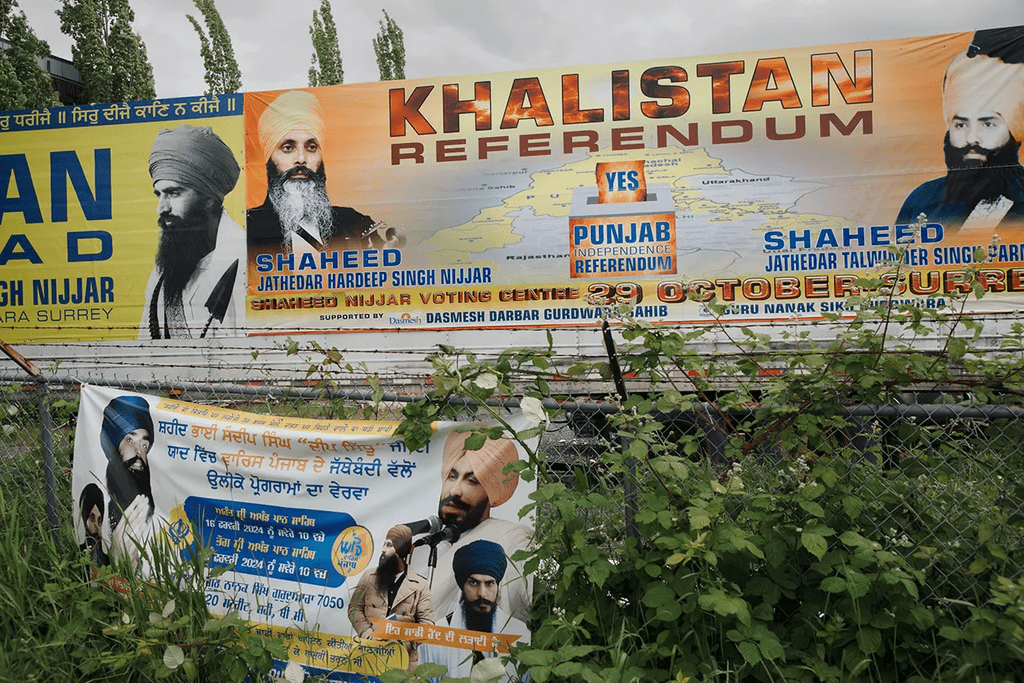
Parmar on the langar wall is a political claim: that the bombing was martyrdom, and that the Guru’s kitchen will say so. Moderate Sikh writers have called that what it is — desecration of a space meant for naam, sewa and equality.
How many halls?
Most have not been.
An news report by News18 in 2023 that of about 250 Canadian gurdwaras, roughly eight were Khalistani-controlled — named around Surrey, Brampton, Abbotsford and Dixie — with perhaps 5,000 hardcore supporters inside a much larger Sikh population. That is a single-source figure from an interested state. Use it as scale, not scripture. Even on that estimate, the captured institutions are a sliver. They dominate the photograph because they want to.
Canada-based Sikh critics have said the same thing: a handful of people turned some gurdwaras into “K-hubs”; the demand is not the community’s. Trudeau himself, late and under pressure, conceded that many Khalistan supporters in Canada do not represent Sikhs as a whole. The sentence should have been the starting point of policy, not a footnote.
The same script, other countries
In Wolverhampton, Punjab Singh sits as a gurdwara trustee after a mid-2000s terror conviction in India. British charity law, the Commission told a congregant, does not automatically disqualify him for an Indian conviction. In 2023 he was arrested again in Amritsar and described by Punjab Police as an associate of Lakhbir Singh Rode, the Pakistan-based ISYF figure and Bhindranwale’s nephew. The point is that Khalistan’s old cases travel by committee election and then preach from a new palki.
At Nankana Sahib — Guru Nanak’s birthplace — Sikhs for Justice has used pilgrimage seasons to hang Referendum 2020 banners across the complex. Some say the ISI made the stage possible. Pakistan has its own uses for a televised Sikh grievance. The pilgrim who came to bow finds a campaign. The holiest geography in the tradition becomes a set for secession.
That is the through-line from Scott Road to Surrey to Wolverhampton to Nankana: the Khalistan project needs the gurdwara because without the gurdwara it is a faction. With the gurdwara it can call itself the Panth.
The Gurus already answered
Sikh history is not pacifist theatre. Guru Hargobind wore two swords. The Akal Takht is a temporal seat. None of that puts a separatist secretariat in the langar.
The Guru Granth Sahib replaced living men so that no commander could sit where revelation sits. Haumai — the ego that turns service into a banner — is the illness the Gurus named, not a political virtue. The pangat exists so that no one eats as a partisan. To park a “referendum” table beside that line of plates is to undo the line. To call a mass murderer shaheed under the nishan sahib is to conscript the Guru as a public-relations officer for a bombing.
Granthis and SGPC-aligned voices have condemned the use of the Guru’s house for faction and for the glamour of militancy. They are easy to omit if the piece is meant to flatten every turban into a yellow flag. They are the evidence that the objection is Sikh, not merely Indian.
The majority sangat does not need to be defended as “moderate,” as if faith were a temperature. It needs to be described accurately. On an ordinary evening the captured gurdwaras are not the story. A granthi reads. The hall feeds whoever walks in. That is the tradition. The Khalistan minority’s achievement is to stand on the steps of that tradition and speak as if they were it.
Reclaiming the door does not require a foreign government to appoint the committee. It requires the congregation to say, without apology, that Khalistan campaigning is politics, and politics does not get to sit on the palki. Host countries can stop treating a Parmar portrait as multicultural décor.
The Gurus asked for a house in which the One is remembered and the neighbour is fed. Some men used that house to preach a country that does not exist and to honour violence the Gurus would not have blessed. Naming the takeover is not an attack on Sikhs. Refusing to name it is how the takeover lasts.