


AI Generated Summary
- Speaking in Jalandhar on Saturday, Singh presented his latest endeavour, ‘Oneness in Diversity’, an ambitious archival project that seeks to preserve and communicate the spiritual plurality contained within the Guru Granth Sahib.
- Born in Gorakhpur in Uttar Pradesh, a region inseparably associated with the legacy of Bhagat Kabir, Singh encountered Kabir before he discovered Guru Nanak in depth.
- The expanded archive is also intended to document the lives and historical worlds of these contributors, allowing audiences to encounter the verses alongside the cultural and spiritual circumstances from which they emerged.
Amardeep Singh’s ambitious ‘Oneness in Diversity’ project seeks to preserve the many spiritual voices enshrined in the Guru Granth Sahib for generations to come
To locate Sikhism solely within the geography of Punjab may be to overlook something fundamental about the tradition itself — the extraordinary breadth of voices, journeys and spiritual encounters that shaped its foundations.
For author and independent researcher Amardeep Singh, that question is also deeply personal. Born in Gorakhpur in Uttar Pradesh, a region inseparably associated with the legacy of Bhagat Kabir, Singh encountered Kabir before he discovered Guru Nanak in depth. His family’s own story crosses the borders that came to divide the subcontinent: his ancestors belonged to what is now Pakistan before settling in Uttar Pradesh following Partition.
It is perhaps unsurprising, then, that borders have rarely determined the way Singh approaches history, faith or cultural inheritance.
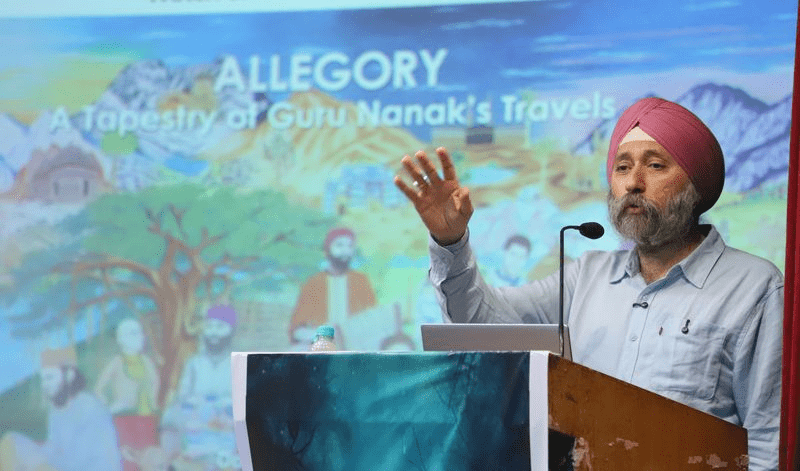
Speaking in Jalandhar on Saturday, Singh presented his latest endeavour, ‘Oneness in Diversity’, an ambitious archival project that seeks to preserve and communicate the spiritual plurality contained within the Guru Granth Sahib.
At the heart of the initiative are 1,656 shabads, being recorded and digitally archived in renditions by artists Satninder Bodal and Salima Khwaja. The collection brings together compositions associated not only with Guru Nanak but with a remarkable constellation of spiritual figures whose words became part of the Sikh scriptural tradition.
Among them are Bhagat Kabir, Bhagat Ramanand, Bhagat Ravidas, Sheikh Farid, Bhagat Namdev, Bhagat Jaydev, Bhagat Trilochan, Bhagat Sadhna, Bhagat Sain, Bhagat Pipa, Bhagat Dhanna, Bhagat Surdas, Bhagat Parmanand, Bhagat Bheekhan and Bhagat Beni, along with Bhai Mardana.
The project was commissioned in January 2023 and its first phase is expected to conclude in December 2027. But that will constitute only part of a much larger undertaking.
A second phase, proposed for 2027 to 2032, aims to document more than 4,300 additional shabads, including compositions of Guru Angad, Guru Amar Das, Guru Ram Das, Guru Arjan and Guru Tegh Bahadur, as well as the Bhatts. The expanded archive is also intended to document the lives and historical worlds of these contributors, allowing audiences to encounter the verses alongside the cultural and spiritual circumstances from which they emerged.
For Singh, preservation is not merely an act of storing the past. It is an attempt to make that past intelligible to people who may inherit the tradition without necessarily understanding the diversity from which it arose.
Following a Trail Across Borders
The project represents another chapter in Singh’s long engagement with the Sikh heritage scattered across the subcontinent.
His earlier books, ‘Lost Heritage: The Sikh Legacy in Pakistan’ and ‘The Quest Continues: Lost Heritage, The Sikh Legacy in Pakistan’, emerged from extensive journeys through Pakistan, where he documented gurdwaras, monuments, architectural remains and communities connected with Sikh history.
During three research expeditions, Singh travelled into areas where traces of that inheritance survived despite decades of political separation and demographic transformation. His work also drew attention to lesser-known Nanakpanthi communities, preserving through photographs, writing and documentary material evidence that might otherwise have gradually disappeared from public memory.
A documentary screened at the Jalandhar event offered glimpses into those journeys and the thinking that shaped the two books.
The experience appears to have reinforced one of Singh’s central arguments: heritage cannot be neatly confined within the religious categories through which modern societies often attempt to understand it.
“Religion isn’t a legacy. It’s a subset of legacies,” Singh said, pointing to military, cultural and architectural histories as well as everyday inheritances expressed through food and clothing.
His approach consequently places Sikh history within a wider civilisational landscape rather than treating it as an isolated religious narrative.
Nanak and the Geography of Ideas
That perspective becomes particularly significant when examining Guru Nanak’s journeys.
Singh questions attempts to compress Nanak’s legacy into contemporary geographical or political boundaries. His own research, he said, led his team to conclude that Guru Nanak travelled through territories that today constitute nine countries.
Yet the importance of those journeys lies not simply in determining how far Nanak travelled. More significant is what he encountered, recognised and carried forward.
The Guru Granth Sahib itself bears testimony to a spiritual landscape extending far beyond a single community. Its pages preserve voices emerging from different regions, social locations and devotional traditions.
For Singh, Guru Nanak’s importance therefore lies partly in his recognition that spiritual insight need not belong to one identity alone.
He asks a deceptively simple question: what would have happened had voices such as Kabir or Namdev simply been ignored?
History would have continued. Yet something invaluable would have disappeared.
Their presence within the Sikh scriptural universe demonstrates an act of spiritual discernment — the recognition and preservation of wisdom irrespective of where, or through whom, it appeared. In Singh’s interpretation, Nanak’s legacy consequently includes a remarkable consolidation of spiritual voices from across the Indian subcontinent.
It is this idea that gives ‘Oneness in Diversity’ both its name and its purpose.
Singh compares the task of documentation with the painstaking work that preceded the recognition and preservation of Buddhist monuments across countries such as Laos and Cambodia. Cultural inheritance, he argues, cannot be protected merely by assuming that future generations will recognise its significance.
First it must be documented.
And increasingly, that documentation must be capable of travelling beyond libraries, institutions and national boundaries.
The online archive seeks to do precisely that — allowing the shabads, their music and the histories surrounding them to remain accessible to a generation whose relationship with heritage will increasingly be mediated through digital spaces.
Ultimately, Singh says, the work is being undertaken for “our daughters, children and the coming generation”, so they can encounter Guru Nanak not merely as a figure claimed by a particular geography or community, but through the much larger spiritual inheritance his journey helped preserve.
Seen through that lens, the question of where Sikhism “comes from” acquires a different meaning.
Its historical heart may beat powerfully in Punjab. But the voices gathered within its scripture lead outward — towards Kabir and Ravidas, Farid and Namdev, across languages, communities and landscapes.
And perhaps the legacy of Nanak lies precisely there: not in diminishing difference, but in recognising the possibility of oneness within it.