


AI Generated Summary
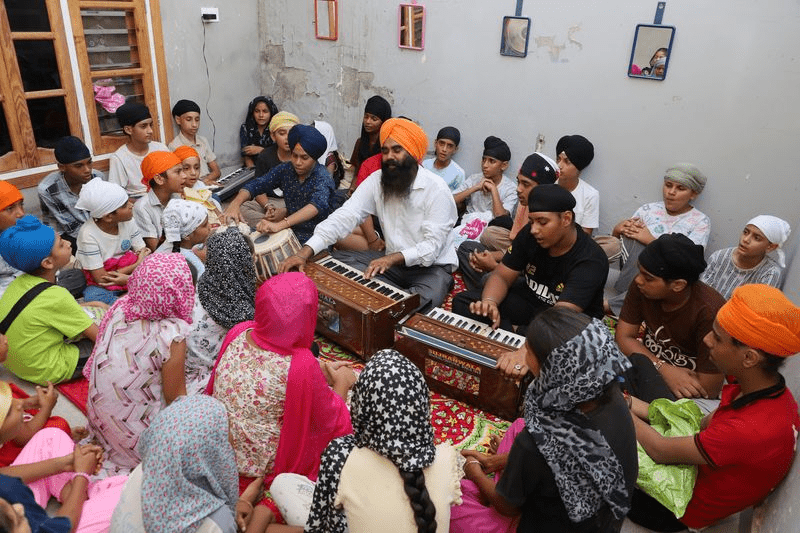
- At a village home in Kang Sabu near Nakodar, the sound of mobile games and online videos is increasingly being replaced on weekends by the notes of the harmonium, the beat of the tabla and children singing shabads together.
- He said concerns about the influence of online gaming had become more pressing after he recently heard about an incident in which a child allegedly attacked another child after losing an online game.
- Concerns in Punjab intensified after a recent case in Nawanshahr in which three students reportedly consumed a poisonous substance after allegedly suffering losses in an online game.
At a village home in Kang Sabu near Nakodar, the sound of mobile games and online videos is increasingly being replaced on weekends by the notes of the harmonium, the beat of the tabla and children singing shabads together.
Concerned over growing cellphone dependence among children, a group of non-resident Indians (NRIs) with roots in the village has launched an initiative aimed at helping youngsters reduce their screen time and develop healthier interests.
Around 60 children, aged between six and 18, are attending free weekend sessions that combine lessons on responsible use of technology with music, Gurbani, Punjab’s history and traditional skills such as turban tying.
The initiative has been supported by UK-based Kamaljit Singh, Baljit Singh and Baljinder Singh, along with Avtar Singh Sodhi from Canada, through the Kang Sabu NRI Welfare Society.
For parents such as the mother of six-year-old Gurbani Kaur, the classes offer hope of breaking a habit that has increasingly become a source of concern at home. She said her daughter would spend considerable time playing games on her phone. The few hours spent at the weekend classes, she hopes, will gradually change that routine.
Rather than seeking to remove smartphones entirely from children’s lives, the programme attempts to teach them to use the devices selectively and constructively. Students are encouraged to turn to phones for homework and educational resources connected with their school curriculum instead of spending long hours gaming or consuming entertainment content.
The initiative comes against the backdrop of growing anxiety over excessive smartphone use and online gaming among children. Concerns in Punjab intensified after a recent case in Nawanshahr in which three students reportedly consumed a poisonous substance after allegedly suffering losses in an online game. Two of them died.
Baljit Singh said the NRIs behind the project felt there was a need to intervene while the children were still young.
“We are already losing many youngsters to drugs, but we want this generation, which is still young, to be protected at any cost,” he said.
Expressing concern about the direction in which younger generations were heading, he added, “Saadiyan peedhiyan gwaach rahiyaan (our generations are getting lost). We want children to remain alert in life and become successful.”
The NRI welfare group has also been organising sporting competitions in the village, providing youngsters with opportunities to spend their time in activities away from screens.
Most of the weekend sessions are being conducted at the residence of Sarwan Singh, who offered his home after members of the NRI community approached him about doing something for village children.
“The NRIs are very concerned. They asked me to do something. Thus, I offered my home for these sessions,” he said.
Government school teacher Ravinder Singh Kang is among those interacting with the children and delivering talks during the programme. He said concerns about the influence of online gaming had become more pressing after he recently heard about an incident in which a child allegedly attacked another child after losing an online game.
The organisers believe simply warning youngsters about excessive smartphone use may not be enough. Their approach, therefore, focuses equally on providing alternatives that can hold children’s attention and connect them with music, community and Punjab’s cultural traditions.
Music teacher Yadwinder Kaul uses the harmonium and tabla sessions not only to introduce children to music but also to speak to them about how prolonged Internet exposure and compulsive online gaming can affect their habits and well-being.
Parents say they are beginning to notice a difference.
Suman Bala, whose eight-year-old daughter has been attending the sessions for about two months, recalled that the child earlier found it difficult to remain away from the phone and had become increasingly irritable. She said there had been a noticeable improvement since her daughter began participating in the classes.
Some of the children, too, recognise the change in their routines. Class VII student Kulraj Singh said he previously spent time playing games on his phone but now uses it considerably less.
“Earlier, I used to play games on the phone. Now, my screen time has reduced a lot,” he said.
For the families gathering in Kang Sabu every weekend, the effort is ultimately about more than restricting access to a device. By filling those hours with music, history, sport and community interaction, they hope children will discover that there is enough beyond the screen to keep them engaged.