


AI Generated Summary
- Raised in a family with deep farming roots in Chogawan Sadhpur village near Amritsar, he once dreamed of securing a government teaching job after earning a Master’s degree in Mathematics.
- His academic journey seemed to be heading in the right direction when he achieved a merit rank in the Teacher Eligibility Test (TET).
- He plans to establish a larger turmeric processing facility that will not only handle produce from his own farm but also source turmeric from other growers, creating additional opportunities for farmers in the region.
For Yadwinder Singh, agriculture was a legacy he inherited, but not the future he originally imagined for himself. Raised in a family with deep farming roots in Chogawan Sadhpur village near Amritsar, he once dreamed of securing a government teaching job after earning a Master’s degree in Mathematics.
His academic journey seemed to be heading in the right direction when he achieved a merit rank in the Teacher Eligibility Test (TET). However, a prolonged legal dispute surrounding the recruitment process altered his plans, compelling him to reconsider his career path.
What initially appeared to be a setback eventually became the turning point that led him toward entrepreneurship and innovation in agriculture.
The foundation for his success was laid much earlier by his father, Karamjit Singh, a progressive farmer known for embracing new agricultural practices recommended by Punjab Agricultural University. Inspired by this forward-looking approach, the family ventured into turmeric cultivation in 2008, becoming among the earliest growers of the crop in Punjab.
Starting with just three acres of turmeric cultivation, the family soon recognised the crop’s potential. Yet, as more farmers entered the sector and production increased, marketing challenges began to emerge. Rather than accept shrinking returns, Yadwinder decided to rethink the business model.
He observed that the real value in agriculture often lies beyond cultivation. Processing, branding and direct marketing, he realised, generated far greater profits than selling raw produce through conventional channels.
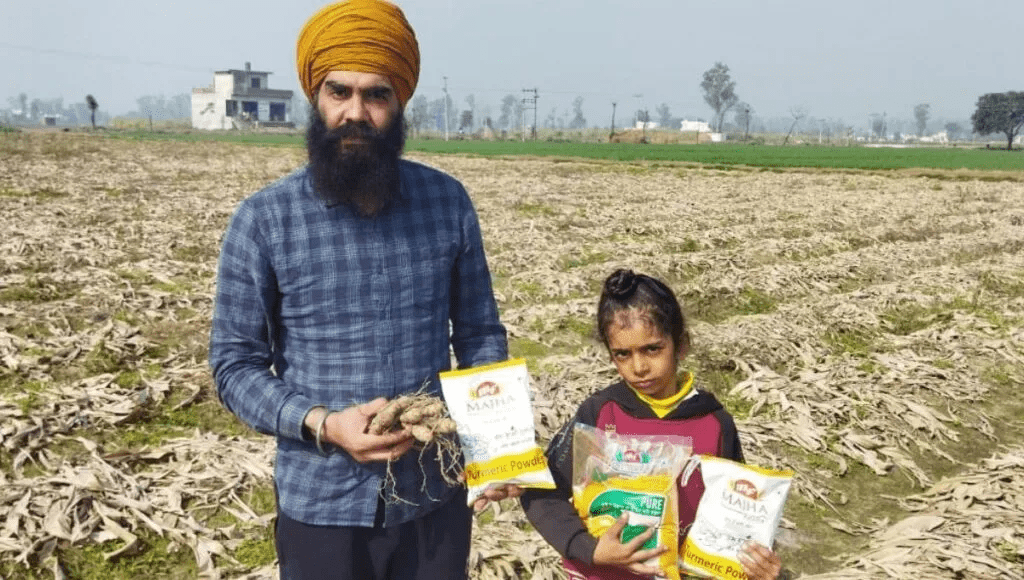
This insight led to the creation of Majha Haldi, a turmeric-based brand that allowed the family to process and market its own produce. Over time, the venture expanded significantly and evolved into Majha Foods, a diversified food enterprise offering products such as basmati rice, honey, jaggery, pulses, spices and even turmeric pickle.
By taking control of the entire value chain and reducing dependence on intermediaries, the family substantially improved its earnings while establishing a strong market presence.
Today, Yadwinder’s farm combines traditional agricultural knowledge with modern technology. Natural farming practices form the backbone of operations, while efficient irrigation systems, including sprinklers and rain guns, help conserve resources and improve productivity.
The entrepreneur now has even bigger ambitions. He plans to establish a larger turmeric processing facility that will not only handle produce from his own farm but also source turmeric from other growers, creating additional opportunities for farmers in the region.
Yadwinder’s journey reflects a growing shift in Indian agriculture, where farmers are increasingly focusing on value addition and branding rather than relying solely on crop cultivation. His story demonstrates how innovation and business acumen can transform farming into a profitable enterprise.
Looking back, he has no regrets about the teaching career that never materialised.
According to him, agriculture has provided not only financial stability but also recognition and respect. He believes that young people should focus on creating businesses and pursuing entrepreneurship instead of limiting themselves to the search for traditional government jobs.
His success stands as a testament to the potential of modern farming when combined with vision, technology and a willingness to take risks.