
AI Generated Summary
- In a statement shared on social media, he said the seizure demonstrated India’s resolve to dismantle international drug syndicates attempting to exploit the country as a transit route.
- According to investigators, the crackdown exposed a Syria-linked trafficking network that allegedly routed narcotics consignments through India before forwarding them to destinations such as Saudi Arabia and other Gulf countries, where the drug has emerged as a major security and public health concern.
- In a coordinated operation named Operation Ragepill, the Narcotics Control Bureau (NCB) seized nearly 228 kilograms of Captagon — an amphetamine-based drug widely associated with militant networks in West Asia — with an estimated international value of around Rs 182 crore.
India’s anti-narcotics agencies have uncovered what officials describe as the country’s first major Captagon seizure, busting an alleged international drug trafficking syndicate that used Indian territory as a transit corridor for smuggling the banned stimulant to Gulf nations.
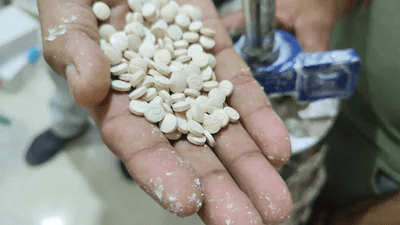
In a coordinated operation named Operation Ragepill, the Narcotics Control Bureau (NCB) seized nearly 228 kilograms of Captagon — an amphetamine-based drug widely associated with militant networks in West Asia — with an estimated international value of around Rs 182 crore.
According to investigators, the crackdown exposed a Syria-linked trafficking network that allegedly routed narcotics consignments through India before forwarding them to destinations such as Saudi Arabia and other Gulf countries, where the drug has emerged as a major security and public health concern.
The operation was initiated after Indian authorities received intelligence inputs from an overseas anti-drug agency warning that international cartels were attempting to use India as a logistical hub for Captagon shipments.
Acting on the intelligence, NCB teams raided a rented property in Delhi’s Neb Sarai locality on May 11. During the search, officers recovered approximately 31.5 kg of Captagon tablets hidden inside a commercial chapati-cutting machine that was allegedly being prepared for export to Jeddah.
A Syrian national was arrested during the raid. Officials said he had entered India on a tourist visa in November 2024 and had remained in the country illegally after his visa expired earlier this year.
Subsequent interrogation and investigation led officers to Gujarat’s Mundra Container Freight Station, where another consignment linked to the syndicate was intercepted. Authorities recovered nearly 196.2 kg of Captagon powder concealed in bags hidden within a shipment of sheep wool imported from Syria.
Preliminary findings suggest the cargo was intended for onward transportation to Gulf nations, particularly Saudi Arabia, where Captagon abuse has become a growing challenge for law enforcement agencies.
Union Home Minister Amit Shah described the operation as evidence of the government’s “zero-tolerance” policy against narcotics trafficking. In a statement shared on social media, he said the seizure demonstrated India’s resolve to dismantle international drug syndicates attempting to exploit the country as a transit route.
Captagon, a banned synthetic stimulant, has gained notoriety across conflict zones in West Asia and is frequently linked to extremist groups, armed militias and organised criminal networks. The drug is often referred to as the “jihadi drug” because of reports that fighters consume it to remain awake for long periods and suppress fear during combat.
Officials noted that the seizure highlighted an emerging trend in which global narcotics syndicates increasingly rely on commercial cargo networks and containerised trade routes to move illicit substances across borders.
The development follows another recent narcotics interception by the NCB in Mumbai, where authorities seized 349 kg of cocaine concealed inside a shipping container originating from Ecuador.
Investigators are now examining the financial transactions, hawala channels and logistics chains allegedly connected to the Captagon network. Agencies are also working to identify overseas handlers and recipients believed to be part of a larger transnational trafficking cartel.
The NCB said the success of Operation Ragepill underscored the growing importance of international intelligence-sharing and coordinated enforcement efforts in tackling narco-terrorism and cross-border drug trafficking operations.