


AI Generated Summary
- In the small village of Rai Bhoi Di Talwandi, during the late 15th century, the summer heat was a physical weight, shimmering off the parched earth and turning the shade of the vanishing scrubland into a precious commodity.
- Rai Bular watched in hushed awe as the “King of Snakes” provided a cool shadow for the future Guru, acting as a servant to a divine presence it recognized instinctively.
- For a venomous creature to exert its energy not to kill, but to protect, was a sign that the person beneath it held a status higher than kings.
The sun over the Punjab plains has always been a relentless force. In the small village of Rai Bhoi Di Talwandi, during the late 15th century, the summer heat was a physical weight, shimmering off the parched earth and turning the shade of the vanishing scrubland into a precious commodity.
It was on such a day that young Nanak, a boy whose quiet intensity often puzzled his father, Mehta Kalu, was sent into the fields to tend the family’s cattle. To his father, Nanak was a daydreamer—a child who seemed more interested in the rhythm of the wind than the accumulation of wealth. But to the landscape itself, Nanak was something entirely different.
The Watcher in the Grass
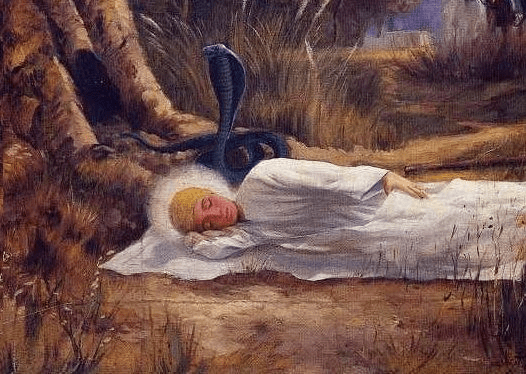
As the afternoon sun reached its zenith, the cattle grazed lazily near the edge of a golden pasture. Exhausted by the heat, Nanak lay down beneath the sparse protection of a small tree. As sleep took him, the Earth continued its rotation, and the meager patch of shade drifted away, leaving the boy’s face exposed to the blistering, direct rays of the sun.
It was at this moment that Rai Bular, the village chief and a man of keen intuition, was riding past the fields. From a distance, he spotted the solitary figure of the boy lying motionless in the grass. But as he drew closer, his breath caught in his throat, and he signaled his attendants to halt.
What he saw defied the natural order of predator and prey.
An Impossible Guardian
A massive black cobra, thick as a man’s wrist, had emerged from the tall grass. Instead of striking, the serpent had reared its body upward, spreading its great, mottled hood wide. It stood perfectly still, positioned precisely between the sun and the sleeping boy.
The cobra was not a threat; it was a chhatar—a royal canopy.
In the ancient traditions of the East, the cobra is often a symbol of elemental power and hidden wisdom. For a venomous creature to exert its energy not to kill, but to protect, was a sign that the person beneath it held a status higher than kings. Rai Bular watched in hushed awe as the “King of Snakes” provided a cool shadow for the future Guru, acting as a servant to a divine presence it recognized instinctively.
The Awakening of Rai Bular
Rai Bular was a devout man, and this sight shook him to his core. He recognized that the boy napping in the dirt was no ordinary village lad. He saw that the universe itself—even its most feared inhabitants—was in a state of constant service to Nanak’s soul.
When Nanak finally stirred and awoke, the cobra sensed the movement. Without a sound, it lowered its hood and slithered back into the depths of the earth, vanishing as quickly as a dream. Nanak rose, rubbed his eyes, and looked toward his cattle, seemingly unaware of the miraculous shield that had just been withdrawn.
Rai Bular rushed to Mehta Kalu, not with a report of a lazy son, but with a plea for reverence.
“Kalu,” he is said to have remarked, “do not be angry with this boy. He is not yours alone; he belongs to the world.”
The Legacy of the Shade
The story of the Cobra’s Shadow remains one of the most evocative “Sakhis” (stories) of Guru Nanak Dev Ji’s childhood. It serves as the first major indication that Nanak’s path would not be defined by the mundane rituals of commerce or farming.
It teaches us that:
- Divine Recognition: Nature recognizes the enlightened long before humanity does.
- Transcending Fear: The most “dangerous” elements of creation find peace in the presence of a truly realized soul.
- Universal Service: Everything in existence has a role in supporting the Truth.
To this day, the site where this event is believed to have occurred is marked by Gurdwara Bal Lila in Nankana Sahib. It stands as a reminder that even in the blistering heat of life’s trials, there is a grace that watches over us—sometimes appearing in the most unexpected of forms.
