


AI Generated Summary
- Hoping to instill a sense of commercial pragmatism, he handed Nanak twenty rupees—a small fortune at the time—and sent him toward the market with a simple directive.
- He argued that no investment on earth could yield a higher return than feeding the hungry, for while gold is fleeting, the blessings of the needy are eternal.
- The site of this original transaction is now home to Gurdwara Sacha Sauda, serving as a permanent monument to the idea that the most profitable business deal is, and always will be, humanity.
In the dusty trade routes of 15th-century Punjab, “profit” was a word measured in gold coins, silk bales, and livestock. But for a young Nanak Dev Ji, the currency of the soul held a far more stable exchange rate. This month, our Our Roots series explores Sacha Sauda—The True Bargain—a foundational moment that redefined wealth for an entire civilization.
The Twenty-Rupee Test
The story begins in Talwandi, where Nanak’s father, Mehta Kalu, grew increasingly concerned about his son’s contemplative nature. Hoping to instill a sense of commercial pragmatism, he handed Nanak twenty rupees—a small fortune at the time—and sent him toward the market with a simple directive: “Strike a good, profitable bargain.”
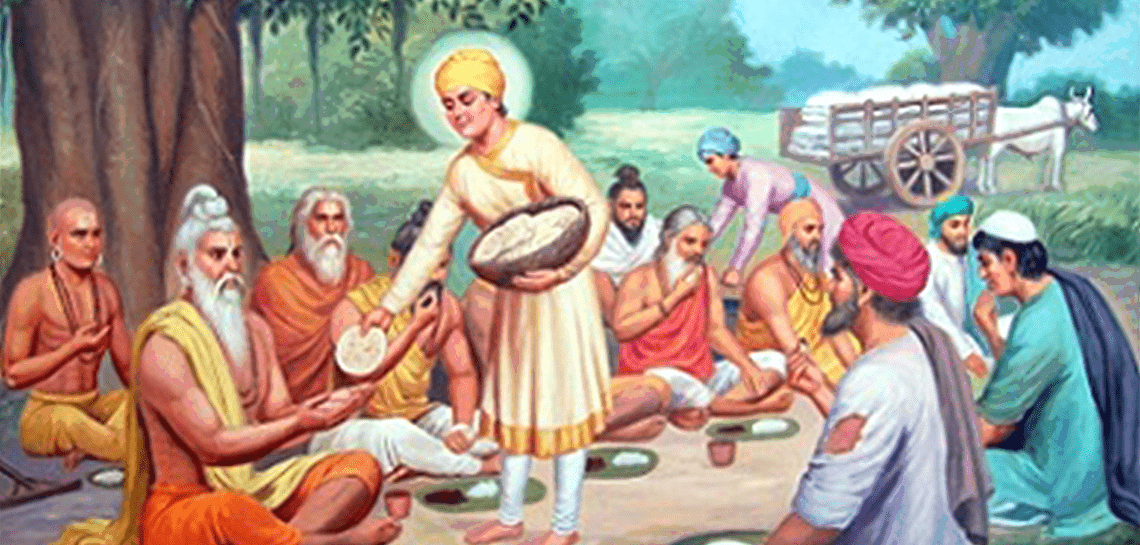
Accompanied by Bhai Mardana, Nanak set out to prove his business acumen. However, his journey was interrupted not by a marketplace, but by a sight of profound suffering. In a nearby forest, they encountered a group of hungry, displaced monks who had been without food for days.
A Different Kind of Investment
While a traditional merchant would have seen a group of penniless wanderers, Nanak saw a divine opportunity. He realized that no purchase of fabric or grain for resale could match the urgency of the moment. Without hesitation, he traveled to the nearest village, used the entire twenty rupees to purchase flour and pulses, and prepared a massive meal for the monks.
When Nanak returned home empty-handed, his father was understandably incensed. Where were the goods? Where was the profit? Nanak calmly explained that he had performed Sacha Sauda. He argued that no investment on earth could yield a higher return than feeding the hungry, for while gold is fleeting, the blessings of the needy are eternal.
The Heritage of Langar
This wasn’t merely a moment of youthful rebellion; it was the founding stone of Langar—the community kitchen. Today, that twenty-rupee investment has matured into a global institution. In every Gurdwara across the world, the spirit of Sacha Sauda lives on through:
- Radical Equality: Everyone sits together on the floor to eat, dissolving barriers of caste or creed.
- Vand Chakko: The core Sikh principle of sharing one’s honest earnings with those in need.
- Seva: The selfless service of preparing and serving food without expectation of reward.
Why It Still Matters
In a modern world driven by “bottom lines,” Sri Guru Nanak Dev Ji’s 500-year-old lesson remains a radical challenge to our priorities. He redefined wealth not as what we accumulate, but as what we are willing to give away. The site of this original transaction is now home to Gurdwara Sacha Sauda, serving as a permanent monument to the idea that the most profitable business deal is, and always will be, humanity.