


AI Generated Summary
- Canada aims to more than double two-way trade with India to roughly $51 billion annually by 2030 — a cornerstone of Carney’s strategy to reduce Canada’s dangerous over-reliance on the United States.
- A small pro-Khalistan fringe tried to disrupt British Columbia Premier David Eby’s trade mission to India in January 2026, waving Khalistan flags and calling for his resignation, accusing him of prioritizing trade over “justice.
- Canada cannot ask India to trust it as a long-term partner while simultaneously allowing fringe groups to desecrate Indian symbols and intimidate diplomats on Canadian soil.
As Prime Minister Mark Carney visits India for one of the most consequential diplomatic missions in recent Canadian history, a familiar and dangerous shadow looms back home. Pro-Khalistan extremists, a small but disruptive fringe operating within Canada’s borders, are actively working to sabotage the very future Carney is trying to build.
The stakes could not be higher. Carney’s trip is designed to unlock new opportunities for Canadian workers and businesses across trade, energy, technology, and defence. Canada aims to more than double two-way trade with India to roughly $51 billion annually by 2030 — a cornerstone of Carney’s strategy to reduce Canada’s dangerous over-reliance on the United States. The agenda is immense, with cooperation agreements potentially covering nuclear power, oil, critical minerals, AI, quantum computing, and education.
This is not diplomacy for diplomacy’s sake. It is an economic lifeline-building. And yet, even as Carney works to reset relations poisoned by years of Trudeau-era tensions, extremist groups are doing their best to tear it down.
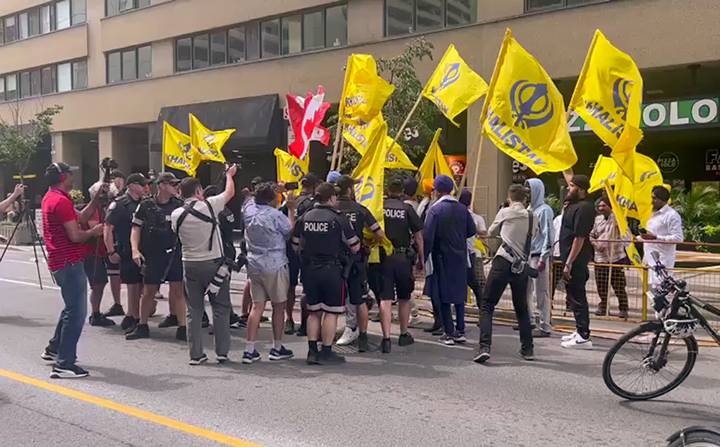
In recent weeks, targeted protests have escalated in Canada. Demonstrators invoking the legacy of Hardeep Singh Nijjar have staged actions including inflammatory displays — tearing and burning symbols associated with India, openly threatening Canadian PM Mark Carney — intended to provoke and undermine bilateral cooperation. This is not a peaceful protest. It is deliberate interference in sovereign diplomacy.
A small pro-Khalistan fringe tried to disrupt British Columbia Premier David Eby’s trade mission to India in January 2026, waving Khalistan flags and calling for his resignation, accusing him of prioritizing trade over “justice.” The same playbook is being deployed against Carney’s far more significant visit. Groups like Sikhs for Justice, which CSIS identifies as engaged in “politically motivated violent extremism”, frame every act of Canadian economic self-interest as betrayal, while offering nothing constructive in return.
The costs of tolerating this behaviour are real and measurable. Indian officials have repeatedly described Khalistani extremism as a “Canadian problem” that Ottawa must address internally to foster genuine reconciliation, emphasizing that progress on trade and diplomacy depends on both sides demonstrating commitment free from radical interference. Canada cannot ask India to trust it as a long-term partner while simultaneously allowing fringe groups to desecrate Indian symbols and intimidate diplomats on Canadian soil.
It is critical to be clear: the vast majority of Canada’s 770,000-strong Sikh community has nothing to do with this extremism. Most Sikhs condemn the politicization of gurdwaras and the stigma this fringe imposes on peaceful Sikhs who prioritize integration and legitimate advocacy. The miscreants represent only themselves — and they do so loudly and destructively.
Canada finds itself at a genuine crossroads. With US trade relations increasingly unstable under Trump-era tariffs, the Indo-Pacific — led by India — represents Canada’s most credible path to economic diversification. Carney understands this. His government has already made security cooperation with India a priority, with national security advisers from both nations meeting in February to coordinate on transnational crime and intelligence-sharing.
The message to Canadian authorities must be equally clear: protect this diplomatic moment. Free speech ends where deliberate economic sabotage and intimidation of foreign diplomats begin. A handful of extremists should not be allowed to hold Canada’s prosperity hostage. The country’s future is being negotiated in New Delhi — and it deserves to succeed.