


AI Generated Summary
- India’s expanding artificial intelligence and robotics ecosystem was on full display at a recent national technology showcase, where developers, universities and startups presented a range of systems aimed at defence, agriculture, education and industrial automation.
- The emphasis on applied AI, educational integration and industry-ready robotics suggests a maturing ecosystem — one increasingly focused on translating research into tools that can operate beyond the laboratory and into everyday use.
- These platforms allow young learners to assemble and program machines using block coding, Python or C++, introducing them to mechanical systems, automation and artificial intelligence at an early age.
India’s expanding artificial intelligence and robotics ecosystem was on full display at a recent national technology showcase, where developers, universities and startups presented a range of systems aimed at defence, agriculture, education and industrial automation. Rather than focusing solely on futuristic concepts, many exhibitors highlighted practical, locally engineered solutions designed to address real-world challenges.
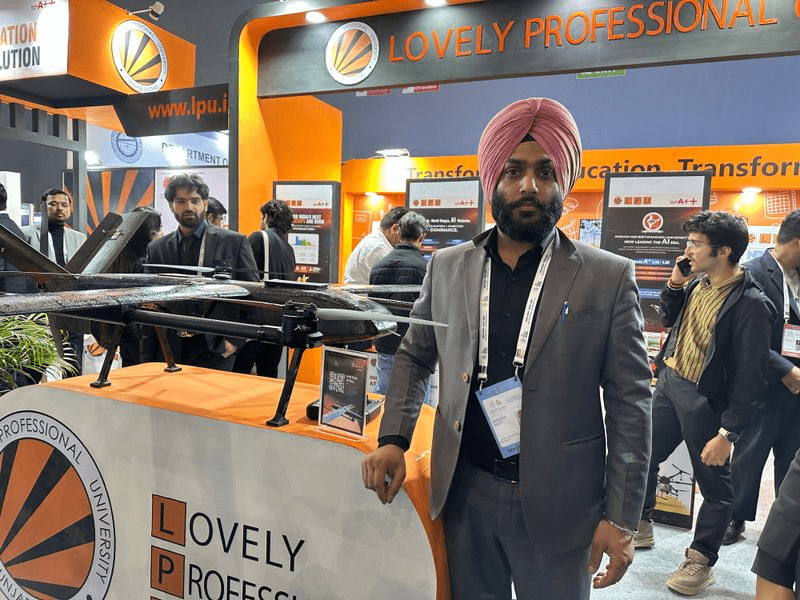
One of the strongest themes across the exhibition floor was the growing role of academic institutions in building mission-ready unmanned platforms. Researchers presented a portfolio of drone technologies tailored for surveillance, disaster response and logistics, reflecting closer collaboration between engineers and operational agencies. According to project leaders, the emphasis has shifted toward adaptable designs that can be modified for specific terrains and mission profiles.
Among the systems demonstrated was a hybrid vertical take-off and landing unmanned aerial vehicle that merges the flexibility of multirotor flight with the endurance of fixed-wing aircraft. Designed for extended aerial monitoring and emergency support, the platform integrates artificial intelligence to assist with navigation and real-time data analysis. Another drone-based solution showcased the use of AI-driven imaging for agriculture, capable of identifying crop diseases early and enabling targeted spraying — an approach developers say could reduce chemical use while improving yields.
Inspection robotics also featured prominently, with engineers unveiling a climbing robot built for wind turbine maintenance. Using AI vision and magnetic adhesion, the machine can scale metal structures and perform routine tightening tasks autonomously, potentially reducing the need for risky manual inspections at height.
Deep-tech startups added another dimension to the exhibition, signalling India’s ambition to move beyond application-level AI toward full-stack robotics. One Hyderabad-based company demonstrated a range of platforms designed to replicate core human abilities such as movement, manipulation and navigation. While some hardware components remain globally sourced, founders stressed that the design architecture, electronics and artificial intelligence systems are developed domestically. Early commercial use cases are expected in logistics and warehousing, with long-term plans aimed at service robotics in everyday environments.
Education emerged as a key driver of innovation throughout the event. Several organisations presented AI-focused learning models that combine academic coursework with extended hands-on development. In one programme, students split their day between theoretical study and lab-based experimentation, building functional prototypes as part of their training. A working demonstration included an AI-powered academic assistant that uses facial-recognition login and structured responses aligned with classroom material, an effort to keep learners focused on curriculum goals.
Grassroots STEM initiatives were equally visible, particularly through modular robotics kits designed for school students. These platforms allow young learners to assemble and program machines using block coding, Python or C++, introducing them to mechanical systems, automation and artificial intelligence at an early age. Developers say the approach encourages practical problem-solving and demystifies complex engineering concepts by letting students build and test robots themselves.
Taken together, the displays reflected a broader shift in India’s technology landscape. Rather than chasing spectacle, many innovators are prioritising functional design, interdisciplinary collaboration and scalable solutions. The emphasis on applied AI, educational integration and industry-ready robotics suggests a maturing ecosystem — one increasingly focused on translating research into tools that can operate beyond the laboratory and into everyday use.