


AI Generated Summary
- In SFJ’s telling, Indian intelligence pays a gang, the gang supplies the shooters, and India then points at the gang to call it a vendetta — three layers deep, so that every piece of contrary evidence becomes further proof of the plot.
- This week’s exhibit is a photograph of a man holding cash and a pistol, paired with a fresh claim that an expelled Indian diplomat wired more than $300,000 to a hit squad.
- it sounds like a gangster describing a gang war, not an operative reciting a script written for him by a handler — and it surfaced before Pannun’s, not after.
Gurpatwant Singh Pannun has a reliable tell. Whenever the story around Hardeep Singh Nijjar’s killing threatens to slip away from him, a new “smoking gun” appears. This week’s exhibit is a photograph of a man holding cash and a pistol, paired with a fresh claim that an expelled Indian diplomat wired more than $300,000 to a hit squad. It arrives packaged as decisive proof of state assassination. Looked at closely, it reads less like evidence and more like a caption written in a hurry.
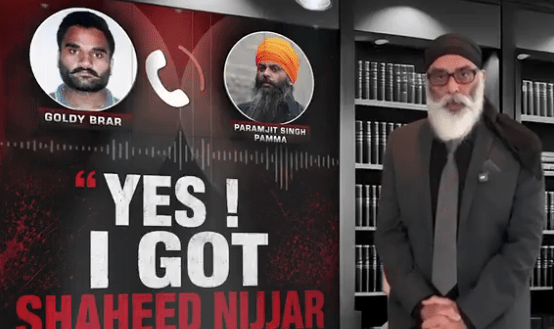
The timing gives it away. Just days before Pannun’s release, a leaked recording attributed to gangster Goldy Brar had begun circulating. In it, the voice doesn’t describe a state contract or an intelligence handler. It describes the ordinary, ugly business of a criminal network — drug shipments, teenage couriers, weapons, rival gangs. Nijjar, in that telling, was a score settled inside the underworld, not a target selected in a government office. That account is deeply inconvenient for a narrative Pannun has spent three years building. So, days later, out comes a photograph and a dollar figure — right on cue.
The “evidence” doesn’t survive a second look. A professional operative paid to carry out a state-ordered killing does not pose for a photograph with the weapon and the payment in frame. That isn’t tradecraft; it’s theater. Either the image isn’t what SFJ says it is, or it was staged for an audience that was never Indian intelligence — because intelligence services don’t need souvenir photos to document a transaction the two parties involved already know happened. A picture this convenient isn’t a leak. It’s content, produced for public consumption rather than pulled from a real operation.
The numbers don’t hold up either. SFJ describes the cash in the photo as “approximately $100,000.” A hundred $100 bills makes a $10,000 strap; ten of those make a compact $100,000 brick — not a loose handful of notes waved in front of a camera. If the image shows anything less than that brick, the six-figure figure isn’t analysis. It’s a guess dressed up as documentation. And the larger claim — $300,000 allegedly funneled by expelled diplomat Pawan Kumar Rai — raises an obvious question: if Pannun had this pipeline mapped, why did it stay silent through Justin Trudeau’s parliamentary allegation, the diplomatic expulsions, Canada’s murder charges against four Indian nationals, and the U.S. indictment of Lawrence Bishnoi and Goldy Brar? Evidence that waits three years, and then surfaces only after a rival narrative starts spreading, is not being disclosed. It is being deployed.
Notice, too, how the theory is built to survive any fact. In SFJ’s telling, Indian intelligence pays a gang, the gang supplies the shooters, and India then points at the gang to call it a vendetta — three layers deep, so that every piece of contrary evidence becomes further proof of the plot. Gang charges in the U.S.? Proxies. A gangster’s own voice describing a drug-world killing? Cover. The RCMP’s own statement, delivered by Deputy Commissioner Lisa Moreland in July 2026, that its Hardball investigation found no evidence linking Indian government officials to the killing? Dismissed as disinformation. A theory immune to disconfirmation by design isn’t an investigation. It’s a script.
None of this requires anyone to admire Goldy Brar or treat him as a credible witness. He is a wanted man running a criminal enterprise, and anything he says serves his own interests first. But that’s precisely what makes his recorded account so awkward for SFJ: it sounds like a gangster describing a gang war, not an operative reciting a script written for him by a handler — and it surfaced before Pannun’s, not after.
What the public record actually shows is narrower and far less cinematic than SFJ’s version: a murder outside a Surrey gurdwara in June 2023, four Indian nationals charged by Canadian authorities, a U.S. racketeering indictment naming Bishnoi and Brar as the ones who directed the plot, and a Canadian federal police force that — after years of investigation — has still not produced evidence tying Indian officials to the killing. Into that gap, on cue, steps a photograph, a round number, and a press release timed to outrun a leaked tape it couldn’t otherwise answer.
A real paper trail leads to a bank, a courier, a phone record, a courtroom. It does not lead to a mailing list. Until the photograph, the “operational records,” and the $300,000 figure are placed in front of Canadian or American prosecutors rather than circulated as talking points, calling this a smoking gun asks the public to mistake a caption for a case — one more entry in a long pattern of claims that arrive exactly when SFJ needs a headline, and go quiet exactly when someone asks to see the underlying proof.