


AI Generated Summary
- Instead of limiting its response to military targets, the Pakistani military engaged in heavy artillery shelling, mortar fire, and drone strikes along the Line of Control (LoC) that deliberately or recklessly hit civilian areas in Jammu and Kashmir, with a clear pattern of striking minority religious sites and communities.
- During the 2025 conflict, Pakistan’s military seemed to revive old Partition-era tactics—echoing the violence against Sikhs and Hindus in 1947—by zeroing in on non-Muslim sites in border areas to terrorize communities and fracture India’s social fabric.
- On the Christian front, a shell landed near Christ School in Poonch—run by the Carmelites of Mary Immaculate—killing two students from Christian families and injuring their parents.
In May last year, India launched Operation Sindoor in response to a brutal terrorist attack in Pahalgam, Jammu and Kashmir, that killed 26 civilians, mostly tourists. The operation involved precise missile and air strikes on terrorist infrastructure linked to groups like Jaish-e-Mohammed and Lashkar-e-Taiba in Pakistan and Pakistan-administered Kashmir. India described the action as focused, measured, and aimed solely at militant camps—not Pakistani military or civilian targets.
Pakistan’s retaliation, however, crossed a dangerous line. Instead of limiting its response to military targets, the Pakistani military engaged in heavy artillery shelling, mortar fire, and drone strikes along the Line of Control (LoC) that deliberately or recklessly hit civilian areas in Jammu and Kashmir, with a clear pattern of striking minority religious sites and communities. This was not collateral damage in the fog of war—it bore the hallmarks of indiscriminate religious targeting, a tactic that reveals the deeper ideological rot within Pakistan’s security establishment.
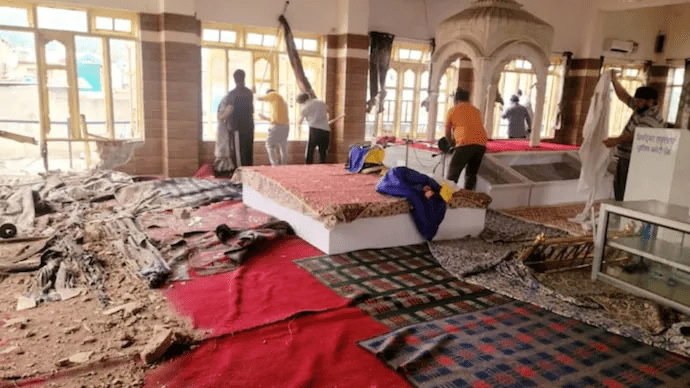
Reports from the ground painted a grim picture. In Poonch district, Pakistani shelling struck the Central Gurdwara Sri Guru Singh Sabha Sahib, killing three innocent Sikhs. Additional Sikh devotees lost their lives in related firing. Pakistani forces also targeted the Aap Shambhu Temple in Jammu, damaging a Hindu religious site. On the Christian front, a shell landed near Christ School in Poonch—run by the Carmelites of Mary Immaculate—killing two students from Christian families and injuring their parents. Another shell damaged a Christian convent belonging to the congregation of the Mother of Carmel, destroying water tanks and solar infrastructure.
Officials from India and all over condemned these actions as “a new low even for Pakistan,” pointing to a deliberate design to sow communal discord by attacking gurdwaras, convents, and temples. This highlighted Pakistan’s rattled response, which included attempts to strike deeper into Indian territory, such as near the holy city of Amritsar—home to the Golden Temple—though Indian air defences thwarted those efforts. Pakistan even tried to flip the narrative, falsely accusing India of targeting Sikh sites like Nankana Sahib, a claim dismissed as a “deranged fantasy”.
A Pattern
This was no aberration. Pakistan has a long, documented history of systemic discrimination and violence against religious minorities, both within its borders and when it projects power outward. Christians, Hindus, Sikhs, and Ahmadis face blasphemy laws weaponized by mobs, forced conversions, church burnings, and targeted killings. During the 2025 conflict, Pakistan’s military seemed to revive old Partition-era tactics—echoing the violence against Sikhs and Hindus in 1947—by zeroing in on non-Muslim sites in border areas to terrorize communities and fracture India’s social fabric.
Why target Sikhs and Christians specifically? Sikhs, though a small minority in Jammu and Kashmir, represent a proud, martial community deeply integrated into India’s defence and national life. Attacking their gurdwaras sends a message of communal intimidation. Christians, often associated with educational and charitable institutions, become soft targets symbolizing “Western” or “infidel” influence in the twisted worldview of extremists who dominate Pakistan’s strategic thinking. By hitting schools and convents, Pakistan aimed not just at physical destruction but at psychological warfare—instilling fear in India’s diverse border populations.
Contrast this with India’s approach in Operation Sindoor. Indian strikes focused on terror infrastructure. There were no reports of deliberate targeting of mosques or Muslim civilian sites in Pakistan. India has consistently maintained that its fight is against terrorism, not against any religion or the Pakistani people. Pakistani civilians suffered in the exchanges, but that stemmed from Pakistan’s decision to escalate rather than from any Indian policy of religious vendetta.
Broader Implications
The world should take note. Pakistan’s actions during the brief 2025 conflict fit a pattern where its military-intelligence complex—often intertwined with jihadist elements—uses religion as both shield and sword. Domestically, minorities in Pakistan continue to endure mob violence, desecration of graves, and blasphemy accusations that lead to lynching. Externally, cross-border aggression takes on a communal colour when convenient.
This indiscriminate targeting undermines any claim Pakistan might make to victimhood. It also exposes the hollowness of its repeated assertions that it is a responsible nuclear state. A military that shells gurdwaras and Christian schools in response to strikes on terror camps is one that prioritizes ideology over restraint and humanity.
India demonstrated resolve and precision in Operation Sindoor, while absorbing Pakistan’s provocative retaliation with composure. The ceasefire that followed, reportedly facilitated by external diplomacy, brought an end to the immediate fighting—but it did not erase the memory of those targeted attacks on innocent Sikhs and Christians.
The international community, particularly those concerned with religious freedom and minority rights, must call out this behaviour clearly. Pakistan’s pattern of religious targeting is not just a bilateral issue between India and Pakistan; it is a symptom of a state that has allowed extremism to shape its security doctrine. Until Islamabad reins in its proxies and abandons the tactic of weaponizing faith against civilians, peace in the region will remain fragile, and minorities on both sides of the border will bear the cost.
Operation Sindoor was about countering terrorism. Pakistan turned its response into something uglier: an assault on India’s pluralistic ethos by attacking its Sikh and Christian citizens. That choice reveals more about Pakistan’s internal demons than about any legitimate military objective. The world must not look away.